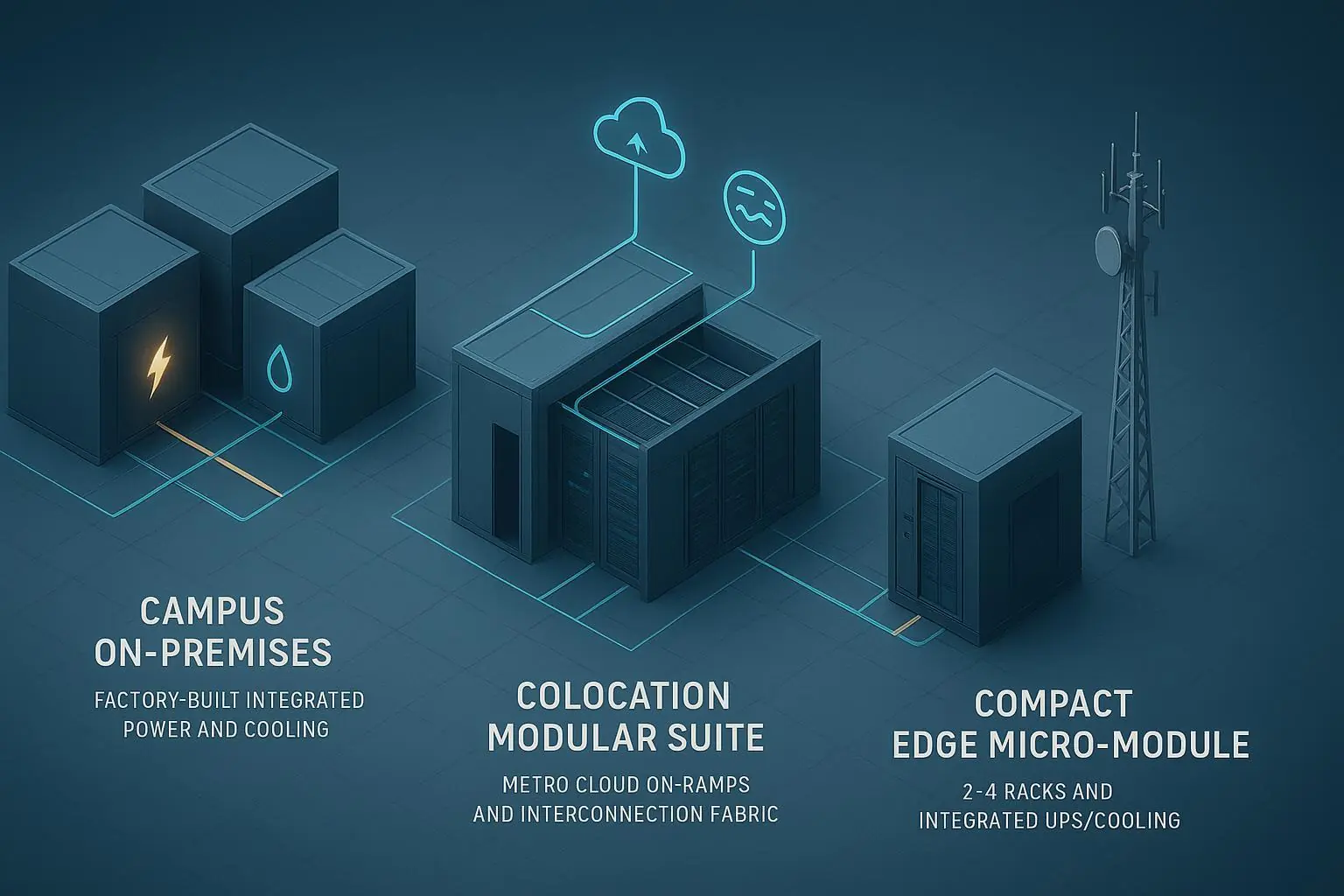
Telecom operators rolling out greenfield micro data centers at edge sites care about two things above all else—how fast a site goes from purchase order to live service, and how reliably the schedule holds. This article defines deployment speed and schedule predictability in modular data center programs, then explains how factory prefabrication and parallel workflows compress timelines for small, sub‑MW edge builds.
Key takeaways
Modular data center deployment speed improves because major subsystems are prefabricated, integrated, and factory‑tested, leaving shorter, repeatable onsite tie‑ins.
Schedule predictability tightens as variability shifts offsite into controlled environments with documented runbooks and Factory Acceptance Testing.
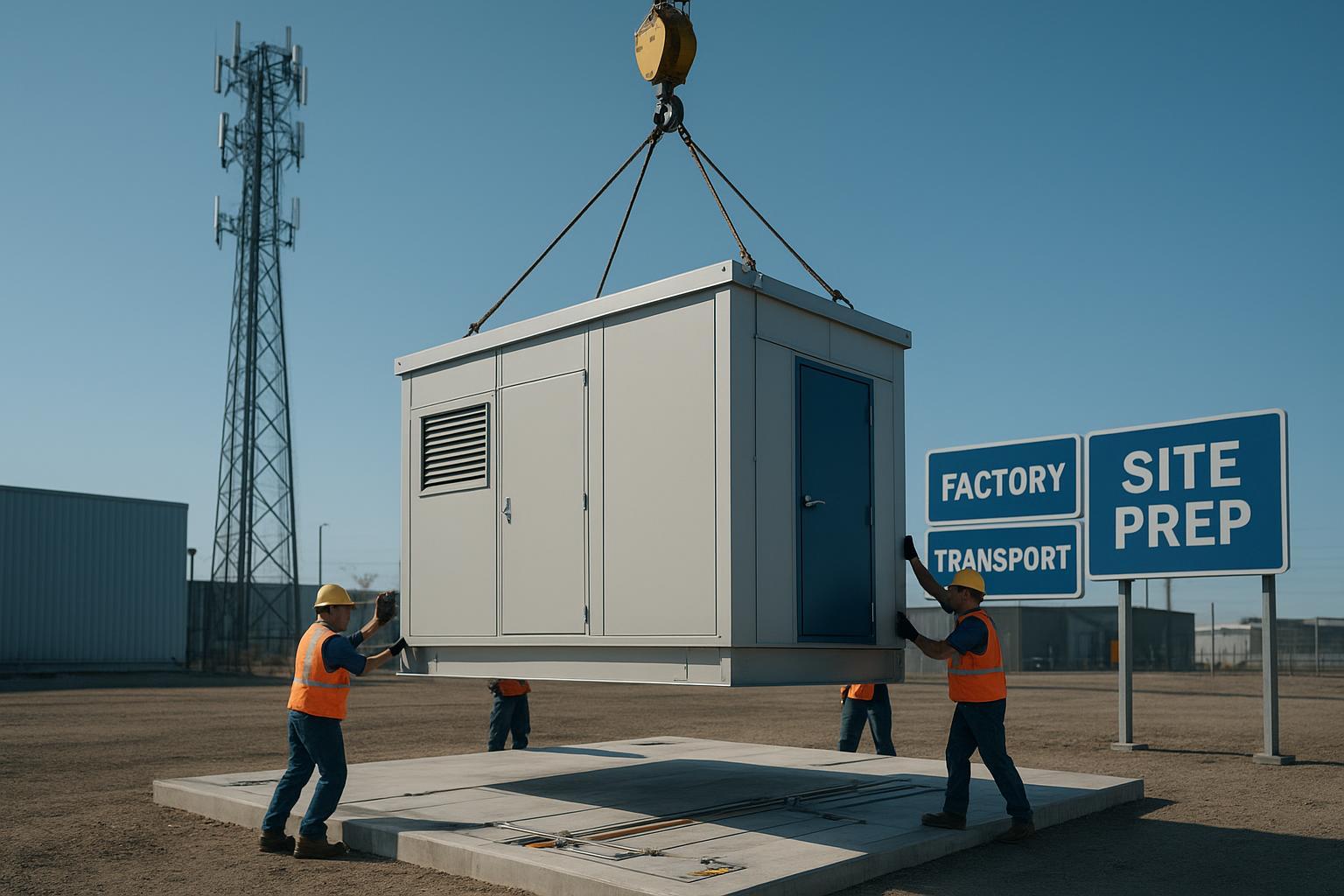
Parallel workflows matter: while the factory builds and tests, the site finishes pad, grounding, power service works, and fiber—shrinking the critical path to transport, lift, tie‑in, and Site Acceptance Testing.
For micro modular units, credible public sources indicate factory work spans several weeks to a few months, with onsite set and commissioning measured in weeks when utilities are ready; a trade‑press example cites ~25 weeks for a ~100 kW unit from design to delivery.
Utility interconnection, permits, and backhaul are external gates that modularization cannot remove; plan for them explicitly.
Use P50/P90 schedule confidence metrics to measure predictability and manage contingency.
What “deployment speed” and “predictability” mean for modular
In this context, deployment speed is the calendar time from purchase order (PO) to operational commissioning. Predictability is how closely the actual delivery date matches the baseline plan, often expressed using confidence levels such as P50 and P90 and tracked as variance to plan.
In project risk practice, a P50 date has a 50% chance of being met (the median outcome), while a P90 date has a 90% chance of being met. The spread between these percentiles is a practical signal of schedule uncertainty and informs contingency and governance. See the guidance on confidence levels in AACE International’s 119R‑21 recommended practice.
Parallel workflows that improve modular data center deployment speed
Think of a modular program as two trains running side by side.
Offsite at the factory: modules are fabricated, integrated, wired, and passed through mechanical checkout and FAT with documentation packaged for handover.
Onsite in parallel: the civil team pours and cures the pad, installs grounding and protective conduit, prepares MV/LV service works, trenches for fiber, and completes interim inspections. Rigging plans and access logistics are finalized.
When these parallel streams converge, the remaining critical path is short: transport, lift and land, final tie‑ins, Site Acceptance Testing (SAT), and go‑live. Industry guidance highlights this parallelization as a key advantage because it removes sequential dependencies that elongate stick‑built schedules; see Uptime Institute’s “Best-in-class data center provisioning” report for context on prefabrication and provisioning discipline.
Why modular builds move faster and more predictably
Factory prefabrication and integration
Modular programs assemble core subsystems—power skids with UPS and switchgear, thermal modules, IT whitespace with racks and structured cabling, and controls—inside controlled factory environments. This reduces weather exposure, multi‑trade clashes, and rework while accelerating integration. Industry research emphasizes that higher standardization and prefabricated subsystems can shorten lead time and improve predictability because more integration work is completed before anything reaches the site; see Uptime Institute’s “Best-in-class data center provisioning” report for a third‑party view of prefabrication and provisioning practices.
Factory Acceptance Testing and documented runbooks
Here’s the deal: when modules are fully integrated and commissioned in the factory, defects and configuration gaps are discovered before shipment, not on a windy pad in week 14. This is the role of Factory Acceptance Testing (FAT) with witness protocols and standardized test scripts. Confidence-based planning practices (P50/P90) and disciplined testing gates are widely used to reduce onsite uncertainty and improve schedule outcomes; see AACE International’s 119R‑21 recommended practice for how organizations use confidence levels and contingency in project governance.
Standardization and repeatable tie‑ins
Standard module designs constrain variability and keep interfaces consistent—power, fiber, monitoring, and safety systems terminate at known points. That means the field scope becomes repeatable work: transport, craning, bolt‑down, connect, test. Less variability equals tighter P50–P90 spreads and fewer late surprises.
Indicative timeline for a telecom greenfield micro site
The ranges below are conservative and illustrative, assuming a standard, pre‑engineered module; timely submittal approvals; and a site where permits, pad, power service works, and fiber are planned early. They synthesize trade‑press and OEM literature that place micro‑unit factory integration in “weeks to a few months” and onsite set and commissioning in “weeks” when utilities are ready; a specific trade‑press example cites roughly 25 weeks from design to delivery for a ~100 kW unit (DataCenterKnowledge, 2024).
Weeks 0–2    PO, design confirmation against a standard module, submittals
Weeks 3–10   Factory fabrication/integration (power skid, thermal module, racks, controls); internal checkout
Weeks 8–11   Factory Acceptance Testing (FAT), documentation, transport prep (overlaps factory work)
Weeks 3–12   Onsite in parallel: pad/foundation, grounding, MV/LV service works, fiber trenching, inspections
Weeks 12–14  Transport, craning/placement, final electrical/fiber tie‑ins, Site Acceptance Testing (SAT), go‑live
Important caveat: the transport and set window must align with site access and craning plans, and any bespoke deviation from the standard module can extend SAT.
What still gates delivery
Some constraints cannot be “modularized away,” and they often dominate schedules if not addressed up front.
Power interconnection and grid capacity allocation: In many markets, interconnection queues and physical delivery constraints have lengthened significantly in recent years. Analyses describe lead times stretching from a year or two toward multi‑year windows in constrained regions; see 2025 commentary on bottlenecks and collaboration needs in EY’s report on utilities–developer coordination and structural process delays discussed by BCG’s 2025 perspective on breaking barriers to data center growth.
Permitting, zoning, and inspections: Local authority timelines vary; pre‑application meetings and standardized submittals reduce rework but do not remove approval gates.
Fiber/backhaul activation: Trenching, cross‑connects, and service activation windows can rival electrical works at remote edge locations.
Site logistics and craning: Access roads, lift plans, weather windows, and safety constraints may fix the exact set date independently of module readiness.
What risks shift offsite—and what remains onsite
Shifted offsite in modular programs:
Multi‑trade clashes and workmanship variability migrate to controlled assembly lines.
A portion of integration and commissioning defects is caught during FAT under stable power and environmental conditions.
Weather exposure during assembly is largely eliminated.
Remaining onsite and still material to predictability:
Utility readiness and authority inspections.
Craning and access logistics on the exact lift day.
Final tie‑ins and any bespoke or non‑standard integrations introduced late in the process.
Operator checklist
Use this quick screen to judge whether modular is a good fit for a greenfield micro site and to protect both modular data center deployment speed and schedule predictability:
Utilities aligned early: Is there a realistic path and date for power interconnect and fiber activation? Are hold points in the plan?
Standardization commitment: Can you stick to a standard module with minimal bespoke changes after PO?
Parallelization discipline: Are civil works, grounding, and service ducts scheduled to start while the factory is integrating the module?
Acceptance planning: Are FAT witness protocols defined, and is SAT scoped with clearly owned test scripts and success criteria?
Logistics readiness: Are craning, access roads, permits, and safety plans booked to a calendar week, with weather contingencies?
FAQ
Q: What percentage of the build is actually prefabricated? A: It varies by product form factor and scope. For micro and containerized modules, a substantial portion of power, cooling, and IT integration is completed offsite, with onsite work focused on placement and tie‑ins. Because audited, cross‑vendor averages are scarce in public sources, treat any percentage as design‑specific rather than universal.
Q: Will modular lock us into vendor‑specific racks and formats? A: Telecom micro sites can be designed around common rack formats and clearances. For mechanical aspects, see the European Telecommunications Standards Institute series on cabinets and racks; for example, ETSI EN 300 119‑2 outlines engineering requirements for fully equipped racks and cabinets. Validate mechanical and service envelope compatibility during submittals.
Q: How should we quantify predictability improvements? A: Track the spread between your P50 and P90 dates, and monitor variance‑to‑plan at each milestone (FAT complete, shipped, set, SAT complete). Standardization and factory QA typically reduce that spread compared with stick‑built baselines, but always measure on your own program.
Q: Are “weeks‑to‑months” claims realistic for every site? A: Only when external dependencies are resolved early. For micro units, trade‑press examples show rapid design‑to‑delivery cycles, but power interconnect, permits, and fiber can extend total schedules if they trail the factory’s pace.
Closing next steps
If you are planning a greenfield telecom edge site, start by defining a standard module, mapping FAT and SAT gates, and scheduling site civil and utility works to run in parallel with factory integration. Quantify predictability with P50/P90 baselines and treat interconnection and backhaul as first‑order risks—not afterthoughts. Done well, these practices can materially improve modular data center deployment speed and deliver schedules that hold when it counts.