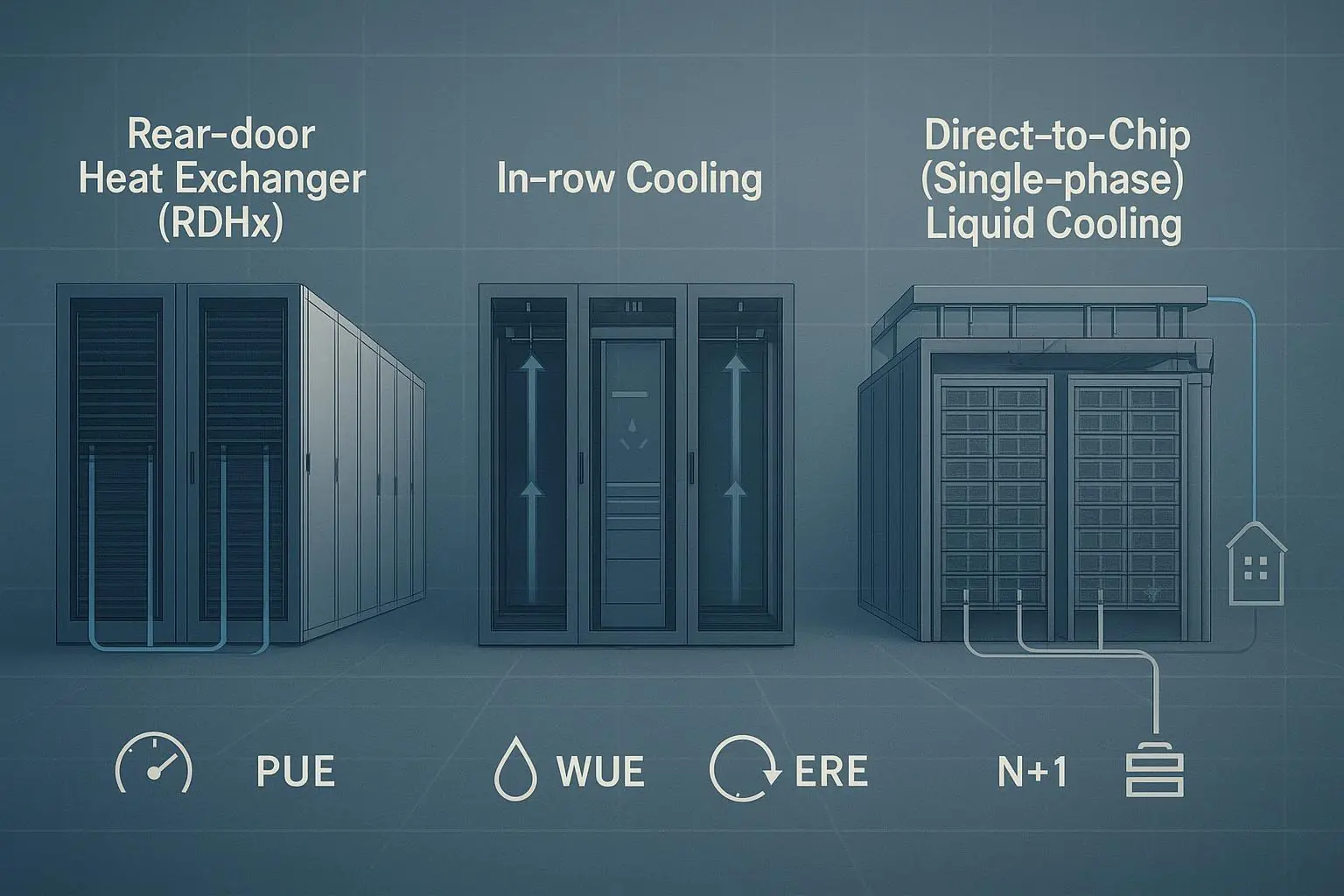
Brownfield retrofit, minimal downtime, limited power headroom—that’s the playing field. If your current room has legacy CRAH/CRAC, hot/cold aisles, and you need to push past 40 kW per rack without tearing the place apart, three approaches rise to the top: rear‑door heat exchangers (RDHx), in‑row air units, and single‑phase direct‑to‑chip (DtC/DLC). This comparison keeps the analysis neutral and evidence‑anchored so you can choose a path that scales beyond 40 kW/rack while meeting Tier III/IV and EN 50600 expectations.
Key takeaways
Primary objective: reliable scalability beyond 40 kW/rack. Secondary: PUE/ERE, WUE, downtime risk, redundancy, maintainability.
Fastest brownfield uplift with near‑zero disruption: RDHx, especially at 40–80 kW/rack with proper containment and inlet water temps.
Sustained 100–200 kW/rack AI racks: single‑phase DtC liquid cooling, with CDU N+1 and dual‑header manifolds.
Moderate, pod‑level density (20–45 kW/rack) and tight space: in‑row with full HAC/CAC and N+1 teamwork modes.
Water risk can be near‑zero for all three with dry coolers; evaporative rejection increases WUE—model it explicitly per EN 50600‑4‑9.
Use a weighted scorecard and staged migration plan; there’s no single overall winner across brownfield constraints.
Side‑by‑side comparison: rear‑door vs in‑row vs direct‑to‑chip liquid cooling
Below ranges are directional and condition‑dependent. Capacity bands reference vendor sources and standards noted in the Evidence column.
Cooling method | Typical max kW/rack | Expected PUE impact | Expected WUE impact | ERE / heat reuse | Retrofit downtime (typical) | Redundancy options | Maintainability | Integration complexity | Space/structural impact | 5‑year TCO (range, as‑of 2024–2026) | Best use cases | Evidence & sources |
|---|---|---|---|---|---|---|---|---|---|---|---|---|
RDHx (rear‑door) | ~40–55 (up to ~68 at ~14°C inlet) | Modest improvement vs legacy air (reduced CRAH load, fan power) | Near‑zero with dry coolers; >0 with evaporative towers | Limited heat‑reuse vs warm‑water DLC; ERE improves if loop runs warm | Rack‑by‑rack swaps in maintenance windows; minimal room‑wide impact | System N+1/2N via secondary loop/CDU; active doors add fan redundancy | Door fans hot‑serviceable; dripless QDs and isolation valves recommended | Low–medium: piping runs, CDU or tie‑in to CW, BMS alarms | Door weight/hinge clearance; check seismic and floor loads | Scenario‑dependent; per‑door CapEx + modest Opex savings | Quick brownfield uplift to 40–80 kW/rack without major rebuild | nVent RDHX Pro performance at 14–24°C; Vertiv RDHx brochures; DOE/Green Grid metrics [nVent overview] [Vertiv DCD brochure] [DOE metrics guide, 2024] |
In‑row (air, DX/CW) | Unit sensible 10–46; per‑rack density depends on containment/diversity | Modest vs legacy air; best with full HAC/CAC and variable‑speed controls | Near‑zero (DX or dry coolers); CW with evaporative plant increases WUE | Limited heat‑reuse potential | Pod‑by‑pod installs; aisle work, electrical and condensate/CW tie‑ins | N+1 per pod with teamwork controls common | Field‑serviceable fans/filters; service while neighbors carry load | Medium: unit placement, power, condensate/CW, controls | Consumes rack positions/aisle; footprint trade‑off | Per‑unit CapEx; Opex varies with fan/compressor hours | Mixed rows at 20–45 kW/rack where space allows units | Vertiv CRV sensible capacity docs; DOE metrics guide [Vertiv CRV data] [DOE metrics guide, 2024] |
Direct‑to‑chip (single‑phase) | ~80–200+ (AI racks) | Can reach ~1.02–1.15 facility PUE with efficient rejection/warm water | Near‑zero with dry coolers; >0 with evaporative towers per EN 50600‑4‑9 | Strong heat‑reuse potential; warm return water improves ERE | Highest initial integration; phased pods minimize risk | N+1 pumps at CDU, dual‑header manifolds; 2N loops feasible | Manifold isolation, dripless QDs; CDU hot‑swap pumps/sensors | Medium–high: CDUs, manifolds, cold plates, training, monitoring | CDU/manifold footprint; highest rack density mitigates floor impact | Higher initial CapEx; Opex benefits at high density; model energy savings | Sustained >100 kW/rack AI/GPU; future‑proof scaling | Vertiv XDU manual (N+1); Introl 2026 PUE case; EN 50600‑4‑9 WUE framing [Vertiv XDU guide] [Introl PUE narrative, 2026] [EN 50600‑4‑9 overview] |
Notes and assumptions (abridged):
Capacity ranges are not guarantees; they depend on inlet water temperatures, containment quality, flow rates, and control strategies. For example, nVent cites RDHX Pro performance of 44 kW at ~24°C and 68 kW at ~14°C inlet water; Vertiv RDHx brochures list nominal 35–50 kW per door under typical conditions.
WUE depends primarily on heat‑rejection method; dry coolers → near‑zero, evaporative towers → >0 L/kWh per EN 50600‑4‑9 framing.
PUE/ERE improvements hinge on overall plant design, economizer hours, and heat‑reuse feasibility.
How each option fits brownfield retrofits
RDHx (rear‑door). Minimal intrusion at the rack level makes RDHx the go‑to for fast, low‑risk uplift. You’ll pre‑install a secondary loop and quick‑disconnects, schedule rack‑by‑rack swaps, and tie alarms into BMS. Redundancy comes from the water loop/CDU (N+1) and, for active doors, fan redundancy. Watch door weight and hinge clearance; confirm seismic requirements.
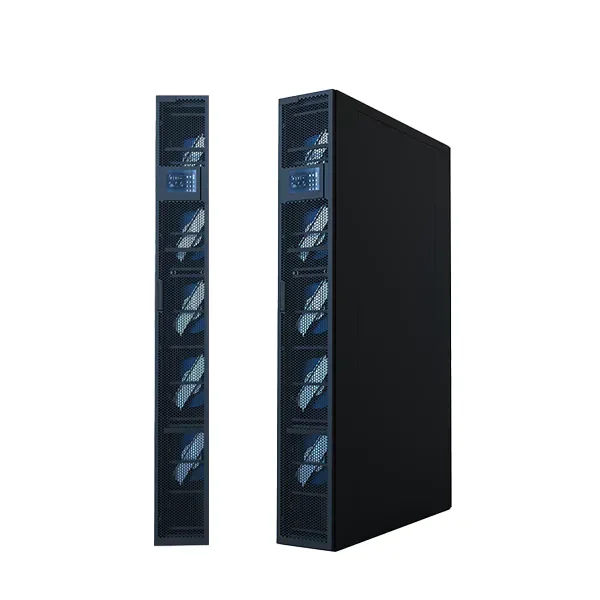
In‑row (air). Best when you can give up a rack position or two per pod and want modular N+1 with teamwork controls. The path is straightforward: unit placement, power and condensate/CW tie‑ins, and strong containment. Expect medium integration work and pod‑level change windows. This favors mixed‑density rows where a few hot racks sit alongside moderate ones.
Direct‑to‑chip (single‑phase). Highest initial complexity but the cleanest runway to 100–200 kW/rack and beyond. Plan CDUs with N+1 pumps, dual‑header manifolds with isolation valves, dripless QDs, and leak detection. Train staff on liquid handling and define rollback plans. Keep a small air assist for residual heat from NICs/PSUs and peripherals.
Scaling beyond 40 kW/rack (primary objective)
RDHx: With disciplined hot/cold aisle containment and reasonable coolant temperatures, RDHx commonly sustains ~40–55 kW/rack, stretching higher at lower inlet water temps. Above ~50 kW/rack sustained, headroom tightens; pairing selective DtC on the hottest trays can extend the ceiling. In practice, the rear‑door vs in‑row vs direct‑to‑chip liquid cooling trade‑off here is speed to deploy (RDHx), modularity (in‑row), and ultimate headroom (DtC).
In‑row: Unit capacities of 10–46 kW sensible are real, but per‑rack translation depends on diversity. In practice, in‑row excels at pods where averages sit 5–15 kW/rack and hot spots touch 20–30 kW/rack under full containment. It’s not the best path to routinely exceed 40 kW/rack across many racks without major row re‑engineering.
Direct‑to‑chip: Industry deployments for AI racks routinely exceed 100 kW/rack on single‑phase cold plates, with CDUs sized 70–1350 kW and N+1 pumps. Warm‑water operation increases heat‑reuse potential and reduces chiller lift, improving PUE and ERE simultaneously. See Vertiv XDU planning guidance for redundancy patterns and pump groups.
For context on efficiency framing and metric definitions, the U.S. Department of Energy’s 2024 Best Practices guide summarizes PUE/ERE/WUE and references The Green Grid definitions, while EN 50600‑4‑9 details WUE reporting bands and calculation methods. Sources: the DOE Best Practices guide (July 2024) and EN 50600‑4‑9 summaries.
Efficiency and water: PUE, WUE, ERE
PUE. Direct‑to‑chip removes most heat at source, allowing higher coolant temperatures, lower compressor work, and more economizer hours. Case narratives in 2026 show facility PUE improving into the ~1.02–1.15 range in favorable climates and designs. Air‑centric methods (RDHx/in‑row) typically improve PUE moderately versus legacy rooms by cutting CRAH work and fan power.
WUE. With dry coolers, WUE approaches zero for all three options. Evaporative towers introduce water consumption that can reach fractional liters per kWh depending on climate and approach; model per EN 50600‑4‑9.
ERE (heat reuse). DtC is particularly strong here because warm‑water return enables practical heat reuse, lowering ERE when heat is delivered to a district loop or building heat sinks.
References: U.S. DOE Best Practices (2024, metrics sections) and EN 50600‑4‑9 summaries (WUE). For a DtC PUE case narrative, see Introl (2026) for warm‑water operations and control strategies.
Brownfield phased migration playbooks (minimal downtime)
RDHx first (40–80 kW/rack). Pre‑install secondary loops and isolation. Execute rack‑by‑rack swaps in short maintenance windows. Validate door clearances and hinge loads. Integrate leak and fan alarms into BMS/DCIM.
Hybrid bridge (RDHx + DtC). Introduce pod‑level manifolds and CDUs where racks exceed ~80–100 kW. Keep RDHx on legacy racks. Plan N+1 at the CDU and dual‑header manifolds to isolate maintenance. Maintain small air assist for peripherals.
Full DtC pod for AI racks (>100 kW/rack). Stage CDUs, commission manifolds, and perform liquid handling training. Define rollback plans and dry‑run MOPs. Map CDU power to dual sources where available. Keep per‑rack downtime minimal by staging hardware before cutover.
Weighted scorecard template (download‑friendly)
Use this scorecard to reflect your priorities. Example weights emphasize our primary objective (scalability) while balancing efficiency and risk. Normalize each criterion to 0–10, multiply by weight, and sum to compare.
Criterion | Weight (example) | RDHx | In‑row | DtC (single‑phase) |
|---|---|---|---|---|
Scalability beyond 40 kW/rack | 0.30 | 6 | 4 | 9 |
PUE/ERE impact | 0.20 | 6 | 5 | 9 |
WUE (lower is better) | 0.10 | 8 | 8 | 9 |
Retrofit downtime risk | 0.15 | 9 | 6 | 5 |
Redundancy flexibility (N+1/2N) | 0.10 | 6 | 7 | 9 |
Maintainability/MTTR | 0.10 | 7 | 7 | 8 |
Integration complexity (lower is better) | 0.05 | 8 | 6 | 4 |
Total | 1.00 | 6.95 | 5.95 | 8.15 |
CSV export (copy/paste):
Criterion,Weight,RDHx,In-row,DtC (single-phase)
Scalability beyond 40 kW/rack,0.30,6,4,9
PUE/ERE impact,0.20,6,5,9
WUE (lower is better),0.10,8,8,9
Retrofit downtime risk,0.15,9,6,5
Redundancy flexibility (N+1/2N),0.10,6,7,9
Maintainability/MTTR,0.10,7,7,8
Integration complexity (lower is better),0.05,8,6,4
Total,1.00,6.95,5.95,8.15
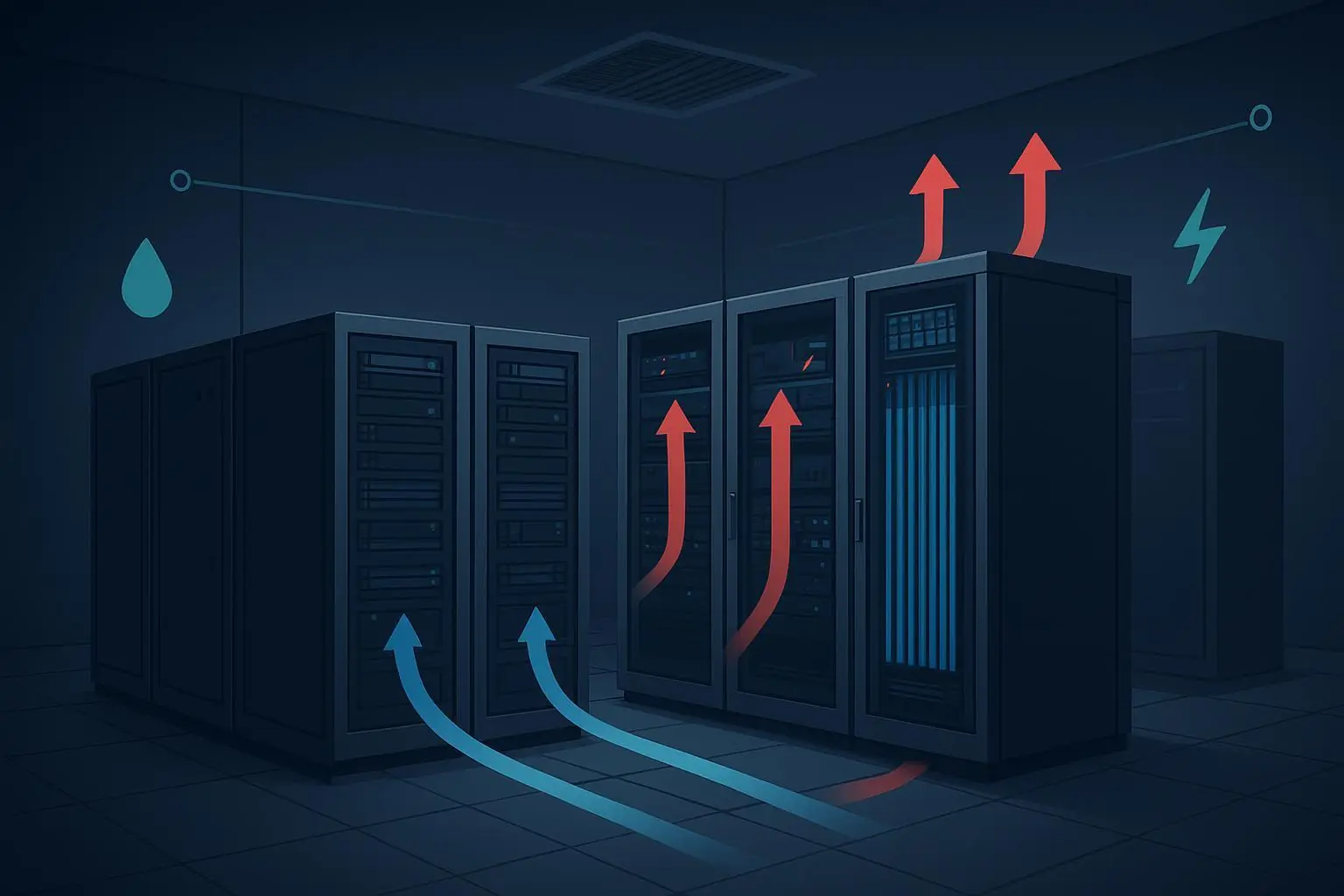
Conceptual CFD snapshots (airflow and thermal plumes)
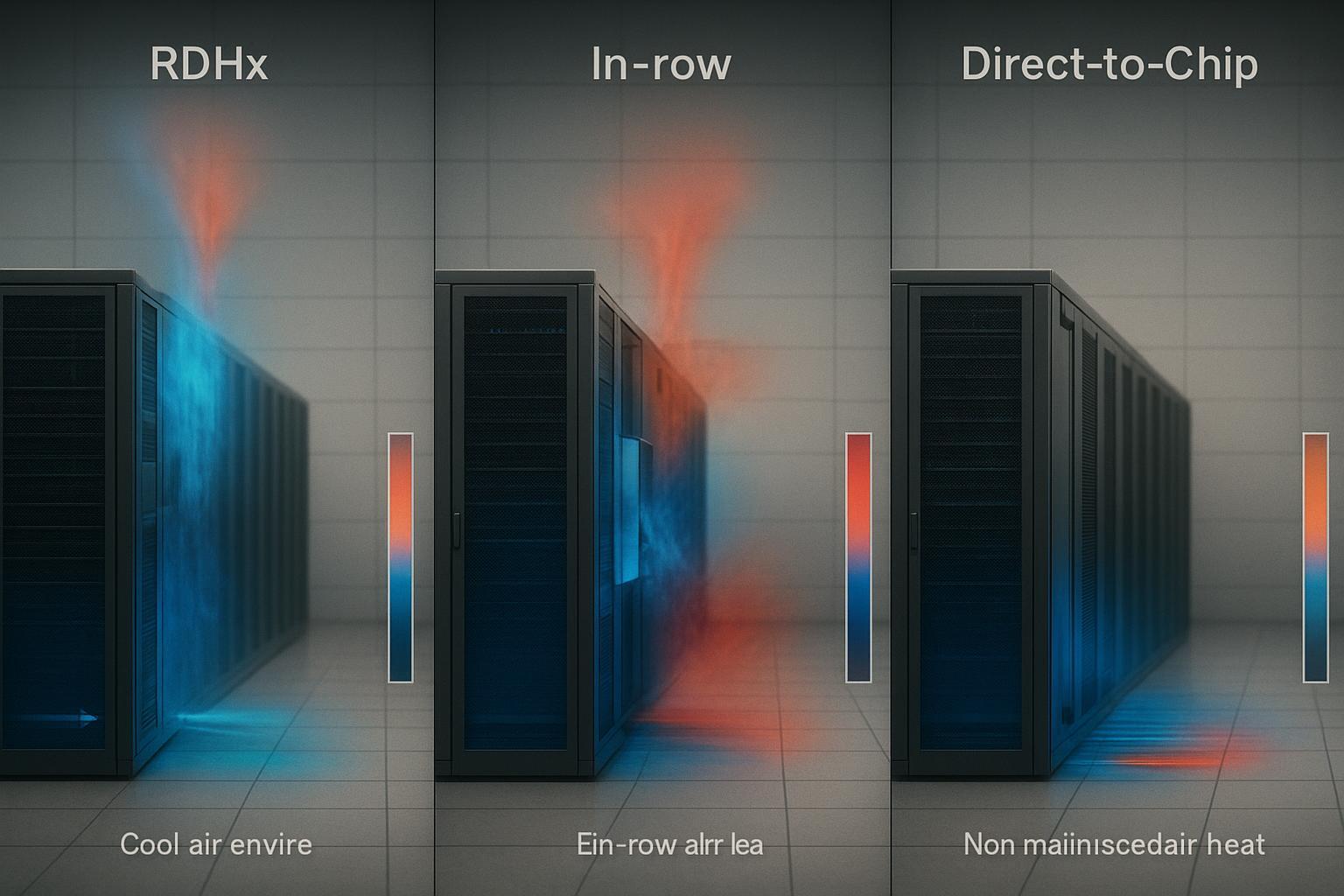
What to look for:
RDHx: hot exhaust is intercepted at the door coil, returning cooler to room; minimal overhead recirculation if containment is strong.
In‑row: short air paths and strong jets between racks; without full containment, expect some hot‑cold mixing and recirculation.
DtC: most heat never reaches room air; small residual plumes remain from NICs/PSUs—air assist handles them.
Decision tree: which path fits your brownfield?
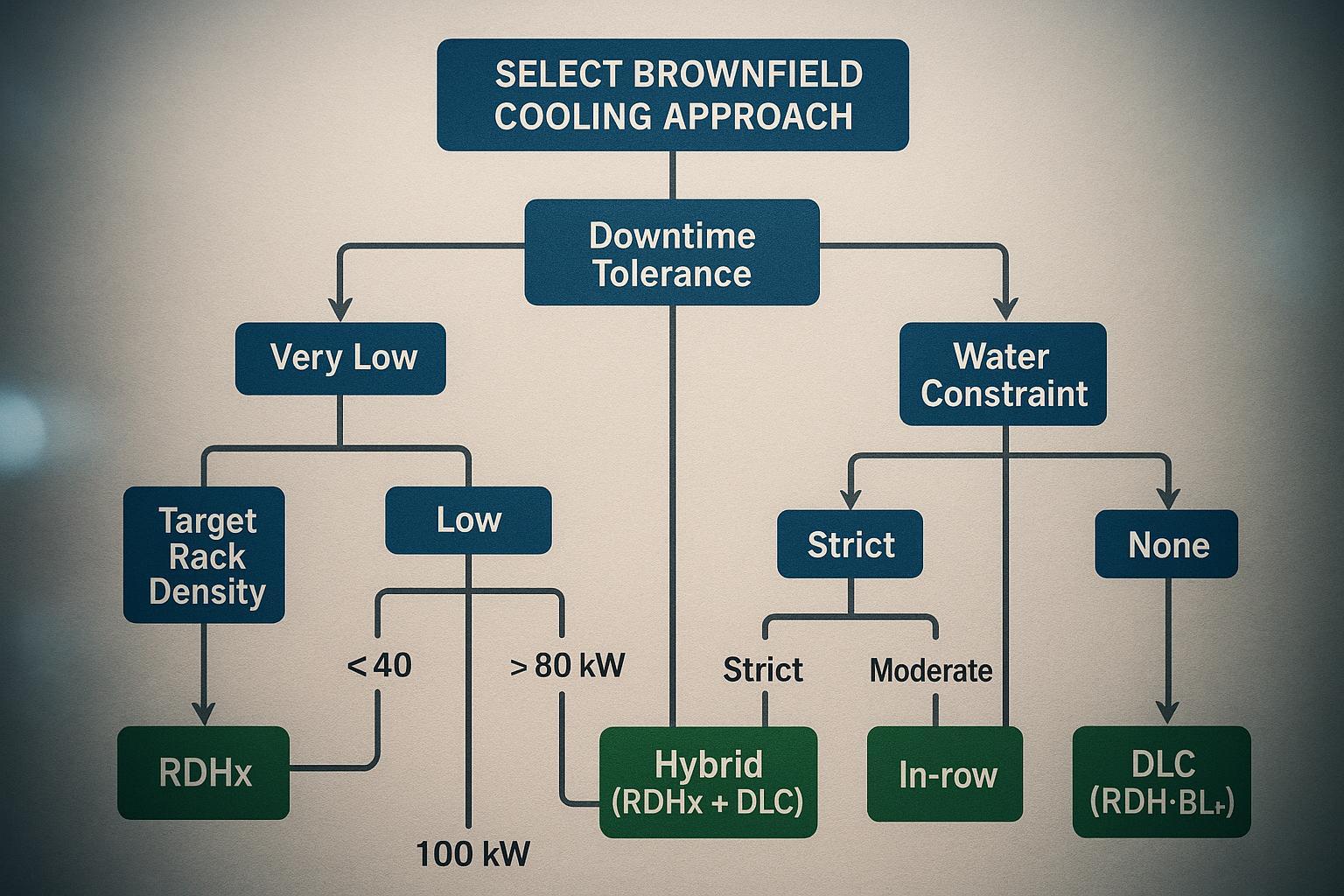
Quick rules of thumb:
Very low downtime and 40–80 kW/rack targets favor RDHx.
Sustained >100 kW/rack density pushes you to DtC with CDU N+1 and dual manifolds.
Pod‑level, moderate density with space to spare leans toward in‑row.
Strict water caps? Favor dry coolers for near‑zero WUE on any path; hybridize RDHx + DtC where densities vary.
FAQs (concise answers for fast lookup)
Q: Which cooling option is best for brownfield data center retrofits with minimal downtime? A: RDHx is typically fastest and least intrusive for 40–80 kW/rack because it mounts at the rack and can be swapped in maintenance windows with pre‑plumbed quick‑disconnects.
Q: Can rear‑door heat exchangers support more than 40 kW per rack? A: Yes. Vendors cite ~40–55 kW/rack at common inlet temperatures, with higher values at lower inlet water (e.g., nVent notes 68 kW at ~14°C). Containment quality and flow control are key.
Q: How does direct‑to‑chip single‑phase cooling affect PUE and water use compared to in‑row units? A: DtC can reduce facility PUE into the ~1.02–1.15 range in favorable designs because it removes heat at source and enables warm‑water operation. With dry coolers, both DtC and in‑row can achieve near‑zero WUE.
Q: How is N+1 redundancy implemented for direct‑to‑chip systems? A: Use CDUs with N+1 pumps, dual supply/return manifolds with isolation valves, and consider 2N facility loops. Vendor manuals (e.g., Vertiv XDU) describe pump group redundancy and controls.
Q: What downtime should I expect when migrating from air to DtC in brownfield sites? A: Initial integration is the most complex. Minimize risk by staging CDUs and manifolds, training staff, and cutting over rack‑by‑rack. Publish a rollback plan; avoid promising fixed hours without site‑specific testing.
Also consider: modular help for phased brownfield pods (neutral reference)
If you’re planning a staged retrofit, a modular integrator can streamline RDHx/in‑row/DtC hybrids under tight change‑control windows. For a practical overview, see Coolnet’s engineering primer on AI cooling and a TCO planning FAQ:
AI Cooling overview: Coolnet — Ultimate Guide: AI Data Center Cooling
5‑year cost planning: Coolnet — Modular Data Center TCO FAQ
Sources and standards (selected)
Metrics and definitions: see the U.S. DOE Best Practices Guide (July 2024) for PUE/ERE/WUE summaries that reference The Green Grid; and EN 50600‑4‑9 framing for WUE categories. [DOE Best Practices, 2024] [EN 50600‑4‑9 overview]
RDHx performance examples: [nVent RDHX overview and performance notes] and [Vertiv DCD brochure].
In‑row capacity references: [Vertiv CRV data sheet].
DtC redundancy and planning: [Vertiv XDU1350 application & planning guide] and a warm‑water PUE narrative [Introl, 2026].
How to choose, in one line: If you need fast, low‑risk uplift to 40–80 kW/rack, start with RDHx; if you’re committing to 100–200 kW/rack AI racks, design single‑phase DtC with N+1 CDUs and dual manifolds; for moderate mixed rows and limited space, consider in‑row with full containment. Then use the scorecard above to fit the choice to your site and constraints.