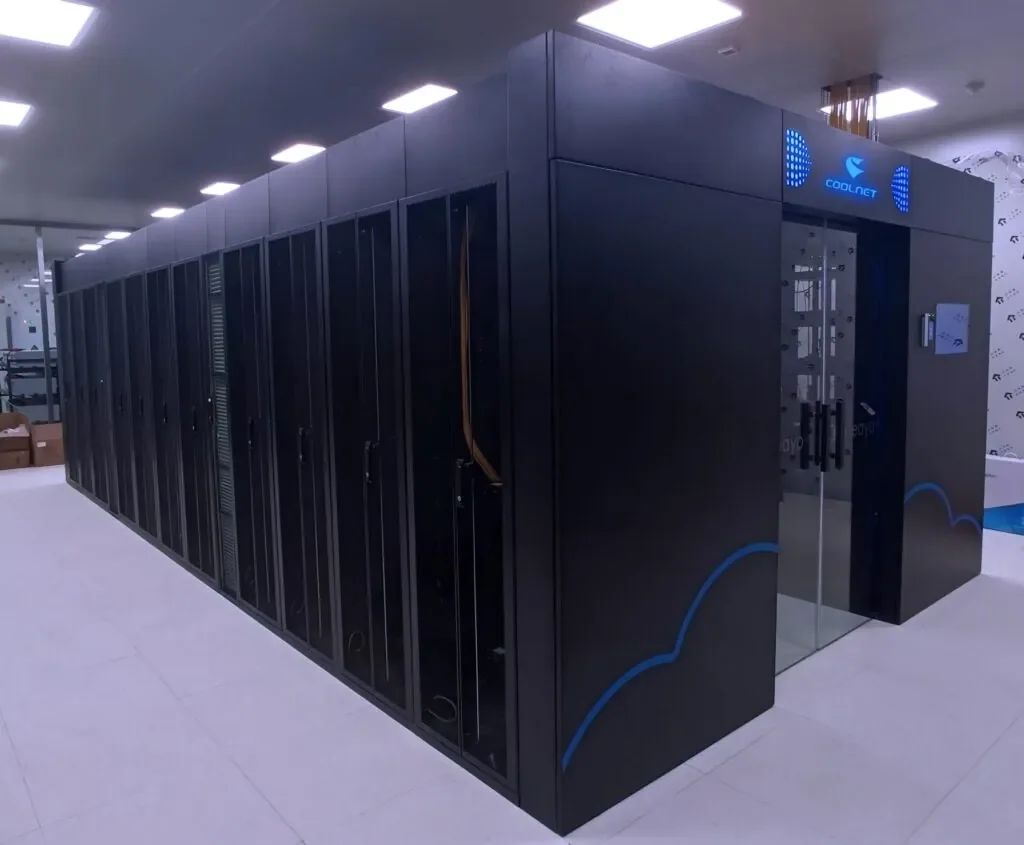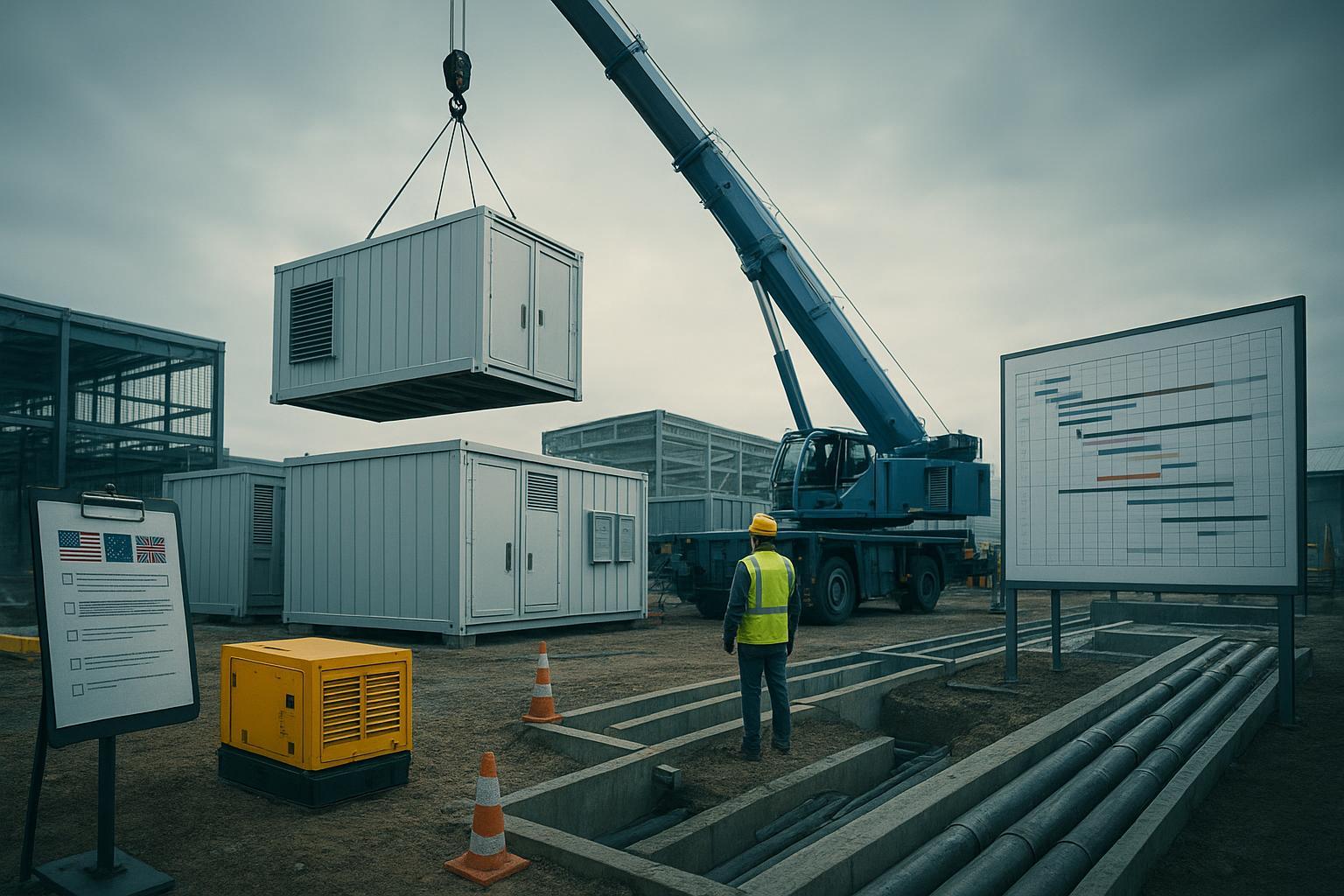
When modular blocks can be factory‑ready in weeks but utility hookups and permits take months, the schedule slips where it’s least visible: off site, inside queues and review desks. This checklist turns those hidden clocks into controllable workstreams.
You’ll find risks, mitigation actions, required coordination artifacts, and what can be safely parallelized—from pre‑application through energization—across the U.S., EU/Western Europe, and the UK. We also include temporary power options and contingencies when grid upgrades lag.
Key takeaways
Most delays stem from off‑site utility reinforcements and environmental/planning reviews; mitigate early with phased load letters, pre‑consultation, and complete artifact packages.
Treat permitting and interconnection as engineering deliverables: one‑lines, protection schemes, grounding and harmonics studies, metering/telemetry plans, and witness‑test method statements.
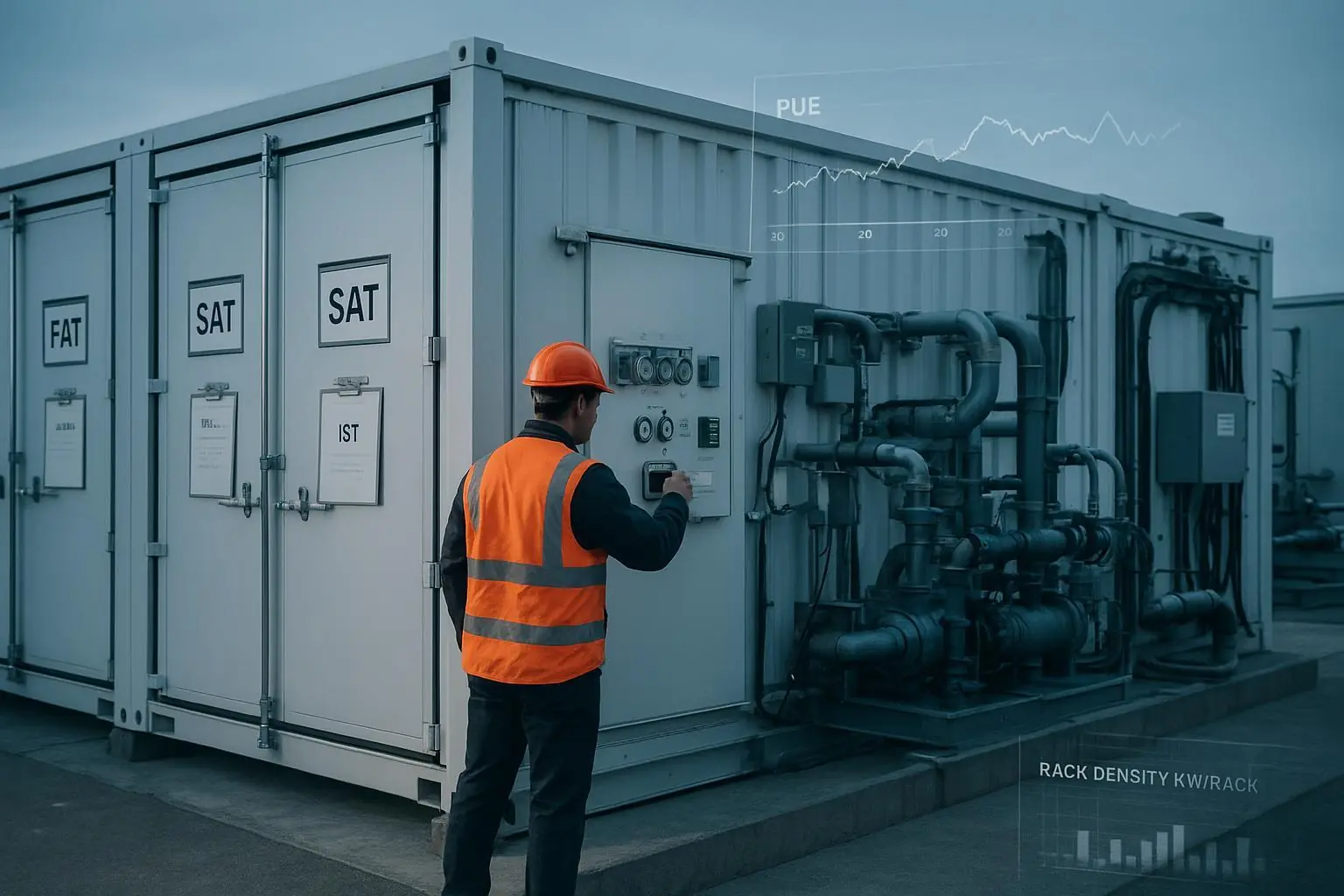
Parallelize aggressively but safely: build duct banks, foundations, and grounding; run factory FATs; install temporary MV skids and non‑export generation while off‑site works proceed.
Temporary/bridging power is a compliance project of its own—air permits, fuel/fire approvals, acoustic controls, and demobilization criteria must be defined up front.
Executive checklist (scan-first view)
Area | Risk (region flags) | Mitigation | Required artifacts | What to parallelize | Owner |
|---|---|---|---|---|---|
Utility interconnection | Off‑site reinforcements add 12–24+ months [US][EU][UK] | Submit phased load letters; align on protection/metering; consider interim limited/flexible capacity | SLDs; protection/relaying; grounding study; short‑circuit/arc‑flash; metering/telemetry; load profiles; energization & witness plans | Duct banks, MV trenches, foundations, grounding grid, FATs, meter cabinet prep | Owner’s engineer + Utility |
Permitting – stormwater (US) | CGP/SWPPP delays ground‑break | Prepare SWPPP early; confirm eligibility; line up inspectors | SWPPP; NOI/authorization; inspection logs; stabilization records | Geotech, potholing; erosion control procurement | Civil GC + Environmental lead |
EIA/planning (EU/UK) | Scoping/consultations extend 6–18+ months | Early screening/scoping; industrial‑zoned sites; lower‑water designs | EIA screen/scope; EIA report; consultation records; water/ discharge permits | Surveys, non‑prejudicial civil works, route/pothole studies | Planning lead + Environmental |
Temporary power | Air/fire approvals slow deployment | Pre‑file permits; non‑export interlocks; double‑wall tanks; acoustic barriers | Air permit/registration; SPCC (US) as needed; fuel storage/fire approvals; temp SLDs; load‑bank plan | Install temp MV skids/gen/BESS; commission subsystems on load banks | MEP + HSE + AHJ liaison |
Commissioning/energization | Returned metering/protection packages | QA/QC against utility standards; hold alignment workshops | Metering diagrams; CT/VT data; relay settings; witness test scripts | Stage energization per available capacity | Owner’s engineer + Commissioning agent |
Phase 1 — Pre‑application alignment for a modular data center permitting and utility interconnection timeline
Risk: Queue uncertainty and unscoped off‑site upgrades extend energization beyond module readiness [US][EU][UK].
Mitigation: Issue a phased load letter with ramp profiles (e.g., 8–10 MW blocks every X months) and minimum power‑quality specs; request pre‑consultation with the utility/DNO/DSO to pre‑align on protection, telemetry, metering class, and site control expectations. In the U.S., understand how generator‑focused reforms like the “first‑ready, first‑served” cluster model under FERC’s Interconnection Final Rule (Order No. 2023) explainer inform study discipline, even though your project is a large load.
Required artifacts: Draft single‑line diagrams; preliminary protection and relaying scheme; grounding approach; short‑circuit assumptions; initial metering and telemetry plan; preliminary harmonics/flicker assessment; route surveys and utility potholing records.
Parallelization tactics: While pre‑consultation proceeds, begin topo/geotech, archaeology where relevant [EU/UK], and utility route surveys; draft stormwater controls and construction sequencing [US]; start module factory design reviews and FAT planning.
Owner: Owner’s engineer; utility/DNO liaison; environmental lead.
Evidence anchors: FERC 2023 explainer on study discipline and readiness (context, generator‑centric) — see link above.
Phase 2 — Applications and studies (utility + permits)
Risk: Incomplete packages trigger rejections and restarts, adding weeks to months [US][EU][UK].
Mitigation: Treat submissions like engineering builds with internal QA/QC checklists mapped to the authority/utility handbooks. For U.S. large‑load interconnection content and expectations (utility‑grade relays, telemetry points, grounding/protection), align with guidance exemplified by the PG&E Distribution Interconnection Handbook and similar utility requirements. For U.S. construction stormwater, confirm coverage under the EPA Construction General Permit and sequence the Notice of Intent properly per EPA CGP FAQs and 2022 CGP text.
Required artifacts: Final SLDs; protection/relaying settings and coordination studies; grounding study and grid layout; short‑circuit/arc‑flash studies; metering diagrams with CT/VT data; telemetry point lists; load profiles and power factor plan; utility standards crosswalk; building/electrical/fire permit sets; SWPPP/NOI [US]; EIA screening/scoping reports [EU/UK].
Parallelization tactics: Submit interconnection and building/electrical/fire/environmental permits within a tight window; in parallel, bid/procure MV gear, transformers, switchgear, and cable; progress civil design, erosion/sediment plans, and traffic/noise assessments.
Owner: Design manager; permitting manager; utility coordinator.
Evidence anchors: EPA CGP materials (timing/eligibility); utility handbooks (protection/metering expectations) — see links above.
Phase 3 — Construction and site preparation
Risk: Off‑site utility reinforcements outlast on‑site works; schedule idles without productive parallel work [US][EU][UK].
Mitigation: Build what you can without energization: duct banks and MV trenches, substation foundations, grounding grid, and module foundations. Prepare meter cabinets and CT/VT wiring; install communications for telemetry. If grid upgrades lag, plan a compliant temporary power bridge.
Required artifacts: Trenching and duct bank profiles; grounding grid test procedure and records; factory test certificates (FATs) for prefabricated modules; temporary plant single‑lines and interlocks; acoustic and traffic mitigation plans.
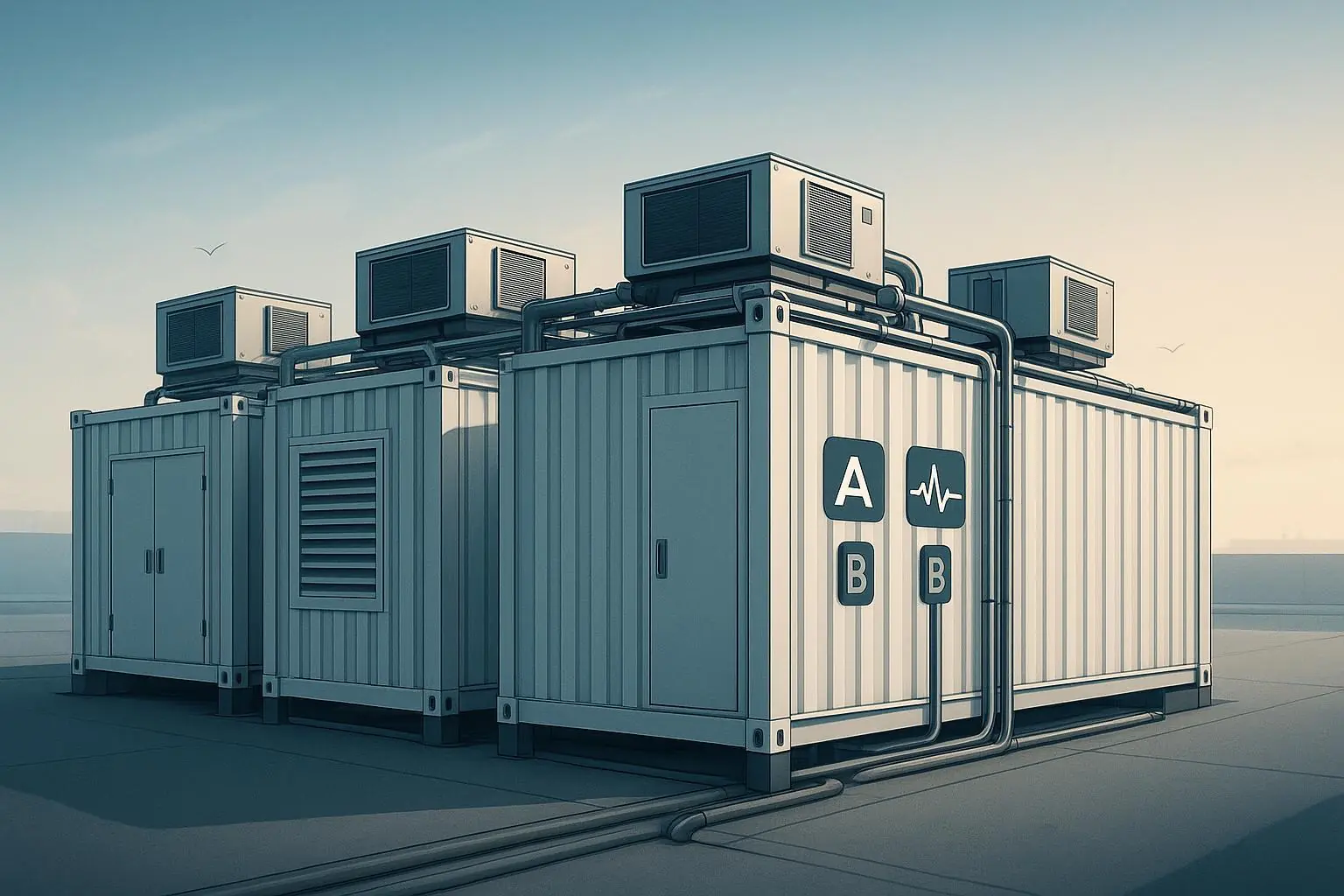
Parallelization tactics: Install temporary MV skids, generators and/or BESS; commission mechanical loops and controls with load banks; run integrated systems tests that don’t require grid backfeed; keep off‑site reinforcement tracking on a formal interface schedule with the utility/DNO.
Owner: Civil GC; MEP contractor; commissioning agent.
Evidence anchors: For temporary generation compliance pathways, see the EPA’s guidance on temporary use of electric generators (US context). For EU/UK, confirm national MCPD‑derived hour limits and permitting triggers via the European Commission’s MCPD overview.
Phase 4 — Commissioning and energization
Risk: Returned metering/protection packages or failed witness tests postpone energization [US][EU][UK].
Mitigation: Hold alignment workshops with the utility/DNO on witness scope; verify relay settings coordination; complete as‑built metering diagrams with CT/VT ratios and polarity checks; validate telemetry points and naming. Stage energization by module if only partial capacity is available (e.g., flexible/limited connections in the UK) under G100 governance—see ENA’s G99/G100 documentation for the framework.
Required artifacts: Witness‑test scripts; energization method statements; as‑built protection settings; metering/telemetry checkout sheets; lock‑out/tag‑out procedures; energized equipment commissioning records.
Parallelization tactics: While awaiting witness dates, complete non‑energized commissioning, update O&M documentation, and train operations staff; if temporary power is in place, finalize demobilization criteria and transition plan.
Owner: Commissioning agent; owner’s engineer; utility/DNO.
Temporary power and contingencies when grid upgrades lag
Are you bridging weeks for commissioning, or months for phased production? That single choice shapes generator sizing, the role of BESS, and which permit path applies. In the United States, temporary diesel/HVO generation may require preconstruction air permits depending on capacity and hours, plus SPCC planning when above‑ground diesel storage meets federal thresholds; align electrical and emergency power practice with NFPA 70/110/37 and fuel handling with NFPA 30. Across the EU/Western Europe, the Medium Combustion Plant Directive covers 1–50 MWth units; some Member States allow limited‑hours backup with simplified obligations—check national transposition for hour caps and local air quality constraints. In the UK, environmental permitting mirrors MCPD, and DNOs can enable interim non‑export or flexible/curtailable connections to accelerate first modules pending reinforcements. Evidence anchors: EPA temporary generator guidance, European Commission MCPD overview, and Planning Inspectorate NSIP/DCO clocks for planning timelines context.
Plan demobilization from day one: define the transition trigger (e.g., ≥X MVA firm capacity), SAT re‑tests on permanent gear, removal of non‑export interlocks, fuel system drain/clean, fire approvals close‑out, and updated as‑builts.
Regional quick benchmarks and caveats
United States: Utility service lead times of about 12–24+ months are common in congested regions when off‑site upgrades are required. Construction stormwater permitting can be obtained in days if the SWPPP is complete and eligibility is clear, but inspector availability and endangered species checks can add time. Evidence: EPA CGP FAQs/2022 CGP text and discipline context from FERC’s Interconnection Final Rule explainer.
EU/Western Europe: EIA processes—screening, scoping, full EIA with consultations—typically span 6–24+ months depending on national law and public engagement. Grid feasibility/impact studies can take 3–12 months, with reinforcements frequently adding 12–24+ months in saturated hubs. Commission guidance describes stages and indicative clocks, but binding timelines depend on Member State transposition; consult national TSO/DSO procedures.
United Kingdom: NSIP/DCO statutory clocks total 12 months from acceptance to decision (6‑month examination + 3‑month recommendation + 3‑month decision), with pre‑application often taking a year or more. DNOs may offer flexible/curtailable connections to enable earlier partial energization pending reinforcements; governance sits under ENA G99/G100.
Next steps you can run this week
Hold a joint readiness workshop with the utility/DNO to agree on protection, metering class, telemetry, and witness scope; issue a phased load letter with ramp profiles.
Complete a QA/QC sweep of SLDs, protection settings, grounding, metering diagrams, and telemetry point lists against the target utility handbook.
Lock in your stormwater/EIA path: draft the SWPPP and NOI [US], or initiate EIA screening/scoping [EU/UK], sequencing submissions to minimize idle time.
Decide your temporary power strategy (commissioning‑only vs. bridging months), select air/fire permit paths, and define demobilization criteria now—not later.
Note: This checklist is informational and does not constitute legal advice. Always confirm local code and permitting triggers with the authorities having jurisdiction (AHJs), utilities/DSOs/DNOs, and accredited assessors.