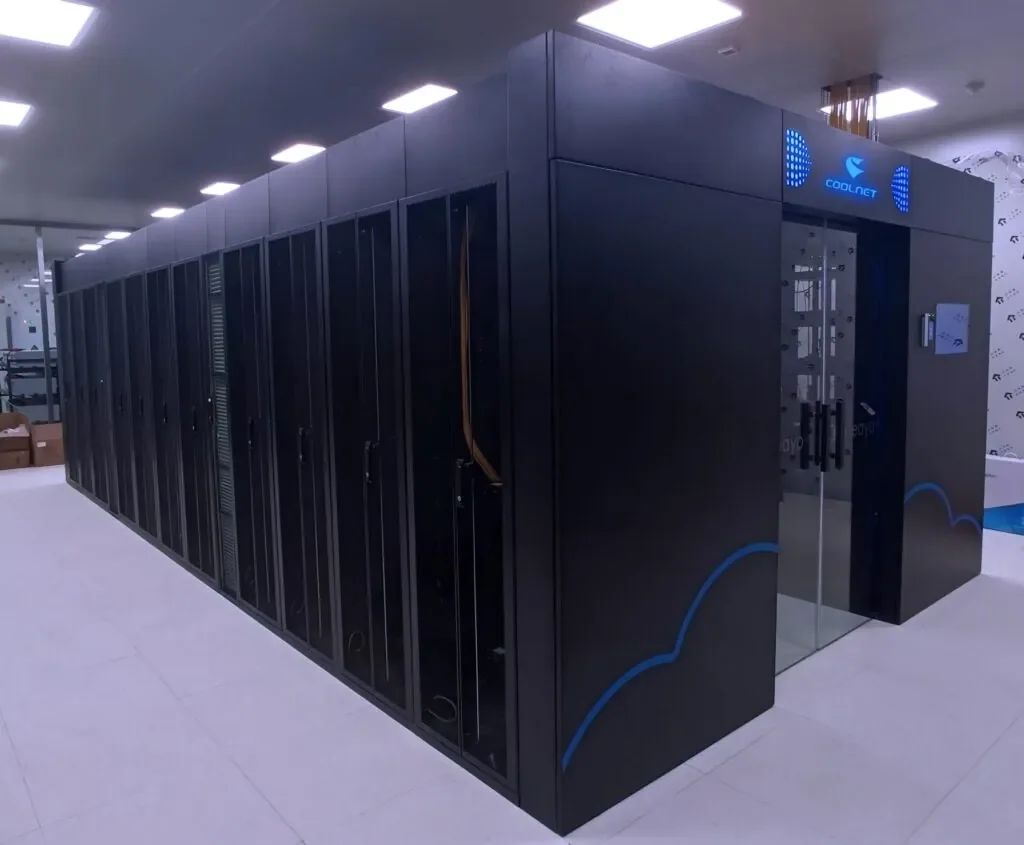
High-density servers in modern data centers produce significant heat, and traditional air cooling methods are often insufficient for maintaining consistent performance. We recognize that managing thermal challenges effectively is critical for protecting hardware and ensuring uninterrupted operation. At Coolnet, we provide a comprehensive data center solution that combines advanced cooling strategies with precision environmental control to support high-density computing environments and reduce the risk of hotspots or thermal bottlenecks.
How Liquid Cooling Works
Liquid cooling operates by circulating a coolant directly to heat-generating components, where it absorbs thermal energy more efficiently than air. Liquids have a higher heat capacity than air, enabling faster and more consistent heat transfer from servers and other high-performance equipment. In our liquid cooling data center designs, this allows more compact rack layouts while maintaining reliable temperature levels. Efficient heat removal not only stabilizes operations under sustained workloads but also helps maintain energy efficiency throughout the facility. By integrating liquid cooling with precision row-based air conditioning systems, our data center solution ensures both local and overall environmental control.
Types of Liquid Cooling Technologies
We apply different liquid cooling methods depending on the specific needs of the data center. Immersion cooling fully submerges components in dielectric fluids, providing uniform heat absorption and allowing high-density configurations. Direct-to-chip cooling delivers coolant through cold plates directly attached to high-heat components, which removes heat at its source. Rack-based cold plate cooling integrates heat exchangers within server racks to efficiently dissipate energy, complementing traditional air circulation. Each of these approaches in our liquid cooling data center projects is chosen to balance operational efficiency, scalability, and integration with broader infrastructure requirements. Our system designs ensure that cooling capacity is available precisely where it is needed.
Advantages of Liquid Cooling
Adopting liquid cooling offers multiple benefits for high-density environments. It improves energy efficiency by reducing reliance on large-scale air circulation and lowering electricity consumption for fans and chillers. It also extends the lifespan of hardware by maintaining stable temperatures, reducing thermal stress on critical components. Additionally, liquid cooling contributes to sustainability goals by reducing the data center’s carbon footprint. At Coolnet, we combine these technologies with precision air conditioning for computer room setups, delivering a comprehensive data center solution that balances component-level cooling with overall environmental stability.
Conclusion: Supporting High-Density Data Center Performance
For high-density data centers, liquid cooling data center solutions are essential for maintaining consistent performance, protecting equipment, and supporting energy-efficient operation. When combined with structured environmental monitoring and precision air management, our systems help maintain stable temperatures even during intensive workloads, including AI and high-performance computing tasks. We believe that the integration of advanced liquid cooling and well-designed infrastructure ensures long-term operational reliability while enabling higher computational density. Our data center solution emphasizes both performance and sustainability, reflecting our commitment to providing practical and efficient thermal management strategies.