If your edge server room runs unattended most of the time, economizers can be reliable—but only when availability leads every decision. With the right topology, filtration, redundancy, and control sequences, both air-side and water-side approaches can meet strict SLAs while reducing compressor run hours. The details depend on climate, outdoor air quality, water availability, and how your BMS arbitrates modes.
Key takeaways
Availability first: design for safe defaults, quick failover, and N+1 or N+N paths before chasing hours of “free cooling.”
Choose topology by risk: air-side excels in clean, mild climates; water-side reduces IAQ risk and often suits unmanned sites.
Filtration matters: target MERV 13+ routinely; escalate to MERV 16 or HEPA or lock out outdoor air during smoke events.
Controls do the heavy lifting: enable by dry-bulb or enthalpy with humidity caps, sensor voting, and smoke/AQI lockouts.
Expect wide regional variation: Seattle often supports many more economizer hours than Phoenix; verify locally with TMY data.
What is an economizer, and which types fit edge rooms?
Short answer: An economizer lets weather do part or all of the cooling. For edge rooms, the fit is mostly about contamination risk, humidity control, water use, and serviceability.
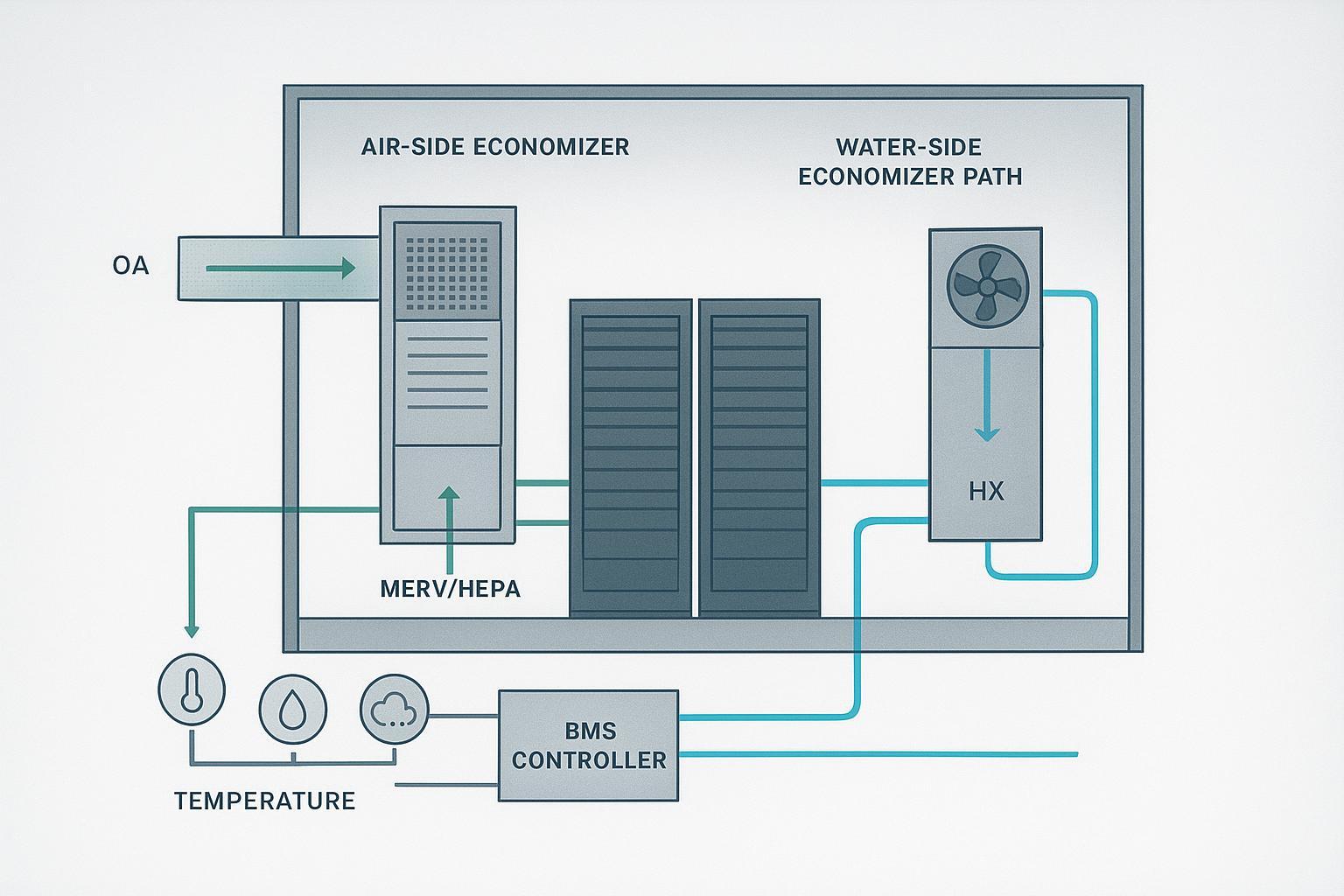
Air-side direct economizer brings filtered outside air into the room through modulating dampers and exhaust/relief. It can deliver excellent energy savings in cool, clean-air regions but exposes the room to outdoor particulates and humidity swings.
Air-side indirect economizer exchanges heat with outdoor air across a heat exchanger, so the server room air never mixes with outdoors. It reduces contamination risk at the cost of approach temperature and added fan or media maintenance; some variants include evaporative stages.
Water-side economizer uses a cooling tower, dry cooler, or pumped refrigerant path to reject heat without bringing in outdoor air. It avoids most IAQ risks but may add water use (for towers) or higher fan power (for dry coolers). Near-optimal staging and setpoint logic are well covered in energy-efficiency guidance from national labs.
Authoritative practice encourages economizers where the climate allows, paired with air management that keeps inlets within the recommended envelope. See the Department of Energy’s Best Practices Guide for Energy‑Efficient Data Center Design (2024) for the big picture on envelopes and economizer options, and how they support higher PUE efficiency gains when used responsibly according to the recommended inlet range from ASHRAE TC 9.9. For details, consult DOE’s Best Practices 2024 and the ASHRAE TC 9.9 reference card.
According to the DOE Best Practices Guide (2024), operators should use economizers where feasible and set inlets near the top of the recommended band to increase economizer windows while maintaining reliability. See the discussion in the DOE Best Practices Guide for Energy‑Efficient Data Center Design (2024): https://www.energy.gov/sites/default/files/2024-07/best-practice-guide-data-center-design_0.pdf
ASHRAE TC 9.9’s freely accessible reference card summarizes recommended and allowable IT inlet ranges that your sequences must respect. See ASHRAE’s TC 9.9 Thermal Guidelines Reference Card: https://www.ashrae.org/file%20library/technical%20resources/bookstore/supplemental%20files/therm-gdlns-5th-r-e-refcard.pdf
Are economizers for edge server rooms reliable enough for stringent SLAs?
Short answer: Yes—conditionally. With >99.99% availability targets, reliability depends on N+1 or N+N architectures, conservative enable logic, and autonomous lockouts.
Design for fail-safe: On any smoke/fire signal, PM2.5 spike, actuator fault, or sensor disagreement, immediately close to minimum outdoor air, open return air, and revert to mechanical cooling. This protects uptime even if it sacrifices economizer hours.
Engineer redundancy: Duplicate critical components like OA/RA damper actuators, outdoor sensors (dry-bulb, RH, PM2.5), and pumps or fans. Use watchdog timers to catch mode-change failures and stuck valves/dampers. Energy standards updates since 2024 acknowledge economizers as a viable path to lower energy, but they rely on controls that hold the ASHRAE envelopes rather than chasing the absolute minimum kWh.
Commission sequences, not just hardware: Functional tests must prove rapid and safe changeover across all expected modes. National lab guidance details enable/disable criteria and staged operation so economizers don’t “hunt” or short cycle.
For standards context, review ASHRAE 90.4‑2022 Addendum g (2024) alongside DOE Best Practices 2024 and NREL’s 2024 guidance on efficient data center operation.
Energy standard context in ASHRAE 90.4‑2022 Addendum g (2024): https://www.ashrae.org/file%20library/technical%20resources/standards%20and%20guidelines/standards%20addenda/90_4_2022_g_20240131.pdf
NREL’s 2024 design and operations guidance for efficient data centers: https://www.nrel.gov/docs/fy24osti/89134.pdf
Air-side vs water-side—how should edge teams choose?
Short answer: Choose by risk and operations. If outdoor air quality is frequently poor or staffing is limited, water-side or indirect paths are usually safer. If air is clean and mild, air-side can be excellent.
Think of it this way: air-side direct economization is the simplest route to savings, but it makes your server room breathe the same air as the street. In smoke or dust, that’s a problem. Indirect air-side and water-side options keep the room sealed, trading some approach temperature and hardware complexity for cleaner, steadier conditions. In unmanned rooms, those steady conditions often win.
What filtration should we specify for air-side use?
Short answer: Make MERV 13 or higher your default, be ready to escalate during smoke, and plan for fan static and maintenance.
Routine target: MERV 13+ filters are broadly recommended to reduce fine particulates like PM2.5 when using outside air. During wildfire smoke events, guidance supports using the highest-efficiency filters your system can accommodate, or temporarily locking out outdoor air if the system cannot maintain pressure and airflow with higher-efficiency media. See the U.S. Environmental Protection Agency’s materials on strategies to reduce indoor exposure during wildfire smoke, which explain PM2.5 behavior and filtration approaches: https://www.epa.gov/wildfire-smoke-course/strategies-reduce-exposure-indoors
Pressure drop planning: Higher MERV ratings increase pressure drop. Confirm fan curves, allow margin in static pressure, install differential pressure sensors across filter banks, and stock seasonal filter spares. For background on MERV ratings and what HEPA means in practice, see the EPA’s MERV explainer and HEPA explainer.
EPA MERV explainer: https://www.epa.gov/indoor-air-quality-iaq/what-merv-rating
EPA HEPA explainer: https://www.epa.gov/indoor-air-quality-iaq/what-hepa-filter
If your region faces recurring smoke, install AQI or PM2.5 sensing at the intake and in the room and add a gas-phase stage where odors/ozone are a concern. During severe events, force recirculation and run mechanical cooling until outdoor quality improves.
What BMS control sequences actually work in edge rooms?
Short answer: Use conservative thresholds with humidity caps, hysteresis, sensor voting, and AQI lockouts. Always fall back safely and quickly.
Recommended elements for dependable operation:
Enable criteria: Use dry-bulb with humidity or full enthalpy. For example, enable air-side when outdoor dry-bulb is at or below ~72–75°F and outdoor RH is at or below ~60%, only on a call for cooling, with 1°F hysteresis to avoid short cycling. For water-side, enable when tower or dry-cooler approach can deliver supply air or coil water at target without compressors.
Humidity, freeze, and dew-point limits: Respect ASHRAE TC 9.9 recommended ranges; add coil freeze protection and low-limit mixing.
Sensor strategy: Dual sensors for OA DB/RH/PM2.5 with voting/validation; disagreement raises an alarm and forces conservative operation until resolved.
Smoke and IAQ lockout: If PM2.5 or AQI exceeds threshold, close OA to minimum and revert to mechanical cooling.
Mode timers and watchdogs: Minimum on/off times for economizer mode; watchdog timers to detect a stuck damper, pump, or valve; time-to-failover alarm if a mode change exceeds a few seconds.
Here is a concise pseudo-sequence you can adapt:
States: SafeRecirc, EconomizerEnabled, MechanicalCooling, SmokeLockout

Entry defaults: SafeRecirc on startup.

Economizer enable (air-side):
  IF call_for_cooling
    AND OA_DB ≤ 73°F (hysteresis ±1°F)
    AND OA_RH ≤ 60%
    AND PM2.5 ≤ threshold
    AND sensors_valid = true
  THEN transition → EconomizerEnabled; modulate OA/RA to hold SA_Temp.

Economizer enable (water-side):
  IF call_for_cooling
    AND predicted_supply ≤ SA_target (based on tower/dry-cooler approach)
    AND sensors_valid = true
  THEN transition → EconomizerEnabled; stage pumps/fans accordingly.

SmokeLockout:
  IF PM2.5 > threshold OR fire/smoke alarm
  THEN OA → minimum, RA → open, transition → MechanicalCooling; alarm.

Failover safety:
  IF damper/valve fails to commanded position within T seconds OR sensor_disagree = true
  THEN transition → MechanicalCooling; alarm; start watchdog timer.
National lab guidance from 2024 details enable/disable logic and staged operation for both air- and water-side approaches; use it to tune your thresholds and timers to local conditions and your equipment’s approach temperatures. See NREL’s 2024 guidance on efficient operations for broader control principles: https://www.nrel.gov/docs/fy24osti/89134.pdf
For telemetry, mode logging, and remote alarms, many teams rely on integrated DCIM/BMS platforms. In this context, a platform like Coolnet can be used to collect dual-sensor data, log economizer transitions, and enforce watchdog alarms through its monitoring layer. For an example of the required telemetry scope, see Coolnet’s DCIM overview: https://www.coolnetpower.com/product/coolnet-data-center-infrastructure-monitoring/
How many economizer hours can we expect in Seattle, Phoenix, Atlanta, and Chicago?
Short answer: It varies widely. Use TMY datasets and explicit thresholds to estimate local hours, then verify with site data. As a starting point, the table below shows illustrative ranges for air-side (direct) and water-side assumptions.
Method outline you can reproduce:
Dataset: NREL’s TMY3 or TMYx files for each city.
Air-side rule of thumb for illustration: enable if outdoor dry-bulb ≤ 72–75°F and outdoor RH ≤ 60%; add 1°F hysteresis; subtract hours during smoke lockouts if applicable.
Water-side rule of thumb for illustration: enable if ambient conditions allow the tower or dry cooler to deliver supply near target with a 5–10°F approach.
City | Air-side direct, illustrative hours/yr | Water-side, illustrative hours/yr |
|---|---|---|
Seattle | ~4,500–6,500 | ~5,500–7,500 |
Phoenix | ~600–1,500 | ~2,000–4,000 |
Atlanta | ~2,500–4,000 | ~3,500–5,500 |
Chicago | ~3,500–6,000 | ~4,500–7,000 |
Notes: These are conservative bands derived from typical enable criteria; your actual results depend on chosen setpoints, containment quality, filtration pressure drop, and whether wildfire smoke forces seasonal lockouts. Always validate with your own weather file and site telemetry. For datasets and a viewer, see NREL’s Typical Meteorological Year resources: https://nsrdb.nrel.gov/data-sets/tmy and the NSRDB Data Viewer: https://nsrdb.nrel.gov/data-viewer
What redundancy patterns should we deploy for availability?
Short answer: Duplicate what can stop cooling, define safe positions, and test failover on a schedule.
Air-side: N+1 supply/relief fans, dual OA/RA damper actuators with spring-return to SafeRecirc on power loss, dual outdoor sensors for DB/RH/PM2.5, and an independent smoke detector that forces lockout. Provide a parallel DX or chiller path sized to carry full load on economizer lockout.
Water-side: N+1 pumps and towers or dry coolers; bypass valves and dual actuated valves to prevent single-failure lockouts; dual control power and network paths for the controls that arbitrate economizer states.
Testing: Include annual failover tests for each state transition, a damper/valve travel-time test, and time-to-failover measurement. Trend and alarm on any growth in transition times—it’s an early warning of sticky linkages or degraded actuators.
When should we avoid air-side economizers entirely?
Short answer: Avoid them when IAQ or humidity risk is chronic, filtration cannot be maintained, or staffing is insufficient for filter service.
Examples include persistent seasonal smoke or dust that would lock you out much of the time, buildings without fan static margin for MERV 13–16, rooms lacking humidification/dehumidification despite large humidity swings, or estates where filter service at scale is unrealistic. In these cases, prefer water-side or indirect paths and consider liquid-assisted approaches that expand your free-cooling window.
For deeper context on how liquid-assisted paths like rear-door heat exchangers raise inlet setpoints and extend free-cooling hours, see this explainer on rear‑door heat exchangers and PUE: https://www.coolnetpower.com/blog/rear-door-heat-exchangers-pue-faq/
If your typical rack power is in the 20–40 kW range, see additional guidance on energy‑efficient cooling approaches suited to those densities: https://www.coolnetpower.com/blog/ultimate-guide-energy-efficient-cooling-20-40kw-racks/
Further reading and standards
DOE Best Practices Guide for Energy‑Efficient Data Center Design (2024) discusses warmer inlet targets and economizer fundamentals with commissioning tips: https://www.energy.gov/sites/default/files/2024-07/best-practice-guide-data-center-design_0.pdf
ASHRAE 90.4‑2022 Addendum g (2024) frames economizer impacts within energy compliance expectations while deferring to TC 9.9 envelopes: https://www.ashrae.org/file%20library/technical%20resources/standards%20and%20guidelines/standards%20addenda/90_4_2022_g_20240131.pdf
NREL’s 2024 data center efficiency guidance connects economizers with practical controls and staged operation: https://www.nrel.gov/docs/fy24osti/89134.pdf
PNNL’s air-side economizer O&M resource provides practical maintenance and controls considerations: https://www.pnnl.gov/projects/om-best-practices/air-side-economizers
EPA guidance on wildfire smoke and filtration informs MERV/HEPA choices and smoke-response playbooks: https://www.epa.gov/wildfire-smoke-course/strategies-reduce-exposure-indoors
As of 2026, the balance is clear: economizers for edge server rooms can be reliable when you choose the right topology for your risks, instrument and filter properly, and make your BMS act conservatively with rapid fallbacks. Start with a TMY-based hour estimate, design for safe defaults, and prove the sequences in commissioning—then enjoy the savings without gambling on uptime.