Data center buyers are increasingly asked to commit to efficiency (PUE) and water performance (WUE)—and then defend those numbers to executives, regulators, and customers. The hard part isn’t naming a target. It’s agreeing on definitions, boundaries, and verification so the KPI can’t be misunderstood (or “gamed”) after signature.
This FAQ is written for consideration-stage procurement: what to ask for, what to define, and what evidence to require—without assuming a one-size-fits-all KPI band.
Key Takeaway: A “PUE/WUE SLA” is only as strong as its measurement boundary, metering plan, and governance process.
How to use this FAQ in an RFP or vendor evaluation (data center PUE SLA)
Use the questions below as an appendix to your RFP and score responses on three dimensions:
Auditability: Can you verify the KPI with meters, logs, and repeatable calculations?
Operational safety: Does the efficiency approach preserve uptime and define override behavior?
Change control: Does the contract state what happens when IT load, operating hours, or cooling architecture changes?
If a vendor answers “yes, we can hit X” but can’t specify boundaries, baselines, and dispute handling, treat it as a risk item—not a commitment.
FAQ — Definitions and measurement boundaries (PUE measurement boundary ISO 30134)
What exactly is PUE, and why does the measurement boundary matter?
PUE is an energy-efficiency KPI defined as total data center energy divided by IT equipment energy—but the number is only comparable when everyone agrees what is counted and where it’s measured.
What to ask for (RFP / contract):
The PUE definition and boundary the vendor will use (e.g., aligned to the ISO/IEC 30134 series and your site’s metering topology).
The metering level / location for “IT energy” and “total facility energy” (PUE can change materially depending on where IT power is measured).
The reporting interval and aggregation method (e.g., 15-minute data points rolled to monthly and annual summaries).
Reference: the ISO/IEC standard series for data center KPIs defines PUE and provides guidance on measurement boundaries (see ISO/IEC 30134-2 at ISO/IEC 30134-2 PUE KPI).
What exactly is WUE (WUE KPI data center), and what counts as “data center water”?
WUE measures water use relative to IT energy, but it requires explicit definitions for:
which water sources are included (e.g., municipal, well, reclaimed)
what water uses are in scope (cooling plant, humidification, adiabatic systems, etc.)
how water is metered and allocated when systems are shared
What to ask for (RFP / contract):
The WUE definition and measurement category the vendor will apply.
A site water balance: which meters exist today, which are missing, and how gaps will be closed.
Reference: ISO/IEC 30134 also defines WUE as a KPI and introduces measurement categories (see ISO/IEC 30134-9 WUE KPI).
Should PUE and WUE be treated as “guarantees”?
In most contracts, PUE/WUE should be structured as targets with defined measurement and remedies, not blanket guarantees—because performance depends on operational conditions (IT load, operating hours, setpoints, maintenance discipline) that can change after handover.
What to ask for (RFP / contract):
A clear statement of assumptions and operating envelope (IT load range, inlet temp range, redundancy mode).
Defined remedies that fit the KPI (service credits, corrective action plans), plus what is excluded.
⚠️ Warning: If a contract commits to a single PUE/WUE number with no boundary definition, no assumptions, and no change-control mechanism, expect disputes.
FAQ — Setting PUE targets as deltas and stability
Why do many buyers prefer a “PUE delta” vs a single absolute target?
A delta structure focuses on improvement relative to an agreed baseline, which is often more defensible when comparing retrofits, control upgrades, or phased deployments.
What to ask for (RFP / contract):
How baseline PUE will be established (time window, data quality rules, exclusions).
How the vendor will avoid “paper improvements” (e.g., shifting loads across boundaries).
How “stability” will be measured (drift detection, threshold triggers, corrective actions).
How should you define a baseline so it holds up in audits?
A defensible baseline is:
long enough to capture operating variability
based on metered data, not nameplate assumptions
documented with a meter list, calibration approach, and data QA rules
In practice, this baseline becomes the backbone of a data center commissioning M&V plan—because without stable inputs (meters, naming, QA), the KPI conversation turns into opinion.
What to ask for (RFP / contract):
A baseline report deliverable: meter topology, time window, missing-data handling, and documented exclusions.
A change log: what operational changes invalidate the baseline (major IT refresh, cooling plant reconfiguration, expansion phase cutover).
What KPIs should sit alongside PUE so you can troubleshoot variance?
PUE alone is a ratio; it doesn’t tell you why it moved.
What to ask for (RFP / contract):
Supporting KPIs that explain variance: IT load (kW), chilled water supply/return temps, fan/pump power, economizer hours, redundancy state, alarms/overrides.
A rule that KPI dashboards include both efficiency and reliability signals.
FAQ — WUE targets under seasonal variance
How do you set WUE targets when water use is seasonal?
You typically set WUE with:
an agreed reporting cadence (monthly and annual)
explicit seasonal interpretation rules (cooling-season vs shoulder-season behavior)
normalization rules so the vendor isn’t rewarded or punished for weather anomalies
What to ask for (RFP / contract):
Whether results will be weather-normalized PUE WUE style (i.e., normalization applied to the KPI analysis using agreed weather/load inputs) and how (inputs, method, and acceptance criteria).
Which operating modes are in scope (free cooling, evaporative assist, chiller-only).
How do you avoid “improving WUE” by shifting risk elsewhere?
Efficiency optimization can create tradeoffs (e.g., water vs energy, or efficiency vs reliability).
What to ask for (RFP / contract):
Joint guardrails: allowable humidity range, allowable approach temperatures, corrosion control plan, water-treatment KPIs.
A combined reporting view: WUE alongside key reliability and asset-health KPIs.
FAQ — Uptime safeguards and override thresholds
How do you make sure efficiency controls never jeopardize uptime?
A credible approach defines safeguards first (limits, alarms, safe modes), then optimizes inside that envelope.
What to ask for (RFP / contract):
A written “safety envelope”: rack inlet temperature/humidity limits, pressure limits, minimum flow thresholds.
Defined override events: what triggers an override, what changes during override, and how the system returns to normal.
An audit trail: override frequency, duration, and root-cause notes.
What’s a reasonable way to handle “optimization vs redundancy mode” conflicts?
If the site shifts redundancy state (e.g., maintenance, equipment failure), the optimization target may need to adapt.
What to ask for (RFP / contract):
A rule that KPI evaluation is tagged by redundancy state (normal vs degraded).
A governance mechanism for temporary KPI relaxation with documentation and corrective plan.
FAQ — Commissioning timelines and time-to-value
What commissioning milestones should be attached to PUE/WUE commitments?
Efficiency KPIs require working instrumentation and stable control. Commissioning should therefore produce evidence packages, not just “system started.”
What to ask for (RFP / contract):
A commissioning plan with milestones such as:
meter installation + point-to-point checks
sensor calibration records
functional performance tests for cooling plant sequences
integrated systems test (controls + alarms + override behavior)
dashboard acceptance (KPI formulas verified)
A handover package: drawings, sequences of operation, alarm matrix, and training.
How do you structure “time-to-value” without overpromising?
Treat it as deliverables-based: “by milestone X, you will have Y measurement capability,” rather than promising a numeric efficiency result by a calendar date.
What to ask for (RFP / contract):
A staged rollout: baseline period → stabilization → optimization.
Clear dependencies: required access to IT load data, maintenance windows, and change-control approvals.
FAQ — M&V (measurement & verification) and third-party validation
What should an M&V plan include for PUE/WUE?
An M&V plan is the contract’s “instruction manual” for how savings/performance will be proven.
What to ask for (RFP / contract):
Meter list and locations (energy and water), with data intervals.
Data QA rules (missing data, sensor drift, calibration schedule).
Baseline and reporting periods.
Normalization rules for weather and load.
A useful general reference for M&V practice is the U.S. Department of Energy’s M&V Guidelines (Version 5.0, 2024), which summarizes common approaches and the need for transparent assumptions.
What does “third-party verification” look like in practice?
It usually means an independent party reviews:
boundary definitions and KPI formulas
meter topology and data integrity
whether exclusions and change events were handled per contract
What to ask for (RFP / contract):
Who appoints the verifier and how independence is ensured.
What triggers verification (annual audit, dispute, major change).
What happens if the verifier finds a material issue (correction window, retest, remediation plan).
How do you reduce disputes over “measurement disagreements”?
Treat measurement as a governed process, not an afterthought.
What to ask for (RFP / contract):
A single source of truth for KPI calculations (dashboard formulas + version control).
A dispute workflow: notice period → joint review → third-party decision.
Explicit exclusions (force majeure, utility interruptions) written in plain terms.
Sample KPI dashboards (mockups)
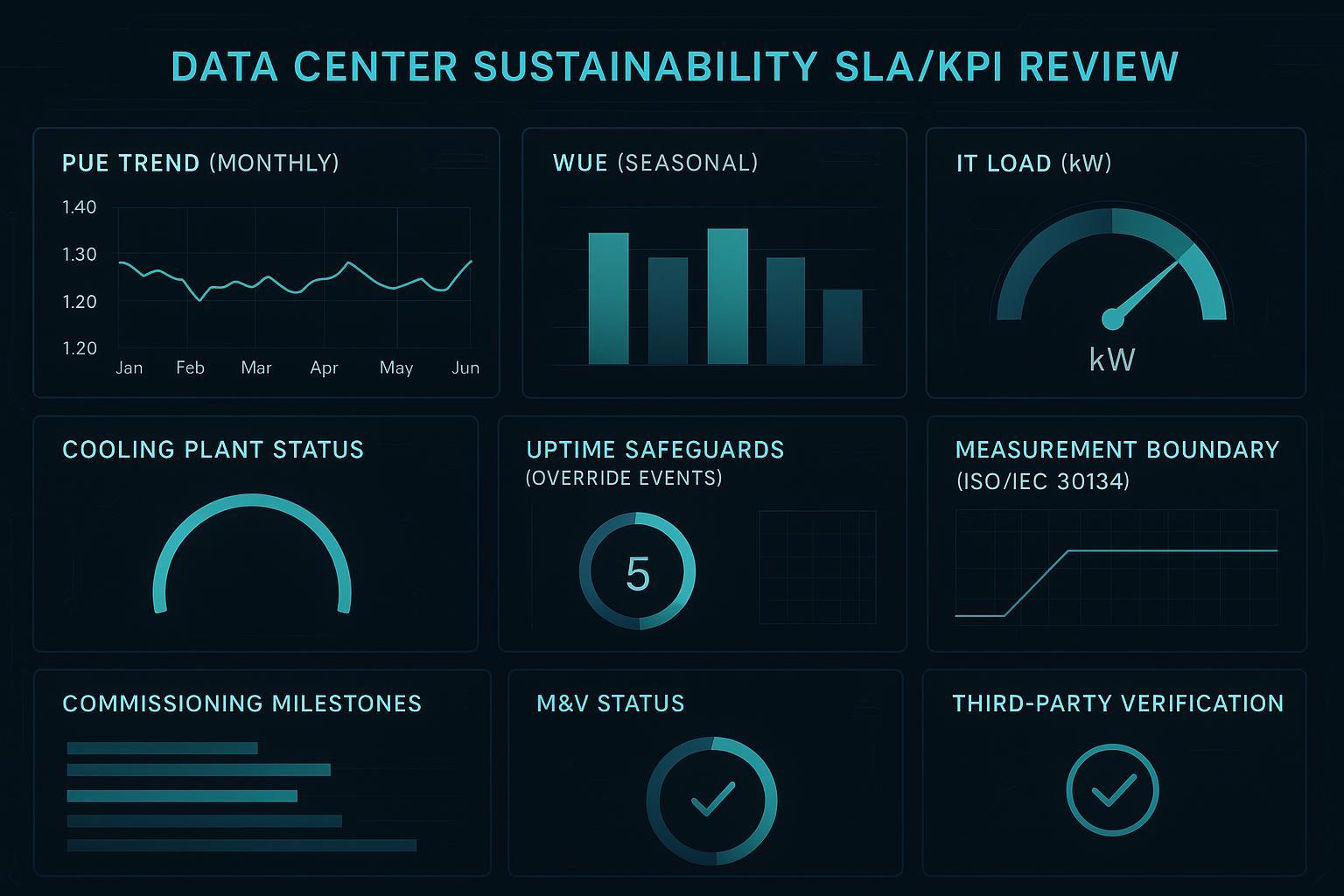
Table-style dashboard mockup (copy-friendly)
Panel | KPI / View | What it answers for procurement | What evidence it should link to |
|---|---|---|---|
Efficiency | PUE (rolling 30/90 days) | Are we improving and staying stable? | Meter topology + PUE boundary definition |
Water | WUE by season + annual | Are seasonal swings explained and normalized? | Water meter list + normalization method |
Context | IT Load (kW) + occupancy | Are KPI shifts driven by load, not controls? | IT power meter point list |
Reliability | Override events + duration | Did safeguards trigger often? Why? | Alarm/override logs + root cause notes |
Controls | Sequence compliance | Are sequences running as intended? | Commissioning test results |
Governance | Change events register | Did a change invalidate comparisons? | Change-control tickets |
Verification | M&V status | Is reporting audit-ready? | Baseline report + QA rules |
Compliance | Boundary & method statement | Is the KPI comparable across sites? | ISO/IEC alignment statement |
Image-style dashboard mockup (for presentation)
Sample contract language excerpts (illustrative)
The examples below are illustrative drafting patterns intended to show structure. They are not legal advice.
1) KPI definitions and boundaries
“PUE shall be calculated and reported in accordance with the agreed Measurement Boundary Statement (Appendix A) and the agreed metering topology (Appendix B). Any material change to boundary or metering shall be treated as a Change Event.”
2) Baseline and change-control
“Baseline Period means the continuous period used to establish the baseline KPI values, subject to data quality rules and documented exclusions. Change Events (including but not limited to material IT load changes, cooling plant reconfiguration, or expansion phase cutover) shall trigger a baseline review and, if agreed, baseline reset.”
3) Safeguards and overrides
“The Control System shall operate within the Safety Envelope defined in Appendix C. Override Events shall be logged with timestamp, duration, trigger condition, and operator acknowledgement. Override Events shall not constitute a KPI breach where they are required to maintain safe operation.”
4) Measurement disputes and third-party review
“In the event of a KPI measurement dispute, the Parties shall first conduct a joint technical review of KPI inputs, formulas, and exclusions. If unresolved within the Dispute Review Period, an independent verifier shall review the KPI calculation basis and issue a determination.”
5) Remedies aligned to governance (not blanket guarantees)
“Where KPI performance materially deviates from the agreed targets during normal operating conditions and outside documented exclusions, Supplier shall propose a Corrective Action Plan within [X] business days and implement commercially reasonable remediation steps within an agreed schedule.”
Pro Tip: Ask vendors to provide these appendices as deliverables (boundary statement, meter list, formulas, logs), not just narrative descriptions.
Next steps
If you’re evaluating vendors, the fastest way to de-risk a PUE/WUE commitment is to standardize the appendices.
CTA: Request a Coolnetpower-ready “PUE/WUE SLA + M&V Appendix Checklist” you can attach to your RFP.
For additional context on how controls and monitoring can support PUE/WUE programs, see Coolnetpower’s guide on how AI cooling improves PUE and WUE.