Immersion cooling has crossed a threshold. It is no longer a lab curiosity for crypto miners or a niche HPC experiment — it is moving into early commercial deployment in data centers the moment rack densities outgrow what air can handle. But “moving into” is not the same as “arrived.” In 2026 the industry is growing quickly from a small base while the forces that will decide whether it goes mainstream — standardization, cost, and reliability — are still being resolved.
This report breaks down the 2026 immersion liquid cooling landscape: the market numbers, the technology, the standards, the barriers, and where the industry is likely headed.
Key takeaways
The data-center immersion cooling market is estimated at roughly $0.35–2.1 billion in 2026 depending on scope, with most forecasts pointing to ~20% or higher CAGR toward 2034–2035.
Adoption is being pulled by AI/HPC rack density (above ~50 kW/rack), PUE and water-efficiency targets, and energy, carbon, and WUE regulation (EU EED, US DOE guidance, corporate net-zero).
Single-phase immersion dominates as the practical default (~PUE 1.02–1.03); **two-phase** offers the highest density headroom (~PUE 1.01–1.02) but carries higher fluid cost and chemistry risk.
The gating factors are standardization (39%), upfront cost (38%), and long-term reliability concerns (35%) in an industry survey — not the physics.
Expect immersion to keep winning ultra-high-density, space-, and power-constrained deployments, while direct-to-chip remains the default for the broader AI rack base.
Table of Contents
ToggleWhat immersion liquid cooling is, and where it fits
Immersion liquid cooling submerges servers — typically boards in a rack, or whole tanks — in a thermally conductive dielectric liquid instead of pushing air over heat sinks. Because liquid conducts roughly three orders of magnitude more heat than air, immersion removes the airflow, fan, and thermal-envelope constraints that cap conventional cooling.
In the density spectrum, this matters. Industry guidance commonly puts the practical limit of air cooling around 20–30 kW per rack; above roughly 50 kW per rack, immersion (or purpose-built liquid infrastructure) becomes the more natural choice. That is precisely the zone AI training and next-generation accelerators are pushing into.
The design choice splits into two main approaches. Single-phase immersion keeps the dielectric fluid in liquid form throughout the loop — typically a synthetic hydrocarbon, ester, or engineered oil — pumping it to a heat exchanger and back. It is simpler, cheaper on fluid, and less demanding to operate. Two-phase immersion uses a low-boiling-point fluid that vaporizes at the chip surface and condenses back to liquid, exploiting latent heat. It delivers the best thermal performance and the most density headroom, but the working fluids tend to be expensive and the sealed-system design raises capital cost.
For operators weighing the two, the trade-offs tend to come down to a handful of axes:
Decision axis | Single-phase immersion | Two-phase immersion |
|---|---|---|
Typical PUE range | ~1.02–1.03 | ~1.01–1.02 |
Density headroom | Good; handles most high-density racks | Highest; built for extreme heat flux |
Working fluid | Synthetic hydrocarbon / ester / oil | Low-boiling fluorocarbon-family fluids |
Fluid & system cost | Lower | Higher (fluid + sealed system) |
Operation & maintenance | Simpler | More specialized control; hot-swap of boards without draining tank is possible |
Regulatory exposure | Lower | Higher (PFAS pressure on fluorocarbon chemistries) |
Neither approach is objectively better; they suit different density, budget, and compliance profiles. The practical question for most teams weighing single-phase vs two-phase immersion is not “which wins?” but “which one fits the loads we can already justify, and can we operate it today?”
Market size and trajectory of the immersion cooling industry
Because reports define the category differently — some cover all immersion systems, others only data-center immersion, others just the fluids — published 2026 market figures vary by an order of magnitude. Two data-center-specific estimates bracket the realistic range:
Global Market Insights puts the 2026 data-center immersion cooling market at roughly $2.1 billion, growing toward $10.9 billion by 2035 at about a 19.8% CAGR.
A more conservative estimate from Fortune Business Insights sizes 2026 at about $348 million, reaching ~$1.69 billion by 2034 at a 21.9% CAGR.
The range itself is the real signal: the category is fragmented and still small relative to the broader cooling market, but every credible forecast points to sustained double-digit growth. Regionally, North America is generally reported as the largest market, with Asia-Pacific the fastest-growing.
The supply side tells the same story. In 2025, specialists Green Revolution Cooling, Submer, LiquidStack, and Asperitas together accounted for roughly 35% of immersion tank shipments (per Mordor Intelligence), which shows concentration in a handful of specialists set against a long tail of entrants — evidence of an early, still-consolidating industry rather than a settled one. Total immersion liquid cooling revenue remains a small fraction of the cooling market precisely because so much of it is still validation and early reference deployments.
What is driving adoption in 2026
The headline driver is simple: chips are too hot for air. AI training and inference clusters are pushing rack heat loads and per-device thermal design power (TDP) far beyond what air cooling can economically reject. Liquid-cooling penetration has been projected to rise from roughly 3% in 2021 toward around 37% in 2026 (a directional figure from industry commentary rather than a measured statistic), and immersion is competing with direct-to-chip for that spend.
Beyond raw density, three compliance-and-sustainability drivers are reinforcing the shift:
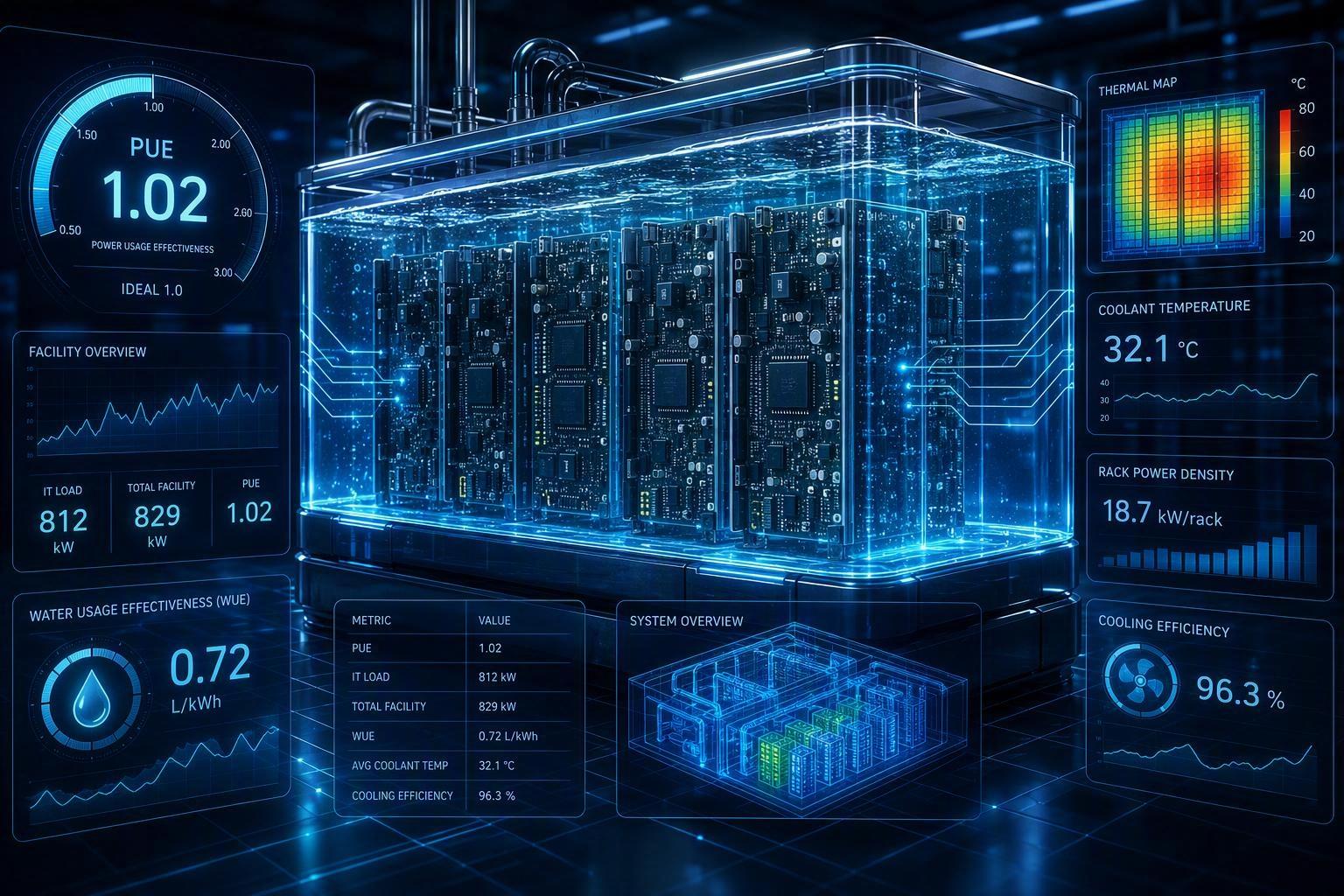
PUE targets. Immersion can bring power usage effectiveness close to 1.0 — typically around 1.02–1.03 for single-phase and 1.01–1.02 for two-phase — versus materially higher figures for conventional air cooling.
Water and WUE. Many immersion designs consume little to no facility water, which matters in water-stressed regions and under tightening WUE scrutiny, including the EU’s Energy Efficiency Directive reporting.
Energy, carbon, and net-zero mandates. Hyperscale net-zero roadmaps and U.S. Department of Energy data-center efficiency guidance push operators toward architectures that cut cooling energy and carbon regardless of local electricity prices.
For a thermal lead weighing a retrofit, the practical tension is that immersion targets the exact loads where value is highest (very high density, tight PUE/water targets) — but it also demands the most infrastructure change. For an executive, the case is strategic rather than operational: a cooling architecture that gets PUE and WUE closer to 1 while shrinking cooling OPEX and water bills becomes easier to defend in an energy, carbon, and WUE compliance review, and easier to present as progress toward net-zero commitments.
Industry standards and the gaps that remain
Standards are the clearest sign that immersion is maturing — and the clearest sign it is not done maturing.
On the thermal side, ASHRAE TC 9.9’s 2026 thermal guidance now covers high-density systems explicitly, introducing a dedicated high-density class and separating the facility water system from the technology cooling system — the separation that matters when liquid touches compute in a sealed loop. The Open Compute Project contributes reference architectures that several vendors build to.
The fluid side is further behind. There is still no accepted industry standard for immersion-cooling liquids; ASTM has an active work item open to specify them, which both confirms the need and confirms it is unaddressed. Regulatory signals are arriving piecemeal: China published its first national standard for cold-plate liquid cooling (GB/T 48023-2026, effective February 2027), a marker that liquid-cooling rulemaking is maturing, even if that specific rule is not about immersion.
The challenges holding immersion back
The physics is not the bottleneck; the deployment ecosystem is. An industry survey of liquid cooling in data centres by the IEA’s 4E EDNA programme found the top barriers:
Lack of industry-wide standardisation — 39%
High initial cost — 38%
Concerns over long-term reliability — 35%
Those three numbers capture the real adoption story. Retrofit complexity compounds them: submerging existing server fleets means re-engineering boards, racks, plumbing, and redundancy, and it can disrupt live workloads. Fluid qualification and materials compatibility are still being formalized. And the operational skill gap — managing liquid loops, leak detection, and maintenance on a new cooling stack — is real for most facilities teams.
Two-phase immersion carries an additional, fast-moving risk: many of its working fluids are fluorocarbon-based, and PFAS-related regulatory pressure across the EU and U.S. is reshaping coolant selection. Operators evaluating two-phase today must plan for the possibility that a fluid they qualify now may face restrictions later.
Where immersion cooling is likely headed
Read straightforwardly, immersion cooling is not displacing direct-to-chip so much as being pulled toward the extreme end of the density curve. Direct-to-chip remains the default for a large share of AI racks, while immersion is coming to define ultra-high-density, space-constrained, and power-dense deployments where even liquid plates hit practical limits.
Two signals reinforce that trajectory. NVIDIA describes its Rubin generation as the first fully liquid-cooled AI infrastructure, with every chip and networking component on a closed liquid loop — a structural bet that liquid-first AI infrastructure is the direction of travel. And the hyperscale roadmap, while directional, points the same way: industry commentary suggests more than half of new hyperscale capacity could be liquid cooled by 2027, with GenAI workloads driving meaningful added liquid-cooled capacity by 2028.
For buyers — whether an enterprise evaluating a retrofit or a hyperscaler planning a greenfield campus — the takeaways are practical. Understand that market-size figures depend heavily on what “immersion” is defined to include. Treat PUE and water claims as directional until validated on your own loop. Plan for retrofit and service complexity, not just thermal gains. And because the fluid and interoperability standards are still being written, favor designs and vendors that keep the loop open rather than locking you into a proprietary chemistry today.
What the trajectory means for different stakeholders
The outlook plays out differently depending on where you sit.
Operators with existing air-cooled or direct-to-chip fleets are not being forced off their roadmap. The density threshold is the trigger: retrofit immersion only where air or direct-to-chip genuinely stops scaling, and treat it as an additive architecture rather than a wholesale replacement.
Hyperscalers and cloud providers are the main pull of the market. Their net-zero roadmaps, AI density requirements, and ability to absorb retrofit complexity make them the segment most likely to push immersion from pilots into production zones.
Colocation and enterprise buyers face the highest friction: retrofit disruption, service skill gaps, and fluid/lock-in uncertainty are proportionally larger relative to their scale. For them, standardized, serviceable, non-proprietary loops should be the default filter.
Vendor and fluid suppliers are racing to standardize because standardization is the unlock. Whoever helps write the missing immersion-fluid and interoperability rules — alongside bodies like ASHRAE and ASTM — helps remove the 39% standardization barrier that currently caps the market.
The immersion liquid cooling industry in 2026 sits at the changeover point: proven at the high-density edge, expanding quickly, and still waiting on the standardization, cost, and reliability proof that will decide whether “exploding” becomes “standard” over the next five years.