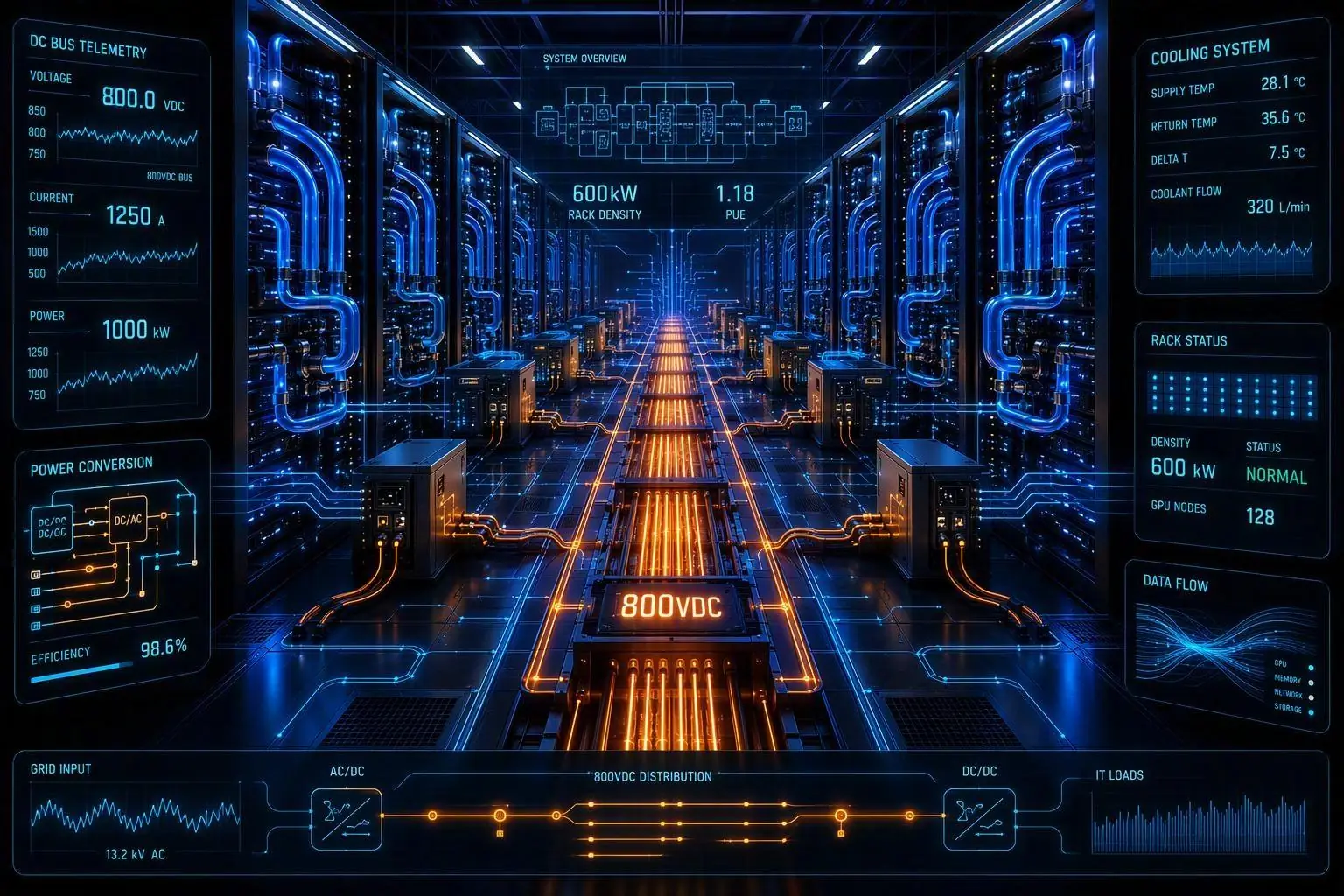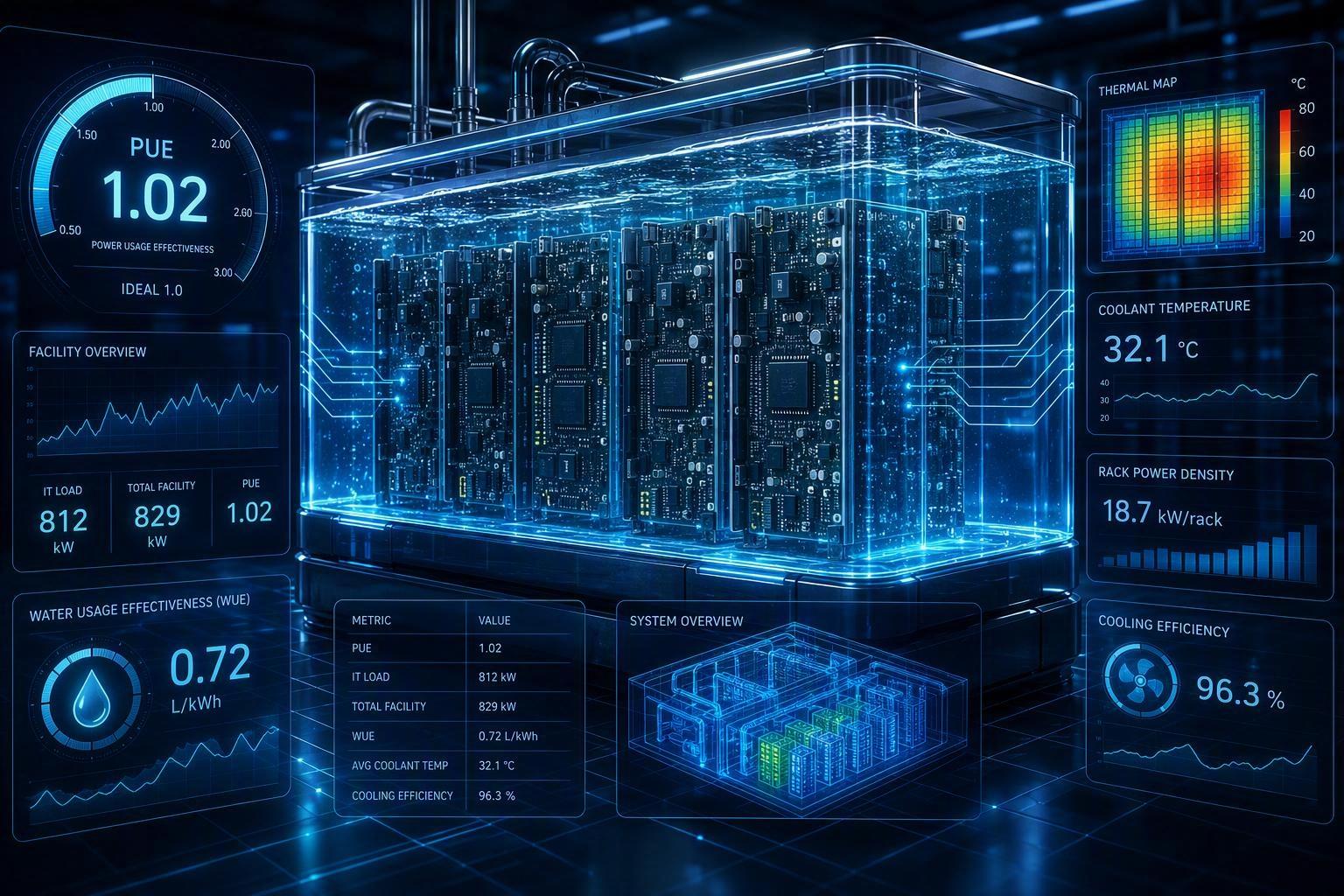
There is no single “best” data center cooling system. The right architecture depends almost entirely on where the facility sits — on its climate, its water supply, its electricity and regulation environment, and the density of the workloads it must cool. Copying a design that works in Northern Virginia will struggle in Singapore, and a solution built for Frankfurt’s grid won’t translate cleanly to Riyadh.
This guide gives you a practical way to think about that decision. You start with a small set of regional inputs, map them to a short list of cooling approaches, and then narrow to a candidate architecture before the detailed engineering begins. The goal is a defensible first selection, not a finished design.
Key Takeaway: Regional data center cooling selection is driven by four inputs — climate, water availability, regulation, and rack density. Match those four to a cooling architecture, and you'll converge on the right direction faster than chasing a single "best" technology.
Table of Contents
ToggleThe four factors that drive regional cooling decisions
Before comparing technologies, define the criteria that will separate them. Four factors account for most regional differences in cooling selection:
Climate. Ambient temperature and humidity gate how much free cooling (economization) is possible. The U.S. Department of Energy’s Best Practices Guide for Energy-Efficient Data Center Design notes that free cooling is generally most useful where wet-bulb temperatures stay below about 55°F for 3,000 or more hours per year — a threshold that cold Nordic and northern U.S. sites meet easily, and tropical sites rarely meet at all.
Water availability. Evaporative heat rejection and cooling towers consume real water. In water-scarce regions this becomes a commercial and regulatory constraint, steering designs toward dry, closed-loop, or liquid-assisted approaches.
Regulation and policy. Energy-efficiency codes, waste-heat-reuse mandates, and disclosure rules shape what’s acceptable. Europe’s heat-reuse requirements are the clearest example, but U.S. state-level water rules and Asia-Pacific efficiency targets matter too.
Rack density. Rack power density is often the single most important factor in architecture choice. As Data Center Knowledge reported in its density analysis, air cooling becomes increasingly impractical above roughly 50 kW per rack, pushing AI-heavy deployments toward direct liquid cooling.
These four inputs rarely point in the same direction at once. That’s the point: region-based selection is about weighting them for your specific site, not finding a universal answer.
Regional data center cooling by region: North America
North America is the largest data center cooling market by a wide margin — MarketsandMarkets’ data center cooling market report put the region around 44% of global value in 2025 — largely because hyperscale AI build-out is concentrated there.
The first decision gate in North America is rack density. AI training clusters with sustained high thermal loads don’t respond well to air-only cooling above the 20–50 kW/rack range. For those, direct-to-chip liquid cooling or a liquid-assisted hybrid becomes the practical next step. If you’re comparing the main liquid options, a useful starting point is this direct-to-chip vs immersion vs rear-door heat exchanger comparison, which separates the three by heat-capture point and infrastructure complexity.
Below that density, the regional split is mostly climate-driven:
Northern and Pacific Northwest markets (e.g., Chicago, the Pacific Northwest) have the free-cooling hours for waterside and airside economizers to run much of the year.
Sun Belt and Southwest markets face hotter dry-bulb conditions, fewer economizer hours, and — in states like Arizona, California, and Nevada — rising water stress and local limits that push designs toward closed-loop, low-water systems.
Practical guidance: if your AI racks exceed about 20 kW, plan for liquid-assisted cooling regardless of climate; if they sit well below that, let climate and water decide between air, economizer, and chilled-water approaches.
Europe: heat reuse is now a design constraint
Europe’s cooling selection is shaped less by raw scale and more by policy. The recast EU Energy Efficiency Directive (2023/1791) requires data centers above 1 MW to assess — and, where feasible, perform — waste-heat recovery, with annual reporting starting at 500 kW. National rules go further: Germany’s Energy Efficiency Act (EnEfG) requires new data centers from July 2026 to reuse at least 10% of waste heat, rising to 15% in 2027 and 20% in 2028, alongside a PUE ceiling of 1.2.
This changes the cooling calculus in two ways:
Free cooling still dominates in the Nordics. Cold ambient conditions allow almost year-round free-air or free-water cooling; Nordic operators can reach facility PUE values near 1.09 using natural-sourced cold. If you don’t need heat export, a well-designed free-cooling system is hard to beat on efficiency.
Heat-reuse obligations favor liquid. Direct-to-chip cooling with a warm-water loop returns heat at a useful temperature for district heating, whereas low-temperature air systems need heat pumps in between. Where the site must satisfy heat-reuse mandates or connect to a district-heating network, liquid or hybrid cooling with a heat-recovery loop becomes the more defensible choice.
So in Europe, the practical selection is often a hybrid: free cooling for efficiency where the climate supports it, plus liquid/heat-recovery infrastructure where compliance or district-heating economics demand it. For operators growing AI capacity across Europe, a hybrid air–liquid retrofit strategy with RDHx and direct-to-chip is a common path.
Middle East: water scarcity overrides almost everything
In the Middle East, the dominant constraint is water. Evaporative cooling and open cooling towers consume water that is scarce, expensive, and increasingly regulated in Gulf markets. As an analysis of MENA data center water stress explains, closed-loop liquid cooling with dry heat rejection — a direct-to-chip system circulating a non-evaporative fluid and rejecting heat through dry coolers or air-cooled heat exchangers — can run with near-zero consumptive water use.
Two practical patterns stand out in arid/hot climates:
Dry and hybrid heat rejection. Closed-loop dry coolers replace open evaporative towers, and warm-water loops operating above roughly 35°C coolant supply keep systems above ambient dry-bulb for much of the year, preserving efficiency without evaporative loss.
Direct liquid and immersion. Direct-to-chip and immersion cooling reduce or eliminate evaporative cooling, which matters both for water use and for the high ambient temperatures around 40°C+ that are common in the Gulf.
Pro Tip: In water-scarce regions, design a "dry fallback mode" from day one. Even if a site starts with evaporative support, having dry coolers or air-cooled heat rejection ready preserves the SLA under drought restrictions or water curtailment — without forcing a re-design later.
Because water access and permitting are first-class inputs here, site selection tends to weigh WUE and water risk alongside PUE.
Asia-Pacific: hot and humid changes the efficiency math
Asia-Pacific is the fastest-growing cooling region, but its tropical climates undermine the free-cooling strategies that work elsewhere. In hot-humid environments like Singapore and much of Southeast Asia, cooling can account for 30–40% of a facility’s energy use, and high humidity adds condensation and corrosion risk alongside heat load.
Two drivers define the region’s selection logic:
Limited free cooling. When ambient air is both warm and moisture-laden, airside and evaporative economizers lose their benefit. Operators fall back on chilled-water systems, indirect evaporative cooling, desiccant dehumidification, and — increasingly — liquid cooling.
Rapid liquid adoption for AI density. Singapore published a tropical data center liquid-cooling standard in mid-2026 to formalize high-efficiency liquid deployment in hot, humid conditions. China’s regional plans have written liquid cooling into expectations for new hyperscale facilities, with efficiency targets around PUE ≤1.3.
For AI and GPU-heavy workloads in APAC, direct-to-chip and hybrid architectures are converging as the practical baseline, because they move heat out of the room loop and reduce reliance on energy-hungry air handling in humid air. For modular builds targeting low PUE and WUE together, a modular AI data center cooling approach is a useful reference.
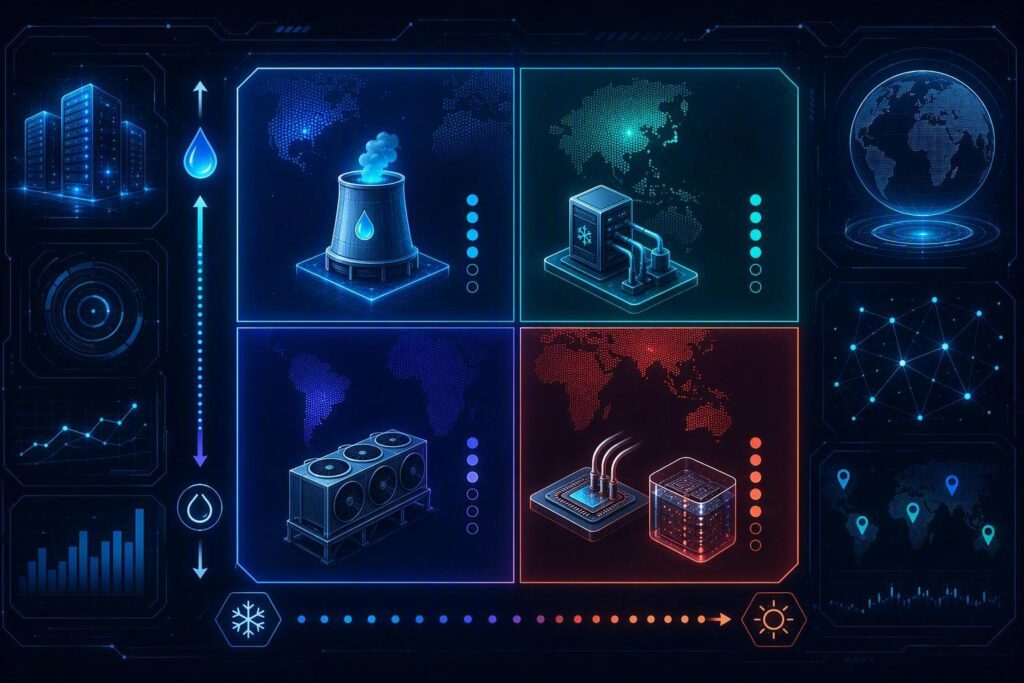
A quick reference for regional cooling selection
Use this table as a starting point for your own decision, then weight the factors for your specific site:
Region | Dominant driver | Typical first-choice cooling | When to add liquid |
|---|---|---|---|
North America (US) | Rack density, then climate/water | Air + economizer in cool zones; closed-loop in water-stressed states | >20 kW/rack AI; >50 kW/rack baseline |
Europe (Nordics/temperate) | Heat-reuse regulation + free cooling | Free cooling + heat-recovery loop; liquid where heat export needed | Heat-reuse/ERF mandates, high-density AI |
Middle East / Gulf | Water scarcity | Dry/hybrid/closed-loop; direct-to-chip or immersion | Any density, to cut water use |
Asia-Pacific (tropical) | Hot-humid climate + AI density | Chilled water + liquid-assisted hybrid | AI/high density; standard-backed liquid |
How to apply these criteria to your own project
Rather than adopting a region’s “typical” solution blindly, run a short needs assessment:
Confirm your rack density today and in 24 months. This is the single biggest gate. If it crosses ~20–50 kW/rack, plan for liquid assistance regardless of climate.
Check your water position. What does the site’s water cost, and what are the local limits? Water-stressed sites favor closed-loop and dry rejection.
Read the local regulation. Does your jurisdiction mandate heat reuse, PUE ceilings, or disclosure? Build those into the selection, not as an afterthought.
Estimate free-cooling hours. Use your climate’s wet-bulb profile to decide whether economizers pay for themselves.
Weight the four factors for your site. No region is uniform; a desert site and a coastal site in the same country may choose differently.
Red flags to watch for: a design that ignores local water constraints, a heat-reuse obligation discovered after the cooling topology is locked, or an air-only architecture on racks that will exceed ~20–50 kW. Must-haves: a documented operating envelope, a plan for density growth, and a tie-back to whatever standards govern your site (ASHRAE, EN 50600, or local codes).
Next steps
Region is the right lens for an initial cooling selection, but the real decision comes down to your density, water position, and compliance obligations. If you want to validate a candidate architecture for a specific site, a Coolnetpower technical fit call can help map your selected cooling approach to a concrete setpoint, sensor, and event-mode plan that ties back to your regional ASHRAE and efficiency-reporting needs. Starting from the right regional constraints makes that conversation materially faster.