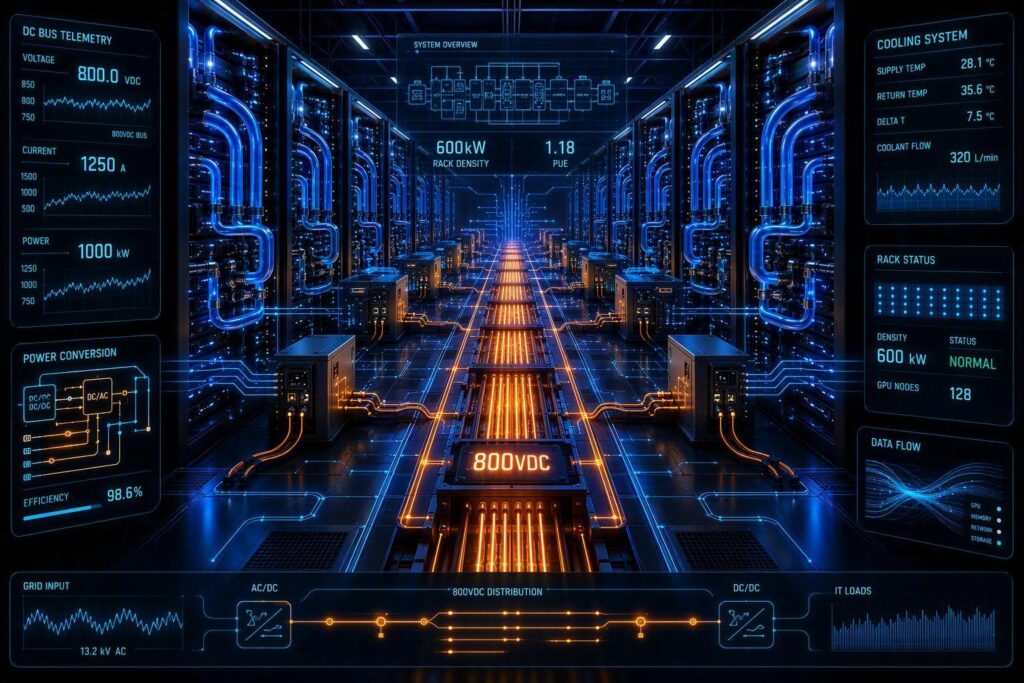
Key Takeaways:
AI rack densities now reach 120–227 kW, versus 5–10 kW for traditional enterprise racks. That 20x gap cannot be closed by conventional AC distribution and air cooling.
The industry is converging on 800 VDC as the reference power architecture for next-generation AI factories, starting commercial deployment in 2027 with NVIDIA's Vera Rubin platform.
Two September 2026 announcements (Compal and Exascale's LOI for a native 800 VDC validation platform, and AirJoule's acquisition of BitSink) signal that the transition has moved from roadmap to market action.
Liquid cooling penetration in AI data centers is rising sharply — from 14% in 2024 to 33% in 2025 by one measure, with AI-chip penetration forecast at 53% in 2026 — driven by rack densities that air cooling cannot physically handle above 30–40 kW. (Penetration figures vary widely by whether they measure AI chips, AI servers, or the total installed base.)
Power, cooling, and rack design are no longer independent procurement decisions. They are one integrated infrastructure problem.
How this analysis was compiled: this article synthesizes publicly available analyst reports, vendor architecture documents, standards-body materials, and two September 2026 market announcements. Efficiency and TCO figures are attributed to their source and, where relevant, classified as vendor-published or independently modeled.
The data center built for web servers and databases looks nothing like what AI training clusters require. Not in layout. Not in power delivery. Not in heat management.
For two decades, a “dense” enterprise rack drew 5 to 10 kW. The cooling systems, transformer chains, and power distribution units across the industry were designed around that band. Then GPU-based AI compute arrived and began rewriting every assumption about what infrastructure a rack actually needs.
NVIDIA’s GB300 NVL72 requires up to 142 kW per rack. The Vera Rubin “Kyber” system, scheduled for 2027, targets 600 kW in a single rack. According to AFCOM’s State of the Data Center Report 2026, average rack density across the industry jumped from 16 kW in 2025 to 27 kW in 2026, the largest single-year increase in a decade of the survey. Within AI-specific deployments, some configurations already exceed 227 kW per rack, with projections above 1 MW within two to three years.
That gap (5 kW versus 142 kW or higher) is not solvable by upgrading transformers or adding containment aisles. It requires rethinking every layer of the data center power chain, from the medium-voltage intake at the building perimeter down to the final voltage conversion at the GPU tray.
Two announcements in September 2026 made clear that this transition is no longer theoretical. On September 14, Exascale Labs and Compal Electronics signed a letter of intent to co-develop a U.S.-based native 800 VDC validation platform for next-generation GPU data centers. Five days earlier, AirJoule Technologies acquired BitSink for $27 million upfront, picking up liquid cooling systems, switchboards, power distribution equipment, and equipment racks for AI and HPC environments.
Disclosure: Coolnetpower is a data center infrastructure provider whose portfolio includes cooling and power distribution equipment. This article is intended as industry analysis, and readers should weigh the publisher's commercial interest in the cooling and power categories discussed below.
Both moves point in the same direction: power delivery, liquid cooling, and the rack itself are being redesigned as a unified system rather than separate procurement categories.
Disclosure: Coolnetpower is a data center infrastructure provider whose portfolio includes cooling and power distribution equipment. This article is intended as industry analysis, and readers should weigh the publisher's commercial interest in the cooling and power categories discussed below.
Disclosure: Coolnetpower is a data center infrastructure provider whose portfolio includes cooling and power distribution equipment. This article is intended as industry analysis, and readers should weigh the publisher's commercial interest in the cooling and power categories discussed below.
Table of Contents
ToggleWhy Conventional Power Architecture Hits a Physical Limit
A traditional data center power chain runs roughly like this: medium-voltage AC from the grid steps down through a main transformer, passes through a UPS, routes through switchboards to computer room PDUs, and finally drops to 54V or 12V at the rack level through multiple conversion stages. Each stage introduces losses. The whole chain, in practice, reaches roughly 82–85% end-to-end efficiency.
At 10 kW per rack, those losses are manageable. At 600 kW per rack, the current flowing through copper busbars and PDU cabling becomes physically unreasonable. Higher current means thicker copper, more heat in the cabling itself, and mechanical constraints on where and how densely racks can be placed.
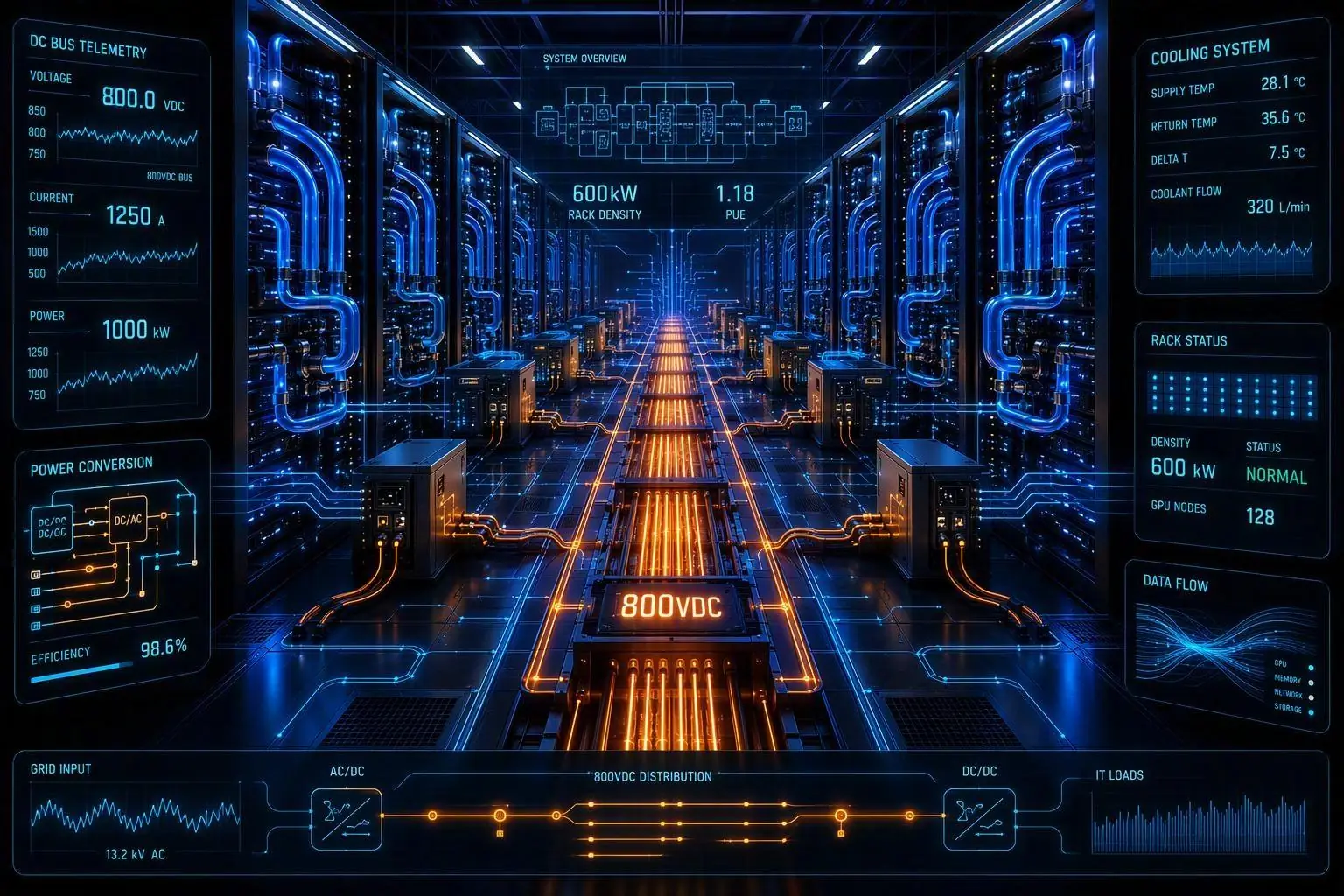
The engineering argument for 800 VDC is straightforward: voltage up, current down. As NVIDIA explains in its published architecture guidance, converting medium-voltage AC to 800 VDC at the facility perimeter (rather than stepping down to 480V AC first and converting again at the rack) eliminates two to three intermediate stages. NVIDIA estimates this improves end-to-end efficiency by up to 5 percentage points versus 54V distribution, reduces cooling load, and cuts TCO by up to 30%.
In a 2.5 MW data center, copper cable usage and floor space drop by approximately 50%, line heating falls by around 32%, and heat-related power losses decrease by 94% compared to conventional AC-based designs, based on figures reported by the Futunn research desk.
Independent analysis from Enverus Intelligence Research, published in June 2026, reaches a comparable conclusion from a different angle: the firm estimates that 800 VDC designs reduce AI data center capex by roughly 13% versus legacy 54V AC distribution, driven by fewer conversion stages, lower copper content, and reduced cooling overhead. The Direct Power Alliance, a neutral industry consortium that published an open native-DC reference architecture in June 2026, frames the same shift as a move from “behind-the-meter AC” to “native-DC power from generation to rack.”
It is worth distinguishing vendor-published efficiency figures from independently modeled ones. NVIDIA’s up-to-5-point efficiency gain and up-to-30% TCO reduction are vendor architecture targets; the Enverus 13% capex figure is an independent analyst model. Both point in the same direction, but they are not the same class of evidence.
The resulting architecture is a two-stage chain: grid AC converts to 800 VDC once, at the perimeter, using industrial-grade rectifiers or solid-state transformers. That 800V bus distributes through busbars directly to racks. At the rack, DC-to-DC conversion steps down to intermediate bus voltages, typically 54V, 12V, or increasingly 6V, and then to GPU core voltages below 1V.
Texas Instruments, working with NVIDIA, published specifications in March 2026 for a complete 800 VDC conversion chain: a GaN-based 800V-to-6V bus converter at 97.6% efficiency, followed by a multiphase buck stage from 6V to sub-1V at the GPU. The silicon ecosystem is being built around this specific two-stage path.
The Role of the Solid-State Transformer
The medium-voltage input stage, where grid power converts to 800 VDC, is where the solid-state transformer (SST) matters. A conventional approach uses a large-format dry-type transformer plus a separate rectification stage. An SST performs both functions in a single power-electronic conversion step, using silicon carbide (SiC) or gallium nitride (GaN) semiconductor switching at high frequency.
Delta Electronics, which collaborated with NVIDIA on its 800 VDC “AI Power Cube” ecosystem and demonstrated the system at OCP Global Summit 2025, reports up to 98.5% conversion efficiency for its SST stage. STMicroelectronics demonstrated a GaN-based LLC converter in October 2025 operating directly from 800V at over 98% efficiency. Some in-development SST architectures, including Infineon and SolarEdge’s joint platform, target over 99% efficiency from medium-voltage input to 800 VDC output.
The footprint reduction is also significant. A comparison published by Arrow Electronics in August 2026 notes that SST-based 800 VDC systems simplify what was previously a two-to-three stage redundant power chain, reducing physical infrastructure size by up to 60% in some configurations.
Comparing the published efficiency claims. The table below consolidates the SST and conversion-stage efficiency figures cited in this section, along with their source type, so planners can separate vendor specifications from independent benchmarks:
Component / stage | Claimed efficiency | Source | Source type |
|---|---|---|---|
Delta Electronics SST stage | Up to 98.5% | Delta (with NVIDIA) | Vendor-published |
STMicroelectronics GaN LLC converter (from 800V) | Over 98% | STMicroelectronics | Vendor-published |
Infineon + SolarEdge SST (MV input to 800 VDC) | Over 99% (target, in development) | Company reports | Vendor-published (pre-production) |
TI GaN 800V-to-6V bus converter | 97.6% | TI (with NVIDIA) | Vendor-published |
Full facility AC-to-800 VDC conversion | ~13% lower capex vs. 54V AC | Enverus Intelligence Research | Independent analyst model |
Two cautions apply. First, vendor efficiency figures are typically measured under ideal conditions and at the most favorable operating point; system-level efficiency across a full load profile is usually lower. Second, the higher the claimed efficiency, the narrower the gap to a theoretical maximum, so marginal gains above roughly 98% must be weighed against cost, thermal management, and reliability trade-offs.
The Open Compute Project has formalized two wire standards for this distribution layer: NVIDIA’s three-wire specification (+800V, neutral, ground) and OCP’s Mount Diablo four-wire standard (+400V, -400V, neutral, ground), co-authored by Google, Meta, and Microsoft. Both converge on 800V-class distribution as the reference voltage for next-generation AI racks, offering operators a choice between vendor-specific and consortium-defined wiring topologies.
Compal and Exascale: Validating the Full Stack Before Volume Production
The Compal-Exascale partnership announced on September 14, 2026 is positioned explicitly as a pre-commercial validation step, not a product launch. According to their joint announcement, Exascale will provide the modular data center (MDC), SST-based 800 VDC power architecture, and deployment and commissioning services. Compal will supply the project site, GPU servers, and liquid cooling systems.
The stated goals of the validation platform include testing SST operational availability under real AI workloads, performing native 800 VDC compatibility testing for GPU servers, running pre-shipment power-on tests, and accumulating operational data for the UL certification process. The two companies had already demonstrated an integrated version of this system at Computex Taipei 2026 in June.
What makes this collaboration structurally interesting is the division of responsibility. Neither party is building the entire stack. Exascale handles the power conversion and modular facility layer; Compal handles the compute and the cooling. The validation platform is designed to prove that these subsystems work together as an integrated AI factory environment, not that each layer passes standalone specifications.
That integration requirement reflects a broader shift in how next-generation AI data centers are being designed. The UL certification process, referenced in the LOI, requires that interconnected subsystems pass testing as a system. Rack-level cooling performance depends on CDU inlet temperature, which depends on facility water temperature, which depends on power conversion efficiency and the heat load from the SST. Power capacity headroom depends on how much the liquid cooling loop reduces in-rack heat relative to air cooling. These dependencies run in both directions.
Liquid Cooling Reaches the Tipping Point
The Compal side of the partnership brought direct liquid cooling (DLC) to Computex 2026. That is not incidental. It reflects that 800 VDC architecture and liquid cooling are converging toward the same deployment window.
Multiple independent trackers converge on rapid adoption, though their figures differ by scope. TrendForce projected in August 2025 that liquid cooling penetration in AI data centers would reach 33% in 2025, up from 14% in 2024, and by August 2026 the firm had raised its AI-chip liquid cooling forecast to 53% in 2026, approaching 60% in 2027. Mordor Intelligence, tracking rack-scale GPU infrastructure, projects direct-to-chip liquid-cooled rack infrastructure growing at a 35.65% CAGR through 2031, while air-cooled rack infrastructure held 54.68% market share in 2025. Separately, Dell’Oro Group projects the data center liquid cooling market approaching $7 billion by 2029, with single-phase direct liquid cooling consolidating as the dominant architecture for AI clusters.
These penetration numbers should be read with their denominators in mind. Figures expressed as a share of AI chips or AI servers are far higher than figures covering the entire data center population. Uptime Institute’s 16th Annual Global Data Center Survey (2026) illustrates the gap: the modal rack density across the broader market reached just 11 kW, even as AI-heavy builds climbed far higher. Liquid cooling dominance applies to AI workloads, not to the installed base as a whole.
The physical reason is straightforward. Air cooling remains viable at roughly 15–30 kW per rack with containment and optimized airflow management. Above that band, heat flux density at the chip surface exceeds what air can practically remove at normal inlet temperatures. At 80 kW, direct-to-chip liquid cooling becomes the design default. At 120–142 kW, the current NVIDIA NVL72 operating range, it is not optional.
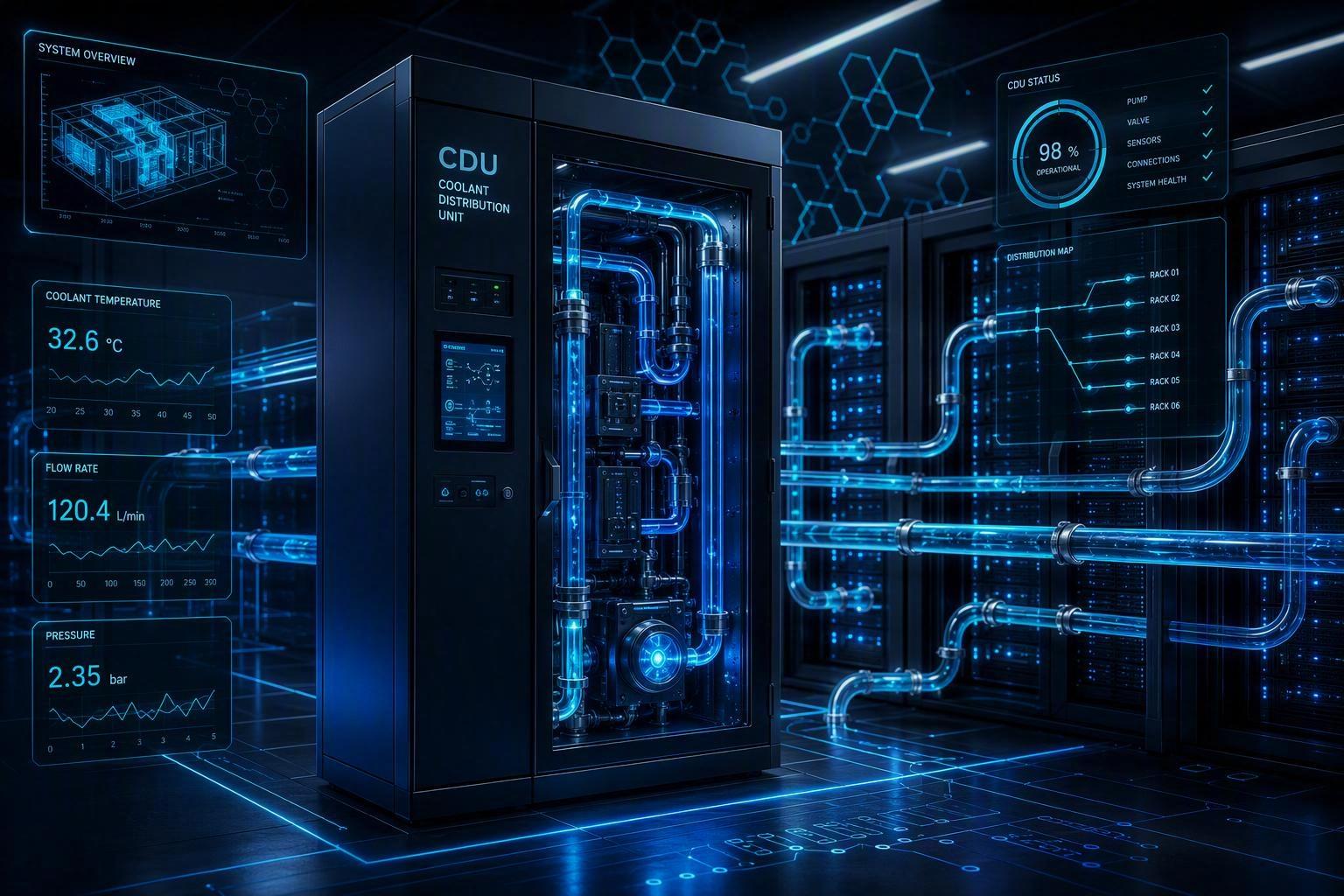
The cooling architecture for AI/HPC racks that has emerged as the practical 2025–2026 standard is a hybrid: direct-to-chip cold plates capture heat from GPU and CPU silicon, connected via manifolds to rack-level or row-level coolant distribution units (CDUs). The CDU acts as the boundary between the IT cooling loop and the facility water system, isolating secondary-loop coolant chemistry from facility infrastructure. Air cooling handles residual loads (memory, networking switches, storage) that either lack cold plate compatibility or sit below the thermal density threshold.
For a 40–80 kW rack row, sizing the CDU correctly requires calculating flow rate from GPU heat load and allowable delta-T across the cold plate, then rolling that into CDU capacity at pod scale with N+1 or 2N redundancy depending on SLA requirements. These parameters interact with facility supply water temperature and pressure available at the raised-floor connection points, which means CDU selection is properly part of the facility engineering process, not a late-stage IT procurement decision.
AirJoule, BitSink, and the Converging Stack
AirJoule Technologies’ acquisition of BitSink on September 10, 2026, reads on the surface as a straightforward market entry into AI infrastructure. BitSink designs and manufactures liquid cooling systems, switchboards, power distribution units, and equipment racks for AI and HPC environments. The deal was structured as $18 million in cash plus $9 million in AIRJ common stock upfront, with up to $40 million in additional stock earnouts tied to revenue targets through 2029.
AirJoule’s stated longer-term intent is to combine BitSink’s cooling infrastructure with its own atmospheric water-generation technology, using waste heat captured by cooling systems to produce water. That integration is still a future plan. But the immediate effect is that AirJoule acquired a company whose product portfolio spans cooling, power distribution, and racks simultaneously, not one of those categories.
BitSink’s multi-category product scope reflects the same structural reality that the Compal-Exascale partnership does: operators procuring AI infrastructure increasingly need to evaluate power, cooling, and rack as interdependent design choices. A CDU sized for a particular GPU configuration implies specific inlet water flow and temperature requirements. Those requirements constrain which switchboard and power distribution topology can be co-located in the same row. Which rack form factor is physically compatible with the selected cold plate manifold routing.
A vendor that supplies only one of those categories passes the integration burden to the operator. A vendor with products across all three can offer a verified stack.
What the Architecture Transition Looks Like in Practice
For operators planning facilities today, the migration to 800 VDC and liquid-dominant cooling does not happen at a single decision point. Three deployment models cover most planning scenarios.
Greenfield AI factory builds, purpose-built for high-density GPU workloads, deploy native 800 VDC from the MV intake forward, with SST-based conversion and a DC busway running directly to rack rows. Cooling uses direct-to-chip DLC with CDU skids pre-integrated during the modular data center build phase. Modular, factory-integrated data center blocks allow the power distribution path, liquid manifold routing, and controls integration to be standardized at the pod level, reducing field piping complexity and enabling faster commissioning.
Existing facilities adding AI capacity face a different constraint set. A brownfield building designed for 10 kW racks has power panels, structural loading, and cooling distribution sized for that density. The practical near-term migration path uses a “sidecar” power architecture: the AC-to-800 VDC conversion happens in a power rack adjacent to the compute rack, not at the building perimeter. According to Schneider Electric’s reference design guidance for AI factories, early deployments can use rack-adjacent sidecars aligned to one or two GPU racks inside an existing building before the facility undertakes full perimeter conversion. Cooling follows a similar phased path: rear-door heat exchangers as a first step to capture existing sensible heat, direct-to-chip as density crosses the 50+ kW threshold.
Modular scale-out (adding AI capacity in 0.5–1 MW increments) uses prefabricated pods with power and cooling pre-integrated. Each pod arrives at the facility with the CDU skid, power distribution bus, and rack infrastructure factory-tested as a unit. Sizing power and cooling for high-density AI racks in modular deployments requires defining the rack power envelope first, converting IT load to a heat model, selecting a CDU architecture matched to the kW band, and validating water routing and structural load before finalizing the design.
The Certification and Standards Layer
The Compal-Exascale LOI explicitly references the UL certification process as a goal of the validation platform. This is not a minor procedural note.
Power systems operating at 800 VDC require different safety standards than 480V AC distribution. Arc fault characteristics, arc energy, and required interruption ratings change substantially at high DC voltages. Personnel safety requirements, maintenance lockout procedures, and upstream protective device coordination need to be qualified for the specific topology and interconnection of the system being certified. A whitepaper on 800 VDC protection published through Data Center Dynamics in July 2026 addresses the specific challenges of arc fault detection and interruption in high-voltage DC busway architectures.
The certification path takes time, which is part of why NVIDIA’s stated target for commercial 800 VDC deployment is 2027 with the Rubin Ultra / Kyber platform, rather than immediately. The validation platform that Compal and Exascale are building is designed to accumulate the operational data that supports that certification process while also proving end-to-end system performance.
The broader standards work (OCP Mount Diablo specification, NVIDIA reference architecture documents, ASHRAE TC 9.9 guidance for liquid cooling) creates the common basis on which multiple vendors can build compatible equipment. Without agreed specifications for bus voltage, wiring topology, rack mechanical interfaces, and liquid cooling manifold connections, every deployment becomes a custom integration project. The convergence on two or three dominant standards (NVIDIA spec and OCP Mount Diablo) reduces that integration burden substantially, even if it does not eliminate it.
Five Practical Implications for Infrastructure Planners
The shift from conventional AC distribution and air cooling to 800 VDC and liquid-dominant thermal management affects how data center operators plan, procure, and operate facilities. Five near-term implications worth tracking:
Power procurement changes. At 800 VDC, the medium-voltage interconnect and SST become critical-path equipment with long lead times. Procurement teams that manage UPS units and PDUs as commodity items will need to adapt to an SST market where supply is still scaling and specifications vary across vendors.
CDU specification enters the electrical design phase. CDU sizing depends on facility supply water parameters (pressure, temperature, chemistry) that are determined during the electrical and MEP design, not after rack configuration is finalized. Operators planning AI deployments should involve CDU specifications in facility design discussions rather than treating cooling as a post-construction IT decision.
Rack certification scope expands. The Compal-Exascale platform’s focus on UL certification illustrates that a rack arriving at a site running 800 VDC and DLC cannot be treated as a standalone device. Its interactions with the power bus, the CDU loop, and the facility water system are within scope of certification. Operators should ask vendors about system-level certification status, not just component-level approvals.
Hybrid air-liquid deployments will remain common for years. Liquid cooling penetration is growing, but the four-phase adoption path mapped in a July 2026 Data Center Dynamics analysis shows that most facilities will operate mixed air-liquid environments through the late 2020s. Planning for air-liquid coexistence, including containment, airflow management in partially liquid-cooled rows, and CDU integration in shared aisles, remains a necessary operational capability.
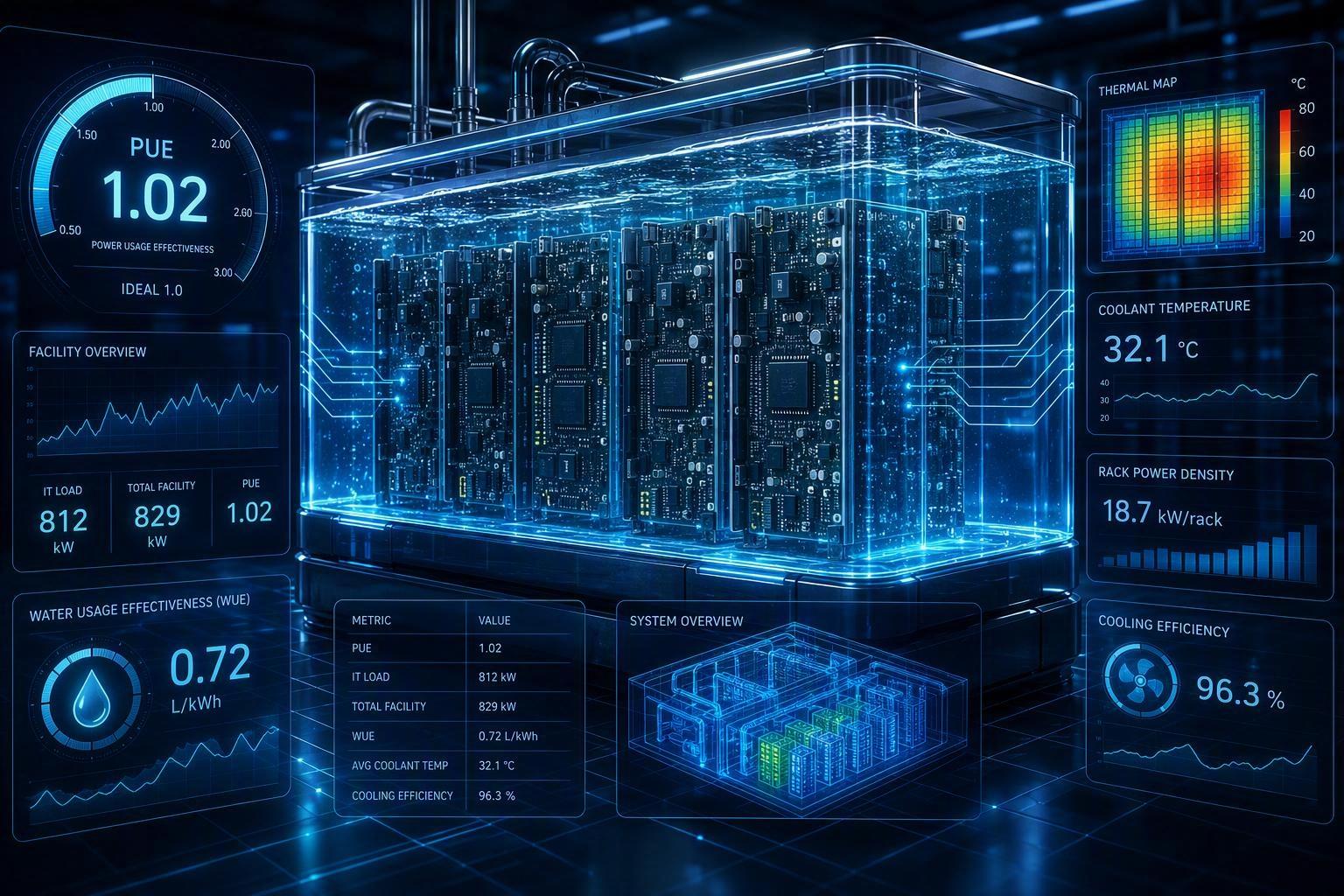
Water and sustainability metrics shift. Data centers with dry-cooler-based closed-loop CDU systems can achieve near-zero water consumption for IT cooling. Facilities relying on evaporative cooling towers add water consumption that grows with IT load. As rack densities climb and liquid cooling becomes the dominant heat removal path, the choice of CDU topology directly affects WUE and sustainability reporting.
The direction of infrastructure development is clear: higher voltage DC distribution, liquid-assisted thermal management at the rack level, and tighter integration between what was previously the facilities side of the house and the IT side. Operators planning new capacity in 2026–2028 will be making decisions that define their facility’s capability for the next decade.
The Compal-Exascale validation platform and the AirJoule-BitSink acquisition are both early markers of the ecosystem forming around that architecture. The validation work being done now, specifically standards alignment, certification testing, and supply chain development, will determine how quickly that infrastructure becomes accessible at production scale.
For operators running facilities today, the practical near-term work is assessment: which rows are candidates for liquid cooling augmentation at current density, which power panels have headroom for higher-density AI blocks, and which facility water systems can support the CDU supply parameters that direct-to-chip cooling requires. Understanding how hybrid cooling and modular AI data center design interact with different deployment timelines is the starting point for that assessment.
Sources and Further Reading
The figures and announcements cited in this article come from the following primary and independent sources. Where a figure originates from a vendor rather than an independent analyst, this is noted.
AFCOM, State of the Data Center Report 2026 (average rack density, 16 kW to 27 kW year over year).
Uptime Institute, 16th Annual Global Data Center Survey (2026) — modal rack density at 11 kW.
TrendForce press releases, August 2025 and August 2026 (liquid cooling penetration figures; note that the 2025 and 2026 figures use different denominators).
Mordor Intelligence, Rack-Scale GPU Infrastructure Market and Data Center Liquid Cooling Market reports.
Dell’Oro Group, Data Center Liquid Cooling Market forecast (market approaching $7 billion by 2029).
Enverus Intelligence Research, 800 VDC | The Voltage Shift That Rewrites AI Power Economics (June 2026) — independent analyst model showing roughly 13% capex reduction.
Direct Power Alliance, An 800 VDC AI Factory whitepaper, Version 1.1 (June 2026) — neutral consortium reference architecture.
NVIDIA, 800 V HVDC architecture guidance and OCP-aligned whitepapers (vendor-published architecture targets).
Texas Instruments press release, March 2026 (800V-to-6V bus converter efficiency, co-developed with NVIDIA).
Delta Electronics, STMicroelectronics, and Infineon/SolarEdge product announcements (vendor-published SST efficiency claims).
Exascale Labs and Compal Electronics joint letter of intent announcement, September 14, 2026.
AirJoule Technologies / BitSink acquisition announcement, September 10, 2026.
Schneider Electric AI factory reference design guidance and 5 Principles for 800 VDC in AI Data Centers (March 2026).
Data Center Dynamics whitepapers and analyses on 800 VDC protection and cooling adoption phases (July 2026).
A note on evidence quality: efficiency and TCO figures from equipment vendors describe best-case performance under controlled conditions; independent analyst models and cross-vendor benchmarks are generally more conservative. This article presents both and flags which is which where the distinction matters.
Last updated: September 15, 2026. This article synthesizes publicly available analyst reports, vendor announcements, and standards documents; it does not contain original laboratory testing.
Want a structured assessment of your current facility’s readiness for high-density AI workloads? Request a power and cooling capacity review from a qualified data center infrastructure specialist.