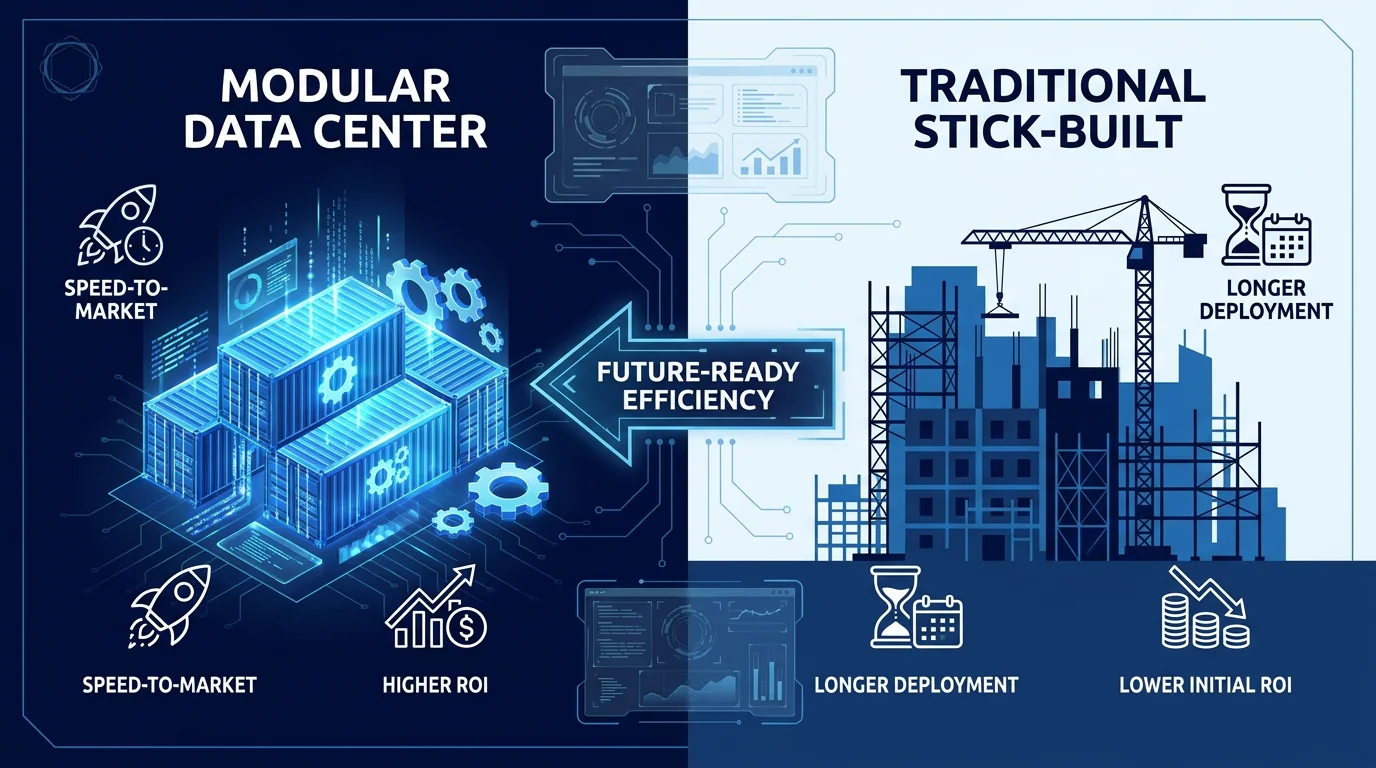
Key Takeaway: Integrated micro data centers transform edge computing by replacing multi-year site civil construction with pre-engineered, factory-tested enclosures. Combining UPS power, precision cooling, physical security, and remote DCIM monitoring into a self-contained module reduces deployment timelines from 12–36 months down to 8–24 weeks, lowers capital expenditure by up to 42%, and ensures predictable operational resilience across remote sites.
Table of Contents
ToggleIntroduction
As data processing shifts from centralized hyperscale clouds to distributed edge nodes, traditional infrastructure engineering faces an existential velocity bottleneck. Multi-access Edge Computing (MEC), industrial Internet of Things (IoT), and real-time video analytics demand processing capabilities located within milliseconds of end devices. However, building traditional brick-and-mortar server rooms at dozens or hundreds of distributed edge locations introduces massive schedule risk, complex multi-vendor management, and unpredictable capital costs.
An integrated micro data center (MDC) solves this challenge by packaging an entire data center facility—uninterruptible power supply (UPS), precision thermal management, power distribution, physical security, and remote monitoring—into a standardized, factory-built enclosure. Instead of constructing a dedicated facility on site, infrastructure teams deploy a self-contained, plug-and-play computing module.
According to a Schneider Electric cost-benefit analysis, micro data center architectures reduce capital expenses by up to 42% compared to traditional site builds while delivering a 20% to 30% reduction in total cost of ownership (TCO). By shifting integration and testing from the field into controlled factory environments, organizations achieve faster time-to-value, repeatable operational standards, and lower risk across every edge footprint.
This standardized approach benefits four key edge stakeholders:
Telecommunications operators: Deploying 5G User Plane Functions (UPF) and cell tower base station computing.
Smart city municipalities: Processing local traffic sensors, public safety video feeds, and municipal data locally.
Utilities and industrial OT-IT teams: Running supervisory control and data acquisition (SCADA) systems and industrial AI in harsh plant environments.
Enterprise IT teams: Standardizing infrastructure across retail branches, healthcare facilities, and regional logistics hubs.
What Is an Integrated Micro Data Center
Core components and architecture
An integrated micro data center is a fully self-contained computing environment designed to support critical IT loads typically ranging from 3 kW to 100 kW within a unified physical footprint. Unlike standard server racks that rely on external room HVAC and building power panels, an MDC incorporates all supporting facility subsystems directly into or alongside the rack cabinet.
The core architecture comprises five essential engineering subsystems:
Sealed Physical Enclosure: A heavy-duty steel cabinet engineered with thermal isolation, acoustic damping, and environmental seals to shield sensitive servers from dust, humidity, and physical tampering.
Power Distribution and Protection: An integrated online double-conversion UPS paired with lithium-ion or high-density VRLA battery banks, coupled with intelligent rack Power Distribution Units (rPDUs) that provide outlet-level metering and remote power cycling.
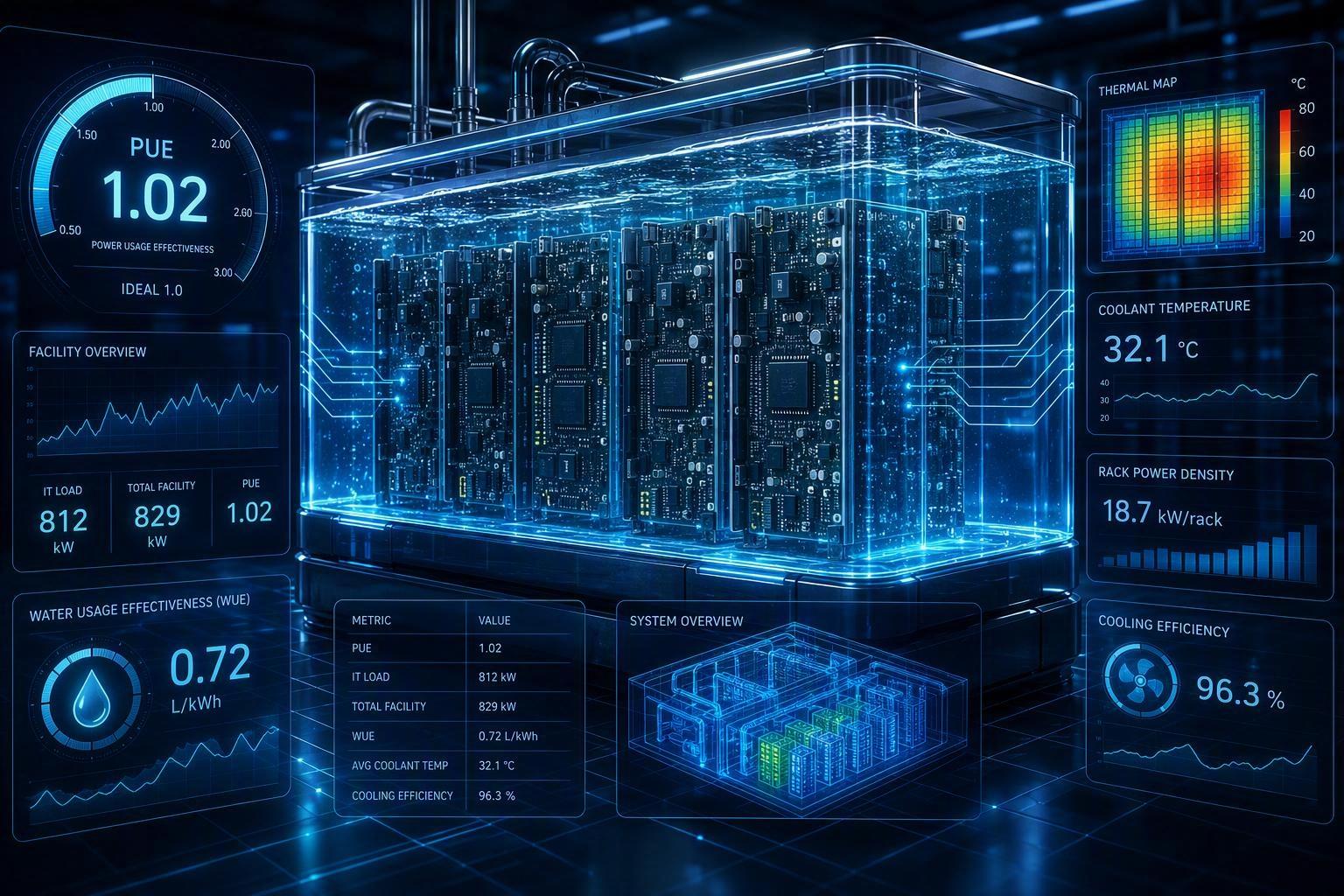
Precision Thermal Management: Direct-expansion (DX) closed-loop cooling units or liquid-to-chip heat exchangers mounted inside or adjacent to the rack. These systems deliver targeted air or fluid flow directly to server intakes, maintaining optimal operating temperatures and lowering Power Usage Effectiveness (PUE) to between 1.2 and 1.4.
Physical Security and Fire Protection: Integrated multi-factor access control handles (smart card or biometric keypad), internal IP surveillance, and automated gas-based fire suppression systems (such as Novec 1230 or FM-200) that extinguish fires without liquid damage.
Environmental Monitoring and DCIM: Centralized sensor controllers that track ambient cabinet temperature, humidity, liquid leaks, door status, and power quality, sending real-time telemetry to centralized Data Center Infrastructure Management (DCIM) software.
How integration accelerates deployment
In a conventional site-built server room, engineers must separately source, mount, wire, pipe, and configure hardware from five to ten different vendors. Electricians wire the wall panels, HVAC technicians run external refrigerant lines, security vendors install standalone door locks, and network engineers set up out-of-band monitoring controllers. Any component delay or wiring mismatch halts the entire project.
Factory pre-integration eliminates this field friction. As highlighted in prefabricated modular data center engineering benchmarks, performing assembly and Factory Acceptance Testing (FAT) under controlled manufacturing conditions ensures that every power feed, cooling loop, and sensor is pre-commissioned before shipment.
When the enclosure arrives on site, field technicians simply anchor the cabinet, connect utility power and network uplinks, and load the servers. This factory-first model eliminates complex field engineering and guarantees repeatable quality across hundreds of remote installations.
Fit for environments (indoor, outdoor, ruggedized)
Integrated micro data centers are built to operate across diverse environmental envelopes:
Indoor Office & Retail Closets: Compact single-rack cabinets featuring built-in sound attenuation (reducing noise to below 50 dBA) and integrated precision cooling. These units fit into standard commercial offices or retail backrooms without requiring dedicated mechanical HVAC infrastructure.
Outdoor Edge Sites: Heavy-duty, double-walled weatherproof enclosures rated to IP55, IP65, or NEMA 4X standards. Equipped with anti-corrosion coatings, sun shields, and internal heating elements, these units operate reliably across extreme temperature ranges from -40°C to +50°C.
Ruggedized Industrial Floors: Reinforced cabinets equipped with shock absorption mounts, vibration isolation, and positive-pressure air filtration to protect compute equipment in dust-heavy manufacturing plants, mining operations, and power substations.
Deployment Playbook and Site Readiness
Timeline compression and commissioning
The primary driver for choosing an integrated micro data center over a traditional brick-and-mortar build is rapid time-to-market. A site-built room requires sequential execution: architectural design, civil permitting, room construction, electrical rough-in, HVAC installation, and on-site testing—a process that typically spans 12 to 36 months.
By contrast, prefabricated MDCs decouple civil site preparation from infrastructure manufacturing. While site civil teams pour concrete pads and drop utility lines, the factory constructs, wires, and pre-tests the MDC module in parallel.
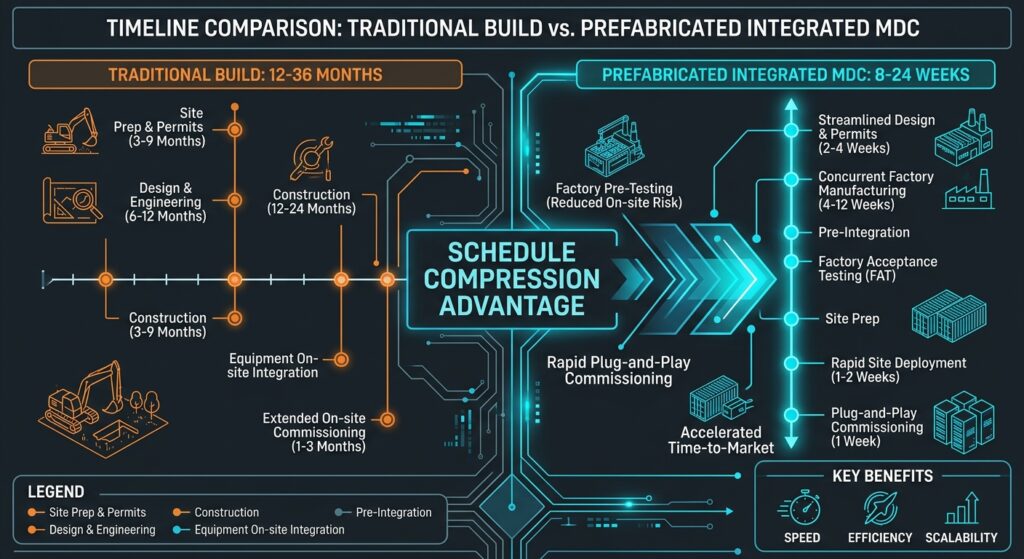
As shown in the timeline comparison above, parallel workflows compress the total deployment lifecycle down to 8 to 24 weeks:
Weeks 1–4 (Design & Procurement): Selection of standardized MDC SKUs, final site survey, and electrical permitting.
Weeks 5–12 (Parallel Execution):
Factory Phase: Cabinet assembly, UPS installation, cooling loop pressure testing, and factory burn-in.
Site Phase: Slab preparation, main breaker installation, and fiber drop installation.
Weeks 13–16 (Delivery & Drop-in): Transit, crane or pallet positioning, electrical connection, and network uplink termination.
Weeks 17–20 (Server Loading & Go-Live): IT equipment mounting, final remote DCIM verification, and live service commissioning.
Site prerequisites and utilities
Although an MDC dramatically simplifies on-site civil scope, successful deployment requires verifying key physical prerequisites prior to arrival:
Floor & Slab Loading: Ensure the floor or concrete foundation supports the total weight of the loaded MDC. A fully equipped dual-rack MDC with UPS batteries and cooling compressors can weigh between 1,200 kg and 2,500 kg (2,600 to 5,500 lbs), requiring slab capacities verified against local structural codes.
Electrical Feed & Redundancy: Verify the availability of single-phase or three-phase power drops with sufficient amperage (typically 30A to 63A per feed). High-availability edge sites require dual independent feeds (A+B power paths) connected to upstream automatic transfer switches (ATS) or standby diesel generators.
Thermal Heat Rejection Paths: For direct-expansion (DX) air-cooled units, plan the heat rejection path. Split-system MDCs require external condenser placement within maximum piping distance limits, while self-contained monoblock units require clear hot-air ducting or room exhaust ventilation.
Network & Out-of-Band Uplinks: Confirm redundant fiber or 5G/LTE wireless WAN connections for out-of-band management and data transmission.
To streamline site prerequisites, standardized solutions like Coolnetpower‘s MetaRack Smart Micro Data Center illustrate how pre-engineered architectures integrate precision DX cooling, online UPS power, emergency heat exhaustion, and environmental monitoring within a single rack footprint. This self-contained approach minimizes complex on-site utility ducting and allows rapid drop-in installation wherever standard power and network drops exist.
Remote operations, DCIM, and security
Because most edge micro data centers operate as lights-out, unmanned facilities, continuous remote visibility and automated security controls are mandatory.
Centralized DCIM & Telemetry: Remote engineers manage hundreds of distributed MDCs through unified dashboard management using open industrial protocols (SNMP v3, Modbus TCP, MQTT). DCIM software aggregates metrics such as rack inlet/outlet temperature, humidity, power factor, battery health, and cooling compressor runtime.
Automated Alerting & Thresholds: Multi-tier alert rules trigger immediate notifications via SMS, email, or webhook when metrics breach normal operational bands (e.g., rack temperature exceeding 27°C or water leak detection).
Physical Access Control & Audit Trails: Electronic door locks restrict physical access to authorized personnel using RFID smart cards, PIN codes, or mobile credentials. Every door opening event is logged in the DCIM audit trail alongside synchronized video snapshots from the cabinet’s internal camera.
Emergency Protection & Fail-Safe Controls: Integrated controllers include automated emergency fan venting. If primary cooling fails and internal temperatures exceed critical limits, emergency exhaust fans activate automatically to draw ambient room air through the cabinet while sending an emergency shutdown signal to non-essential IT loads.
Use Cases and ROI at the Edge
Telecom edge and 5G/MEC
The deployment of 5G standalone networks relies on pushing compute capabilities closer to cell towers to support ultra-reliable low-latency communications (URLLC). In Vertiv’s micro data center architecture guide, MDCs are highlighted as key enablers for supporting 100 kW to 150 kW localized computing nodes at network aggregation sites.
By placing an outdoor-rated MDC directly at a cell tower base station or regional switching center, telecom operators host virtualized Radio Access Network (vRAN) software, UPF functions, and third-party MEC applications locally. This setup eliminates backhaul traffic to central cloud facilities, reduces round-trip latency to under 5 milliseconds, and cuts expensive WAN bandwidth costs.
Smart city analytics and public safety
Municipalities implementing smart city initiatives generate vast streams of high-definition video data from traffic cameras, environmental sensors, and public transit trackers. Streaming raw 4K video feeds from thousands of urban cameras back to a centralized cloud consumes prohibitive network bandwidth and introduces unacceptable latency for emergency response systems.
Deploying ruggedized micro data centers at traffic intersections and municipal utility hubs allows local edge servers to process computer vision algorithms locally. The MDC filters raw video feeds, executes real-time license plate recognition or incident detection within milliseconds, and transmits only lightweight metadata logs back to the central municipal database.
Utilities and industrial OT-IT
In electrical substations, oil refineries, and automated manufacturing plants, Operational Technology (OT) systems demand strict deterministic execution and high availability. Substation automation, predictive maintenance, and robotic safety controls cannot tolerate cloud connectivity drops or latency spikes.
Deploying NEMA-rated or IP55-sealed micro data centers directly on industrial plant floors protects enterprise-grade servers from conductive dust, ambient heat, and chemical exposure. Industrial engineers converge OT SCADA systems with IT analytics locally, maintaining full operational autonomy even during WAN network isolation.
Conclusion
Integrated micro data centers mark a fundamental shift in how organizations build and scale edge infrastructure. By replacing multi-vendor on-site construction with standardized, pre-engineered enclosures, MDCs eliminate schedule risk, ensure strict quality control, and deliver up to 42% CapEx savings over site-built facilities.
Whether deploying 5G computing at remote cell towers, AI analytics in smart cities, or industrial automation on manufacturing floors, factory-integrated MDCs provide the speed, security, and operational predictability needed for modern edge workloads.
Evaluation Checklist for Edge Infrastructure Planners
Before selecting an integrated micro data center solution, infrastructure teams should evaluate candidates against seven core technical criteria:
Power Density & Capacity: Does the cabinet support required IT densities (kW/rack) with adequate UPS runtime and N+1 or 2N electrical redundancy?
Cooling Architecture: Is the thermal management system (DX air or liquid-to-chip) sized for peak heat loads with variable inverter compressors to optimize PUE?
Environmental Ingress Rating: Does the enclosure match the target environment (IP20/IP32 for indoor office; IP55/IP65 or NEMA 4X for outdoor/industrial)?
Physical & Environmental Security: Are multi-factor electronic locks, camera integration, and gas-based fire suppression built-in?
DCIM & Open Protocols: Does the remote management controller support open protocols (SNMP, Modbus, REST APIs) for seamless integration with existing central management platforms?
Compliance & Certifications: Does the prefabricated module comply with relevant safety and performance standards (e.g., TIA-942, UL2416, CE)?
Deployment & Lifecycle Support: Is the solution backed by comprehensive factory integration, factory acceptance testing, and global on-site field maintenance support?
To explore how pre-engineered micro data center architectures can accelerate your edge infrastructure rollout, review available cabinet configurations and thermal options from Coolnetpower.