Table of Contents
ToggleKey takeaways
A micro data center (MDC) is a compact, self-contained “mini facility” that bundles IT equipment (compute/storage/network) plus supporting infrastructure (power protection, cooling, monitoring, and often physical security) into a small footprint.
Adoption is rising because edge workloads (real-time inference, caching, OT-adjacent analytics, 5G/MEC) need compute closer to where data is generated—and many sites can’t justify a full facility build.
For IDC project directors, the real value is often schedule and risk control: repeatable design, factory integration, and clearer commissioning boundaries across many distributed sites.
The trade-off is that “small” doesn’t mean “simple”: unattended operation makes monitoring, security, serviceability, and acceptance testing first-class requirements.
What is a micro data center (MDC)?
A micro data center (MDC) is a compact, self-contained computing environment that integrates the core functions of a traditional data center—compute, storage, networking, plus supporting infrastructure like power and cooling—into a small enclosure or tightly packaged footprint.
In the rest of this article, I’ll use “MDC” as shorthand for micro data center.
There isn’t a single universal size definition across the industry. What’s consistent is the intent: make a deployable, repeatable unit that can be installed close to the workloads it serves, especially at the edge. Industry glossaries and vendor explainers converge on the same idea: integrated infrastructure in a compact form factor designed for distributed deployments (see Sunbird’s micro data center definition and Data Center Knowledge’s practical guide to MDCs).
What’s inside an MDC (and what’s optional)
Most MDCs follow a simple principle: bundle the dependencies so the unit can run reliably with minimal site work.
Core components you should expect
A cabinet-scale deployment typically includes:
IT stack: servers (and sometimes accelerators), storage, and networking
Power chain (rack scope): input distribution, rack PDUs, and usually UPS or power conditioning
Thermal management: a rack-level or enclosure-integrated cooling approach appropriate to the site
Monitoring and management: sensors, alarms, remote visibility, and basic control/telemetry
Vertiv’s explainer provides a concrete component list for a “single-rack” configuration (UPS, rack PDU, rack cooling, and monitoring) in What Is a MDC?.
“Optional” features that become baseline at the micro edge
In distributed edge deployments—especially where sites are unattended—the following “options” quickly become baseline:
Physical security (locks, access logging, tamper detection)
Environmental sensing (temperature/humidity at multiple points, smoke/leak where relevant)
Remote operations (out-of-band access, alarm forwarding, role-based access)
Serviceability design (how filters, fans, batteries, and modules are accessed and replaced)
Key Takeaway: In edge programs, “micro” describes footprint—not the consequences of failure. Design the cabinet like a tiny critical facility, not a beefed-up network closet.
Why MDCs are reshaping edge computing
Edge computing is shifting from “nice-to-have locality” to production requirements: real-time AI, distributed analytics, and availability expectations that look much closer to data center workloads than branch-office IT.
1) Latency is becoming a facilities requirement, not just a network metric
When workloads are latency-sensitive (industrial control loops, near-real-time inference, local decisioning), pushing compute closer to the data source reduces round-trip delays. LF Edge’s ecosystem review frames this as a broader trend: edge is becoming a core part of AI deployment strategies (LF Edge: 2025 Year in Review and What’s Ahead in 2026).
2) Bandwidth and backhaul costs change the architecture math
Many edge sites exist because “send everything to the core” is too expensive, too slow, or too unreliable. Local processing filters, aggregates, and retains data so only what’s necessary travels upstream.
3) Unattended operation is normal
Equinix’s edge taxonomy is useful for stakeholder alignment: “micro edge” is typically very small and unstaffed, which changes how you should think about operations, alarms, and recovery workflows (Equinix: digital edge vs mobile edge vs micro edge).
For an IDC project director, the implication is practical: your design must assume failures happen when nobody is present.
4) Standardization helps when you’re building many sites quickly
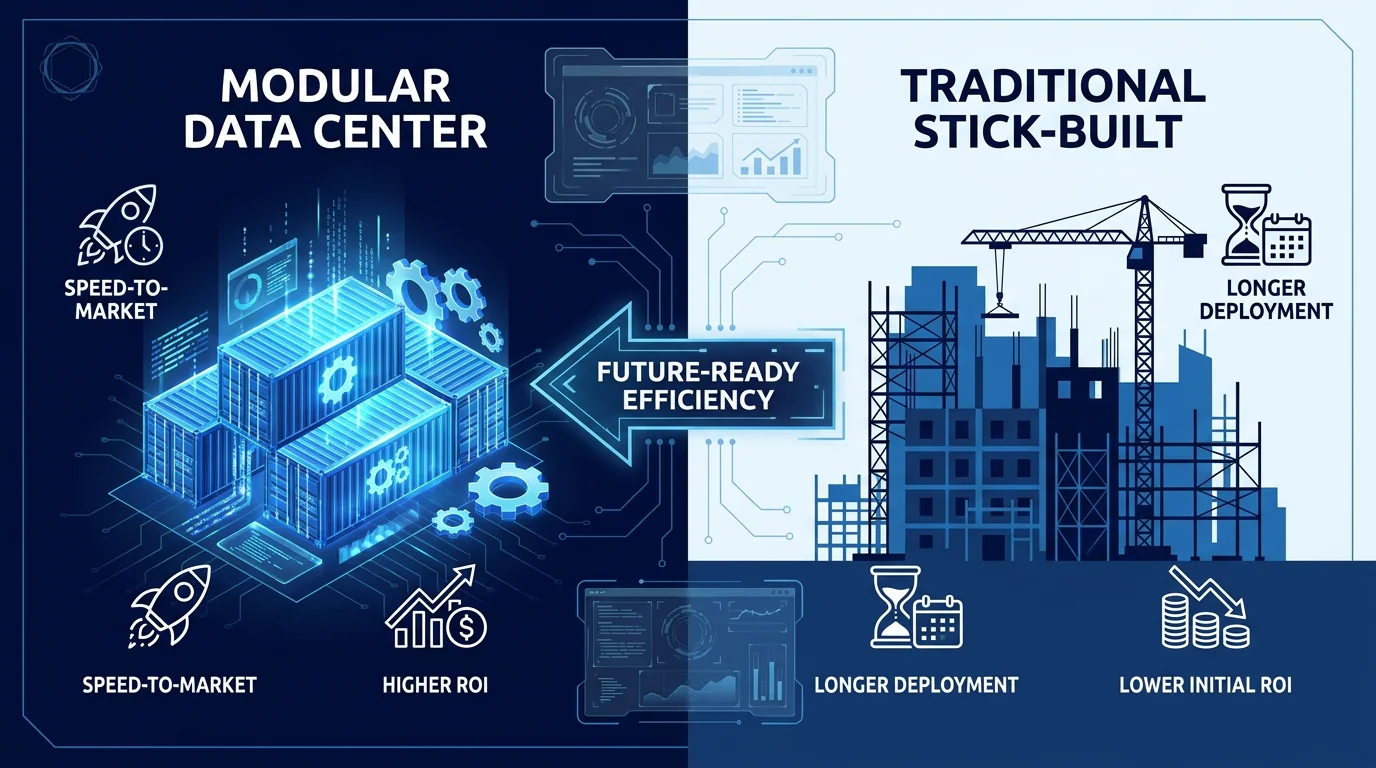
Edge programs scale by replication. In practice, teams often end up choosing between a cabinet-scale MDC and a modular micro data center approach depending on site constraints and growth assumptions. The infrastructure advantage is less about “one perfect cabinet” and more about the ability to:
stamp a repeatable reference architecture across regions
reduce integration ambiguity between vendors
tighten the acceptance/commissioning scope
This is why edge computing infrastructure discussions increasingly include cabinet-scale MDCs and modular micro data center patterns.
Edge data center vs MDC vs modular DC vs traditional DC
The terms are often mixed in meetings. This section is a quick alignment tool for the common debate: edge data center vs micro data center—and where modular builds and traditional facilities sit in the same landscape.
Concept | Typical scope | Typical footprint | Operational model | Best fit when… |
|---|---|---|---|---|
Micro data center | Self-contained rack/cabinet or tightly packaged mini facility | Small (often 1 rack; sometimes a small pod) | Often unattended; remote monitoring is critical | You need repeatable, distributed deployments and fast time-to-service |
Edge data center | A small facility near users/devices (can include multiple racks/rooms) | Small-to-medium | May be lightly staffed or visited periodically | You need more capacity than a cabinet and want local autonomy |
Modular data center | Prefabricated modules (IT/power/cooling) assembled as a facility | Medium-to-large (site-specific) | Facilities-like operations | You need rapid build but at larger scale than “micro” |
Traditional data center build | Custom facility project | Large | Full facilities operations | You need long-term scale and custom integration across many systems |
If you want a practical deployment narrative, this internal roadmap is a useful reference for scoping and sequencing: rapid edge data center deployment roadmap.
When an MDC is a good fit (and when it isn’t)
Good fit patterns
A cabinet-scale approach is usually a good fit when:
you’re deploying to space-constrained sites (substations, telco PoPs, compact enterprise facilities)
the workload needs local autonomy (tolerate upstream link issues without immediate outage)
you value repeatability across many sites more than bespoke optimization at one site
you can define a clear acceptance evidence pack (what tests prove it’s ready for production)
Red flags
Consider stepping up to a larger edge facility or modular build when:
the site will quickly exceed the cabinet’s thermal or electrical envelope
you need significant on-site expansion headroom and multiple future IT generations
the operational model requires frequent hands-on changes (high-touch O&M)
the regulatory/compliance requirements require facility features that don’t map cleanly to an enclosure approach
⚠️ Warning: The fastest way to create SLA risk is to treat an edge cabinet like “IT gear in a box,” then discover late that your security, monitoring, or commissioning evidence isn’t audit-ready.
A planning checklist for IDC project directors
Use this as an early scoping checklist. The point is to surface constraints before the design is locked.
Site and utilities
What is the realistic power feed at this location (and what is the timeline risk to get it)?
Do you have constraints on delivery access, lift plans, and service clearance?
What ambient conditions will the unit face (heat, dust, humidity), and is the enclosure designed for that?
Thermal and power assumptions
What steady-state and peak kW per rack are you designing for, and what’s the growth plan?
What is the failure plan for thermal excursions (how long can you tolerate “allowable” conditions)?
Have you defined redundancy intent clearly (N, N+1, 2N) and aligned it with business impact?
For a deeper rack-level sizing mindset, this internal article is a good next read: power and cooling per rack for AI edge.
Monitoring, security, and operations
What are the alarm thresholds and escalation paths (and who is on call)?
Do you have out-of-band access for remote recovery?
What is the physical security model (keys/badges, audit trails, tamper alarms)?
What is the serviceability plan for batteries, filters, fans, and swap parts?
Commissioning and acceptance evidence
Do you have an Owner’s Project Requirements (OPR) and Basis of Design (BOD) that cover edge-specific assumptions?
What are the acceptance tests (power transfer, thermal stability, alarm forwarding, remote access)?
What evidence must be delivered at handover (FAT/SAT reports, as-builts, labeling, training, spares)?
Standards and frameworks: how to reference them safely
Implementations vary widely, so it’s safer to frame standards as references you map to rather than boxes you automatically “check.”
A pragmatic approach for global IDC programs is to pick:
one facilities framework as a backbone reference (Europe often uses EN 50600; globally ISO/IEC 22237 is commonly referenced)
one availability/resilience classification reference (often Uptime Institute tier concepts)
thermal/environmental guidance (ASHRAE thermal guidance as a reference point)
For definitions and scope, see the ISO overview for ISO/IEC 22237-1 (Data centre facilities and infrastructures — General concepts) and NEN’s overview of the EN 50600 data center standard series.
FAQ
Are micro data centers the same as modular data centers?
Not necessarily. “Modular” usually describes prefabricated building blocks that can assemble into a larger facility. “Micro” typically emphasizes a smaller, more self-contained footprint—often a rack/cabinet scope.
How many racks is a micro data center?
There isn’t a universal number. Many definitions center on single-rack/cabinet solutions, while some extend the term to small multi-rack pods. The more important factor is whether the unit is self-contained and deployable as a repeatable edge building block.
Why does edge computing make micro data centers more common?
Edge workloads often need local compute for latency, bandwidth, resilience, and data locality reasons. A compact, integrated enclosure is a practical way to deploy compute plus the supporting infrastructure where a full facility build would be overkill.
What’s the biggest early mistake teams make?
Under-scoping operations. If the site is unstaffed, you need a plan for monitoring, security, alarm escalation, remote access, and serviceability—before you scale from 2 sites to 50.
Next steps
If you’re in early planning, standardize two artifacts across deployments:
A one-page OPR that states availability, thermal, security, and operational assumptions.
A short acceptance evidence pack that defines exactly what “ready for production” means.
If you want one more internal deep dive before drafting your program standards, see: (Coolnetpower publishes several practical references in this area.) micro data centers for edge computing guide.