Introduction
Archives and laboratories don’t need “comfort cooling.” They need environmental control that is repeatable, measurable, and defendable—because temperature and moisture are failure mechanisms, not minor inconveniences.
In practice, a constant temperature and humidity air conditioner (often shortened to CTH AC) is a precision HVAC system designed to hold tight temperature and moisture limits across 24/7 operation—despite outdoor weather swings, variable occupancy, ventilation requirements, and internal heat/moisture loads.
You’ll see this category described in specs as archive temperature and humidity control or precision humidity control—because the point is repeatability, not comfort.
That engineering focus shows up in outcomes that matter to program owners and auditors: preservation of collections and samples, fewer compliance surprises, reduced downtime risk, and more stable processes.
Key takeaways
Stability is the goal: in many archive scenarios, limiting temperature/RH swings protects materials as much as the absolute setpoint.
Tight humidity control usually requires dehumidification below dew point + reheat, plus humidification when conditions get too dry.
In labs and cleanrooms, targets must be paired with validation: sensors, calibration, alarms, and documented acceptance tests.
Environmental Targets
Archives: Setpoints and Stability
Archive targets depend on what you store (paper, film, photographs, magnetic media, mixed collections), how often the space is accessed, and whether you’re prioritizing longevity, access, or both.
Two principles are widely consistent:
Keep relative humidity out of the danger zones.
Minimize fluctuations. Dimensional movement from RH swings (expansion/contraction) is a real damage pathway for many organic materials.
A practical starting band for mixed collections is often described as roughly cool to moderate temperatures with moderate RH, then tightened based on material sensitivity and building capability. Preservation organizations also emphasize that “ideal” numbers are less useful than a stable, controlled environment you can maintain reliably—especially in real buildings with seasonal loads and energy constraints. See NEDCC’s guidance in “Temperature, Relative Humidity, Light, and Air Quality: Basic Guidelines for Preservation” and the U.S. National Archives view in “Realistic Preservation Environment”.
Labs and Cleanrooms: Ranges and Validation
Laboratories and cleanrooms are different: you’re not only protecting stored assets—you’re protecting process integrity.
In general labs, temperature/RH control supports repeatability (instrument drift, weigh scales, incubation conditions) and prevents condensation or static issues.
In cleanrooms, environmental control also supports particle control and room-to-room containment via pressure differentials. ISO classification is primarily based on particle concentration, but cleanroom operations typically pair classification with defined monitoring and control strategies. A practical overview of environmental monitoring expectations is discussed in a cGMP cleanroom environmental monitoring review (PMC, 2024).
The core operational point: for labs, “target ranges” are only credible when paired with validation evidence—sensor placement, calibration records, alarm history, and commissioning/qualification documentation.
Risks at Extremes: Mold >60% RH; Brittleness <30% RH
Humidity is where many projects fail, because it’s easy to control temperature “on paper” while losing the moisture battle in real operation.
High humidity risk: Mold risk rises materially when RH climbs above ~60% for sustained periods; preservation guidance treats this as a key threshold to avoid.
Low humidity risk: Below ~30% RH, many organic materials become more brittle and damage-prone; the exact limit depends on the substrate, adhesives, and the stress of fluctuations.
Those thresholds are a useful starting point for alarm philosophy: design the control band so normal variation never approaches the thresholds, then set alarms with enough early warning to act before you cross them.
Technology and Control
Dehumidification + Reheat for Tight RH
If you need tight RH, you generally can’t rely on “cooling only.” The common control sequence is often described as dehumidification with reheat:
Dehumidify by cooling below dew point: Air passes over a cooling coil cold enough to condense moisture.
Reheat to hit supply/space temperature: The air is now dry but too cold; reheat raises temperature without adding moisture.
This decouples sensible control (temperature) from latent control (moisture). Without reheat (or an equivalent strategy), systems often satisfy temperature quickly and then cycle—leaving humidity unmanaged.
From a specification standpoint, it’s helpful to request:
a clear dehumidification mode sequence (including coil leaving air conditions and reheat control logic)
condensate management design (drain, trap, overflow detection)
documented control performance under worst-case outdoor dew point conditions
Humidification, Filtration (MERV13+/HEPA), and Airflow Management
Most archive and lab environments need both sides of moisture control:
Humidification is needed when outside air is cold/dry or when dehumidification is aggressive. For labs and cleanrooms, humidification selection should consider cleanliness, water quality, maintenance access, and response speed.
Filtration should match risk:
Many controlled environments specify MERV 13+ as a baseline for fine particulate control.
HEPA becomes relevant where process/cleanliness demands justify the pressure drop and maintenance discipline.
Airflow management is not just “CFM.” It’s distribution, short-circuit avoidance, and preventing microclimates at shelves, cabinets, or instrument inlets.
Procurement tip: when filtration goes up, fan and static pressure capability must be sized accordingly—otherwise the “paper spec” won’t hold in operation.
Precision, Redundancy (N+1), Monitoring and Alarms
Precision control is as much about reliability and observability as it is about coils and compressors.
Key design expectations in mission-critical rooms:
Redundancy (often N+1): so a single unit failure or maintenance event doesn’t immediately push conditions out of limit. Procurement specs may label this explicitly as N+1 redundancy HVAC.
Monitoring at the right locations: sensors should represent the conditions the assets experience (not the warmest wall, not the easiest spot to wire).
Alarm strategy: staged alarms (warning vs critical), escalation paths, and operational playbooks.
Calibration discipline: humidity sensors drift; if you don’t calibrate, you don’t control.
Note for brand integration
In practice, teams often adapt “precision cooling” patterns from data centers to other controlled environments—because the requirement is the same: hold tight limits continuously and prove it with monitoring.
For example, Coolnetpower’s published precision AC materials describe control accuracies (temperature and humidity) in the context of their CyberMaster series, and they also discuss applying DX air conditioning approaches beyond IT rooms into laboratory environments. If you want a concrete reference point, see:
Coolnetpower’s CyberMaster Series PAC control accuracy (includes stated accuracy figures)
The important takeaway isn’t a brand claim—it’s what to request in any vendor’s submittal: defined control tolerances, sensor and alarm architecture, and commissioning evidence that the system holds limits under real loads.
Applications and Design
Archives: Storage Rooms, Cold Rooms, and Handling Areas
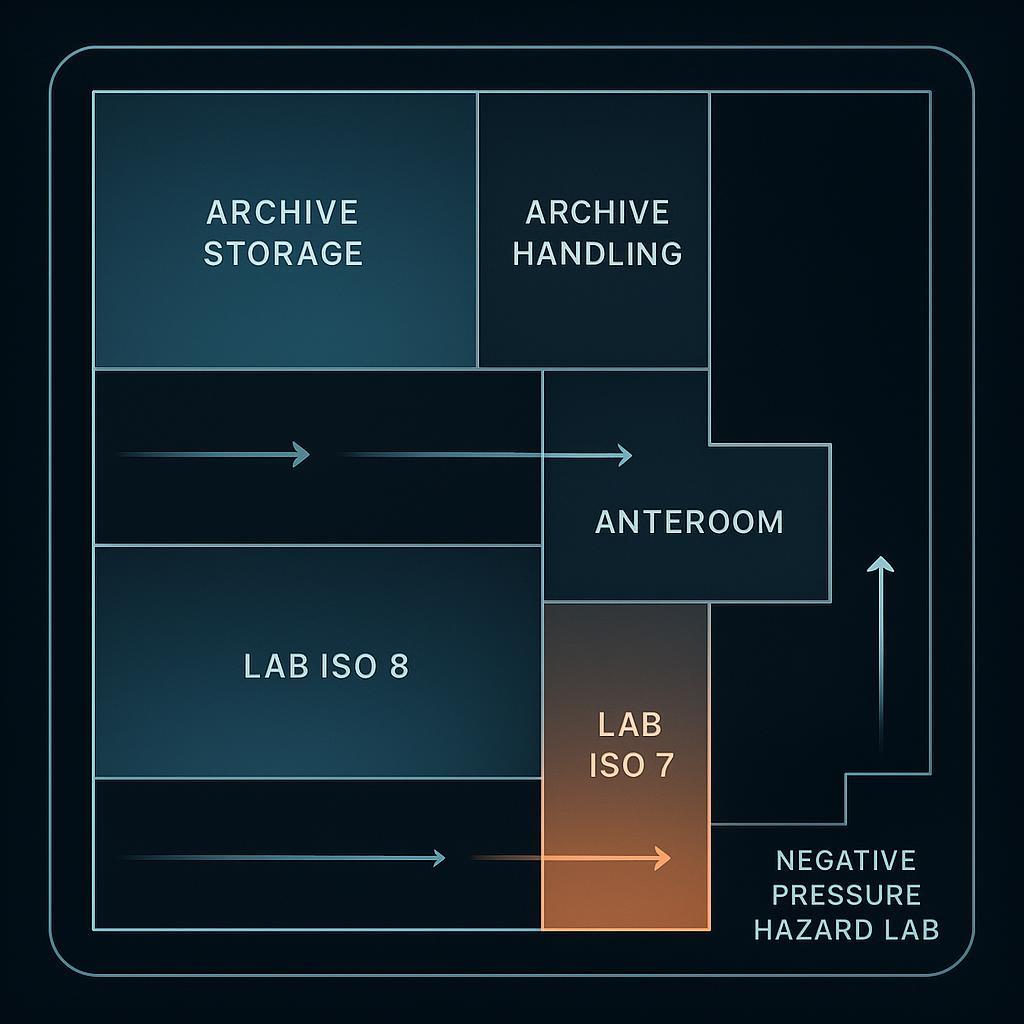
Archive environments typically need zoning by function, because the loads and door cycles differ:
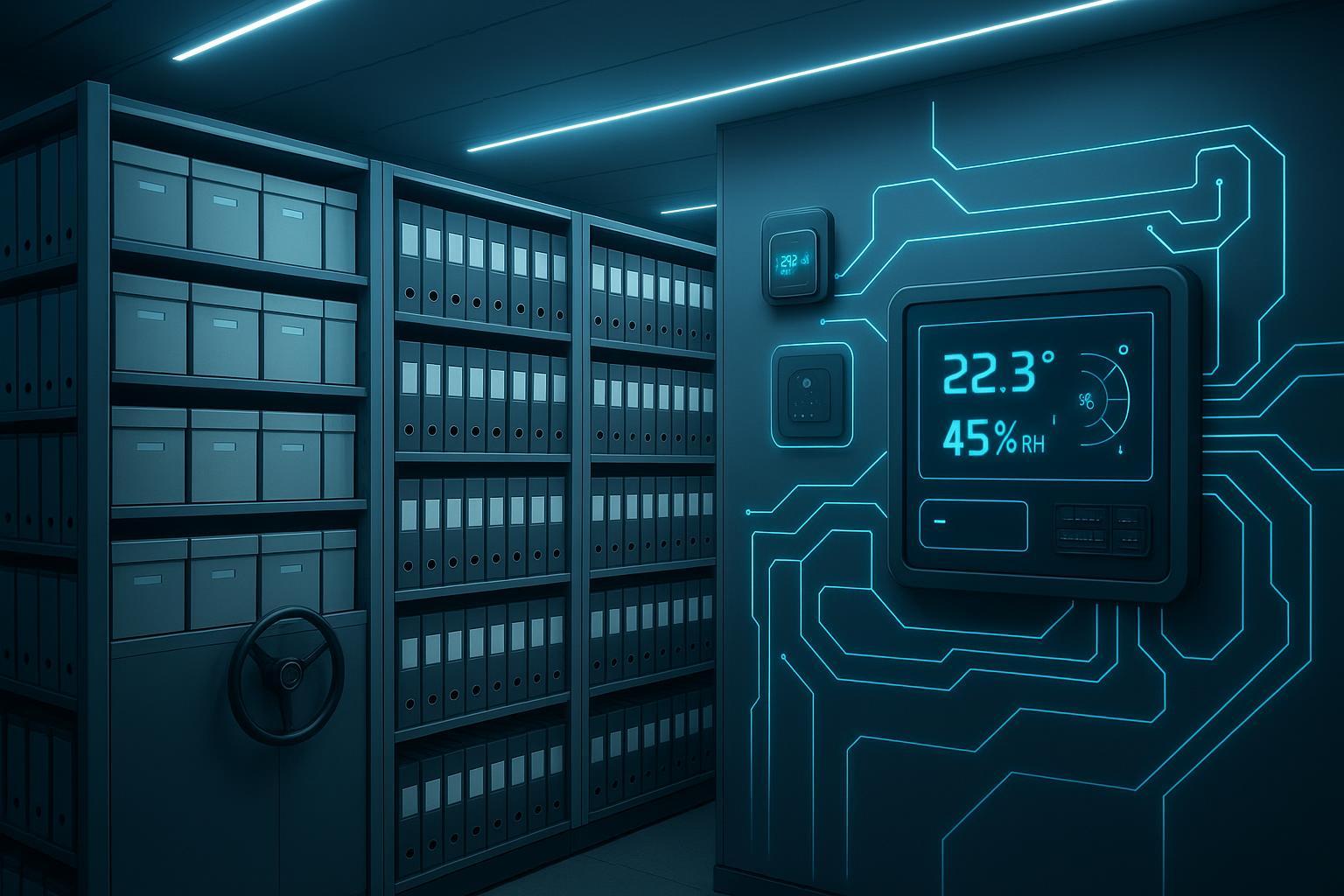
Storage rooms: lowest variability target; minimize outside air; prioritize stability and continuous operation.
Cold rooms: used for sensitive media; design must address condensation risk during access (vestibules/anterooms, controlled warm-up procedures).
Handling/reading areas: higher occupancy swings and door traffic; often benefit from separate systems so “people loads” don’t destabilize storage.
A practical design pattern is separate systems for storage vs handling, so maintenance or operational variability doesn’t propagate into the preservation-critical zone.
Laboratories: BSL, Cleanroom, and General Lab Zones
Laboratory zoning is driven by containment, cleanliness, and ventilation—not just temperature.
General labs: stable conditions support repeatability; ventilation requirements (and exhaust) can dominate energy and humidity load.
Cleanrooms: require pressure cascades, filtration strategy, and airflow distribution aligned to the cleanliness class.
BSL or hazardous labs: often require negative pressure, dedicated exhaust paths, and strict monitoring—making them mechanically distinct from clean (positive pressure) spaces.
This is why “one HVAC system for everything” is a common failure mode: you end up compromising both stability and containment.
Selection and Commissioning Checklist
Use this as a procurement-friendly checklist to move from “we want stability” to verifiable requirements:
Define environmental targets by zone: temperature, RH (or dew point), and allowable rate-of-change.
Clarify what ‘stability’ means: maximum short-term excursions and seasonal drift policy.
Specify the humidity control sequence: dehumidification method, reheat approach, humidifier type, and control logic.
Confirm filtration and pressure drop: required MERV/HEPA level and fan/static capability.
Plan ventilation explicitly: outside air volume, how it’s conditioned, and how doors/traffic affect control.
Redundancy model: N, N+1, lead/lag rotation strategy, and what happens during maintenance.
Monitoring points: sensor locations (supply/return/space), representativeness, and number of sensors per zone.
Calibration plan: intervals, documentation, and acceptance criteria for sensor drift.
Alarm philosophy: warning/critical thresholds, notification routes, response SLAs, and trend reporting.
Commissioning tests: step tests (door openings, load changes), failure simulations (unit offline), and report deliverables.
Conclusion
A constant temperature and humidity air conditioner is less about “comfort” and more about engineered control: stable setpoints, validated sensing, and failure-tolerant operation.
Key takeaways are simple but non-negotiable: design for stability first, build monitoring you can trust (including calibration), and use engineered redundancy so one fault doesn’t become a preservation or quality event.
Next steps are straightforward: confirm zone targets, specify the humidity-control features and alarm requirements that make those targets achievable, then plan commissioning tests and alerting before the room goes live.