Table of Contents
ToggleIntroduction
Why modular UPS for enterprise data centers matters in 2026
Enterprise data centers are being asked to do two things at once: scale faster and fail less. That’s harder than it sounds when your load profile is no longer a smooth ramp—AI training bursts, dense clusters, and fast tenant onboarding can turn “steady-state” into a series of step changes.
Modular UPS architectures are increasingly chosen because they let you match capacity to actual ramp plans, add redundancy without a full rip-and-replace, and reduce maintenance downtime risk—if (and only if) the design is specified properly.
How this guide helps you select modular UPS for enterprise data centers
This guide is written as a procurement tool. It focuses on decisions you can defend in design reviews and in an RFP: topology class, redundancy model, part-load efficiency, battery chemistry, maintainability, monitoring integration, standards evidence, and 10‑year total cost of ownership.
What you will evaluate: availability, efficiency, batteries, maintainability, compliance, TCO
You’ll evaluate six areas:
Availability and redundancy (N, N+1, 2N) and what they mean in real one-line designs
Efficiency at partial load, including eco modes and module sleep behaviors
Battery strategy, especially Li‑ion vs VRLA trade-offs and lifecycle impacts
Maintainability and integration, including concurrent maintainability and open protocols
Compliance evidence in a UK/EU context (EN 50600 and EN/IEC 62040)
10‑year TCO and procurement controls, including FAT/SAT and lead-time risk handling
Architecture and redundancy
In this section, we’ll keep the discussion anchored to what you can specify, verify, and test when procuring modular UPS for enterprise data centers.
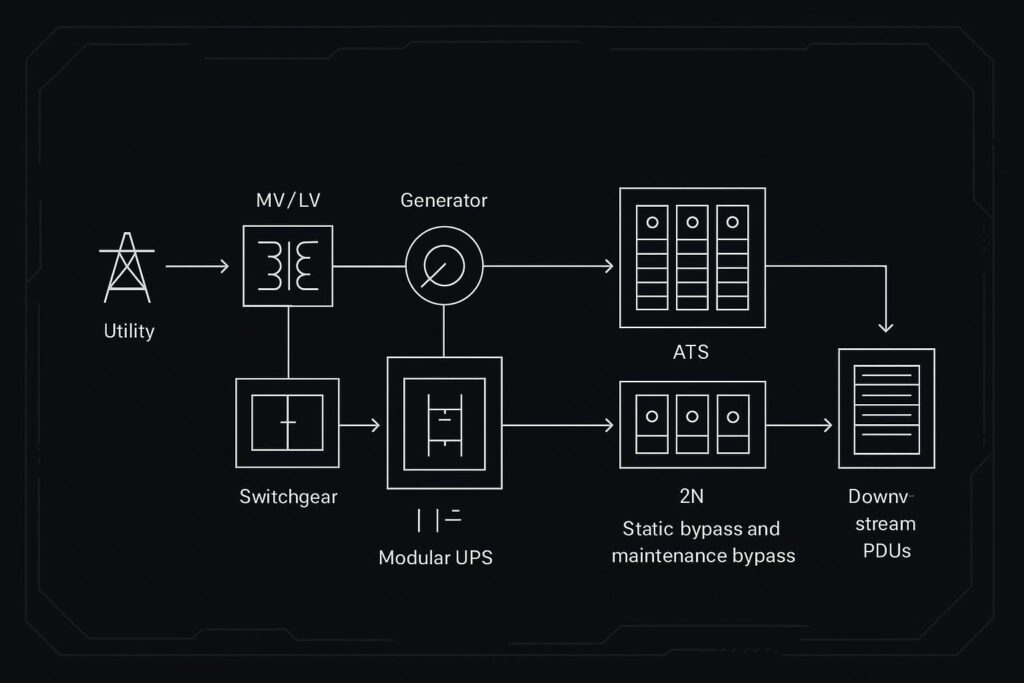
Topology and IEC 62040-3 class
Start with the simplest procurement-safe question: What IEC 62040‑3 performance class is the proposed system?
IEC 62040‑3 defines performance and test requirements for UPS systems (including how they behave under disturbances and transitions) and is the standard many specifications reference for validating topology and output behavior.
For data center critical loads, you’ll often see the VFI/VI/VFD classification used in requirements language. In practical terms:
VFI (Voltage and Frequency Independent) maps to online double-conversion behavior—output is independent of both input voltage and frequency.
VI (voltage independent) and VFD (voltage and frequency dependent) typically correspond to line-interactive and offline behaviors, which are usually less aligned to high-availability enterprise facilities.
If you want a procurement-friendly reference for the terminology and classification tests, the U.S. Department of Energy’s “Test Procedure for Uninterruptible Power Supplies” (2022) summarizes how UPS architectures are classified by VFD/VI/VFI based on IEC terminology.
Key Takeaway: Make the IEC 62040‑3 class an explicit line item in your technical schedule—then verify it during FAT/SAT against the delivered configuration.
Redundancy: N, N+1, 2N
Redundancy decisions are often framed as a single question (“Do we need 2N?”), but the better procurement framing is:
What failures must we tolerate without impacting IT load? (single module, full UPS frame, upstream breaker, maintenance event)
Are we buying redundancy at the UPS only, or end-to-end across the power path?
Here’s a decision table you can reuse in an RFP discussion:
Scheme | What it means | What it buys you | Common buyer pitfalls |
|---|---|---|---|
N | Exactly the capacity required | Lowest capex and footprint | No headroom for a module failure; maintenance often means bypass exposure |
N+1 | One extra module (or block) beyond N | Tolerates a single module failure; supports live maintenance if designed correctly | N+1 at UPS doesn’t fix single points of failure elsewhere (switchgear, bypass path, downstream distribution) |
2N | Two independent full-capacity power paths | Higher fault tolerance and maintenance flexibility when paths are truly independent | “2N UPS” can still leave single points upstream/downstream; independence must be proven in the one-line |
A key procurement caveat is that redundancy must be assessed across the entire chain (not just the UPS). CoreSite highlights this end-to-end point in its overview of redundancy (see CoreSite’s note that redundancy must be evaluated end-to-end, 2021).
Scalability and AI transients
In 2026, scalability isn’t only about future MW expansion. It’s also about transient behavior:
How does the UPS behave under step-load conditions?
How does it coordinate module loading and sharing?
What happens to efficiency and harmonics when a subset of modules is lightly loaded?
For buyer due diligence, translate “AI-ready” into testable requirements:
Ask for the vendor’s recommended module loading setpoints for best efficiency and best dynamic response.
Define allowable performance during fast load changes in your FAT/SAT scripts (not just steady-state nameplate ratings).
Energy efficiency at partial load
Efficiency curves and setpoints
A single “up to 97% efficiency” number is not a buying criterion. What matters is the efficiency at your operating points over the year.
Procurement action: request an efficiency curve (typically at 25%, 50%, 75%, and 100% load) and evaluate it against your growth plan and day‑1 utilization. Modular deployments often run below nameplate early in life; a strong part-load curve can materially affect operating cost.
Module sleep and eco modes
Two common features can improve efficiency but change the risk profile:
Module sleep / hibernation: fewer active power modules at low load.
Eco modes: operating that may rely more heavily on bypass paths under specific conditions.
Treat these as operational modes that must be explicitly approved, documented, and tested. If you intend to use them, you should specify:
the conditions under which the UPS enters/exits the mode
the expected transfer behavior
the monitoring/alarms required so operations teams can see when the facility is in a reduced-protection state
Power quality and harmonics
Power quality is where “efficient on paper” can become “painful in commissioning.” For enterprise buyers, harmonics aren’t a checkbox—they affect:
upstream transformer heating and losses
generator compatibility
protection coordination and nuisance trips
Practical procurement phrasing:
require declared harmonic performance under realistic loading, not only idealized conditions
include power-quality verification steps in SAT (especially if you operate with generators or expect frequent transfers)
Battery strategy
Li-ion vs VRLA trade-offs
The battery decision is one of the highest-leverage TCO choices in a modular UPS program because it drives replacement cycles, footprint, maintenance windows, and operating temperature constraints.
A procurement-friendly comparison looks like this:
Dimension | Li‑ion (typical buyer-facing claims) | VRLA (typical buyer-facing claims) |
|---|---|---|
Lifecycle | Longer design life; fewer refresh cycles | Shorter replacement interval in many deployments |
Footprint & weight | Higher energy density; smaller and lighter | Larger and heavier for equivalent runtime |
Temperature tolerance | Generally more tolerant of higher ambient temperatures | More temperature sensitive; life reduction at elevated temps is commonly cited |
Maintenance | Fewer replacements; relies on BMS telemetry | Familiar maintenance model; more frequent refresh planning |
Upfront cost | Typically higher | Typically lower |
A widely cited rule-of-thumb is that VRLA life reduces materially as temperature rises above typical design conditions; Power-Solutions discusses this in its comparison article.
Thermal, safety and codes
Battery chemistry selection must be aligned to site constraints and safety evidence, not only cost.
For Li‑ion deployments, buyers should ask vendors to provide their safety case for the complete battery system, including BMS behavior and any certification/testing evidence relevant to the offered configuration. For example, Eaton’s lithium‑ion UPS battery brochure (2024) references UL 9540A for a lithium-ion system—useful as an example of the type of evidence to request.
⚠️ Warning: Don’t let “Li‑ion is safer now” or “VRLA is always simpler” substitute for a site-specific safety review. Require the vendor’s documentation pack and align it to local AHJ expectations before freezing the design.
Lifecycle, recycling and space
Over a 10‑year horizon, battery logistics can become a critical-path risk:
Replacement windows: VRLA refresh cycles can collide with expansion or other critical works.
Space planning: footprint and weight can constrain battery room sizing, floor loading, and transport routes.
End-of-life handling: both chemistries require planned disposal/recycling pathways.
In an RFP, ask bidders to provide:
expected replacement intervals under your target ambient temperature band
recommended inspection/maintenance schedule
replacement method statement (how long, what downtime exposure, what lifting/transport constraints)
Maintainability and integration
Concurrent maintainability
A common spec failure is assuming that “modular” automatically means “concurrently maintainable.” Redundancy can help, but the system must be designed so you can isolate and replace a module while the remaining capacity supports the load—without forcing a risky transfer.
Centiel’s modular UPS overview explicitly distinguishes redundancy from module-level concurrent maintainability, describing scenarios where a module can be isolated and replaced while remaining modules carry the load with no transfer to bypass.
Procurement checks to include:
Which components are truly hot-swappable (power modules, control boards, fans, static switch, batteries)?
What remains a single point of failure (shared controls, busbars, bypass switchgear, upstream/downstream breakers)?
What is the required redundancy level to perform module replacement at your maximum expected load?
Monitoring and open protocols
Monitoring is not an accessory; it’s how you keep MTTR low and prove compliance to your own operations standards.
At minimum, specify:
alarms and event logs (including bypass transitions and eco-mode states)
battery health telemetry and runtime estimation
secure remote access model, including auditability
protocol requirements compatible with your DCIM/BMS/NOC stack
For protocol evidence examples, vendor documentation for UPS connectivity cards commonly lists SNMP/Modbus, and in some cases BACnet, as supported integration options—useful as a sanity check when you’re writing protocol requirements into the RFP.
Installation and logistics
For enterprise builds, logistics routinely determine schedule risk:
delivery constraints to the power room (routes, door sizes, lifting plans)
floor loading and layout constraints (especially for large battery cabinets)
spares strategy (on-site module spares vs regional depots)
In your scope, require the bidder to submit a logistics plan with:
shipping split (frames vs modules vs batteries)
site handling method statement
commissioning sequence and staffing plan
Compliance, TCO and procurement
EN 62040 and EN 50600 evidence
In a UK/EU context, it’s useful to separate what you’re proving:
UPS product compliance (the UPS itself)
data centre facility/infrastructure alignment (the site design, power distribution, operational practices)
EN 50600‑1 describes general principles for data centre facilities and infrastructures and is part of a wider EN 50600 family.
On the UPS side, IEC/EN 62040 is the UPS standards family; procurement should expect the relevant safety and performance designations to appear clearly in supplier documentation.
What to ask for (minimum):
declaration of conformity (standard designation clearly stated)
test evidence for the offered configuration (not a “similar model”)
commissioning documentation pack aligned to your FAT/SAT scripts
RFP checklist and testing
Treat commissioning and acceptance testing as a contract deliverable. Your RFP should require:
FAT: redundancy behavior, module isolation/replacement procedure, bypass behavior, alarms, and protocol integration in a controlled factory setting
SAT: verification in the actual site one-line, including generator/ATS interactions (where applicable), monitoring integration, and maintenance scenarios
A practical way to make this enforceable is to include a pass/fail “evidence schedule” with named documents:
Evidence item | Purpose | When due |
|---|---|---|
UPS standards declaration + test certificates | Proves design claims are tied to standards | With technical submittal |
FAT test script + FAT report | Proves delivered configuration meets spec before shipment | Pre-shipment |
SAT script + SAT report | Proves installed system meets spec and is monitorable | Post-install |
As-built drawings and protocol map | Enables operations handover | Handover |
10-year TCO and lead times
A 10‑year TCO model for modular UPS should include at least:
capex (frames, modules, batteries, switchgear/interfaces)
installation and commissioning labor
energy losses (based on part-load efficiency curve and your load profile)
battery replacements and disposal/recycling
planned maintenance, spares, and firmware/support agreements
downtime exposure during maintenance events (risk cost, even if you keep it qualitative)
Lead times are a buyer risk lever, not a marketing bullet. In 2026, treat long lead items and supply-chain variance as constraints to be mitigated via:
approved alternates policy (pre-qualified substitutions)
staged delivery plans aligned to capacity ramp
factory slot reservations tied to milestone payments
Conclusion
Key takeaways and next actions
Start with architecture clarity: specify the IEC 62040‑3 class and validate it in FAT/SAT.
Choose redundancy by failure tolerance, not by labels—verify end-to-end single points of failure.
Evaluate part-load efficiency using curves and setpoints that match your real ramp plan.
Treat batteries as a lifecycle program: Li‑ion vs VRLA is a decision about replacement windows, temperature constraints, and safety evidence—not just capex.
Make maintainability and monitoring measurable: concurrent maintainability checks plus protocol requirements (SNMP/Modbus/BACnet) belong in the RFP.
How to translate this into your RFP and scorecard
Convert each section above into scored criteria: architecture/topology, redundancy, efficiency, batteries, maintainability, monitoring, compliance evidence, and TCO inputs.
Require an evidence pack: declarations, test reports, FAT/SAT scripts, and as-built documentation.
If you want a neutral technical partner to review your one-line and RFP language, include a lightweight specialist review step early—before vendor designs harden.
If your team needs support assembling an evaluation pack, Coolnetpower can help with a procurement-ready checklist and commissioning documentation structure for enterprise data center power and infrastructure projects.