Introduction
Edge and micro data centers exist for one reason: put compute close to users, radios, sensors, and industrial systems—without building a full facility every time. In telecom, that often translates into many small, distributed locations with minimal on-site staff and limited tolerance for downtime.
This article is an Awareness-stage guide to all-in-one UPS systems in that environment—specifically, an all-in-one UPS for edge data centers and micro sites. You’ll learn:
What an all-in-one UPS is (and what it’s not)
Why integration often beats piecemeal power protection at small sites
How to select, size, and deploy with practical notes for both US and global voltage standards, runtime expectations, and redundancy targets
The theme is simple: each edge site is small, but the portfolio is operationally big. Standardization is what keeps that portfolio manageable.
What Is an All-in-One UPS for Edge Data Centers
An all-in-one UPS is a power-protection system delivered as a tightly integrated package—designed to reduce the number of separate components you must specify, wire, test, and monitor. The exact bundle varies by vendor, but the intent is consistent: fewer seams between “UPS,” “battery,” “bypass,” and “monitoring.”
Core integrated components
Most all-in-one UPS designs integrate the essentials below (inside one enclosure or as a single rack-based system):
UPS power electronics (often double-conversion/online for critical loads)
Battery system (VRLA or lithium-ion)
Bypass provisions (internal bypass and/or service bypass, design-dependent)
Monitoring and communications (network card, alarms, telemetry)
Some deployments also incorporate distribution features (metering, branch protection) or interfaces that make rack PDUs easier to standardize.
How it differs from centralized UPS
A centralized UPS model (common in larger data centers) supports a broader downstream electrical system—often feeding panels, floor PDUs, multiple rows, and dedicated electrical rooms.
An all-in-one approach is closer to distributed protection:
sized for a micro data center pod, shelter, or a small rack group
designed to avoid a dedicated UPS room
optimized for repeatable deployment across many locations
In other words: centralized UPS optimizes a facility; all-in-one optimizes a fleet.
How integration simplifies operations
Edge power problems are rarely theoretical. They’re operational:
How many unique parts do you need to stock?
How many alarm definitions does your NOC need to interpret?
How many “almost identical” wiring variations create commissioning defects?
How many vendor workflows slow down service when the site is remote?
Integration reduces seams, and fewer seams generally means fewer failure modes and fewer surprises during commissioning.
Key Takeaway: For edge operators, the main value of an all-in-one UPS is often standardized deployment and monitoring—not one isolated technical spec.
Benefits for Micro and Edge Sites
All-in-one UPS isn’t a universal answer. But for micro and edge sites—especially telecom footprints—it directly addresses three recurring constraints: space, rollout speed, and serviceability.
Space and footprint efficiency
Edge locations rarely have perfect electrical layouts. The UPS may need to fit inside:
a compact shelter
a cabinet near transport and compute
a backroom or constrained facility space
By packaging UPS + batteries + bypass + monitoring as a cohesive system, you can often avoid a sprawl of separate cabinets and ad-hoc wiring runs.
Fast rollout and modular growth
At the edge, “standardize and deploy” becomes a strategy.
Integrated designs support that strategy because they tend to be:
pre-defined (fewer configuration permutations)
modular (grow capacity or runtime without a redesign)
commissioning-friendly (clearer end-to-end responsibility for power + monitoring)
This aligns with how micro data centers are delivered: repeatable units with known interfaces. For broader context on micro deployments, see Coolnetpower’s guide on micro data centers for edge computing.
Remote monitoring and serviceability
For telecom edge teams, a UPS is not just a battery. It’s a monitoring node.
An all-in-one UPS can simplify remote operations by standardizing:
alarm naming and severity mapping
battery test schedules and health telemetry
event logs (transfers, input anomalies, bypass events)
service workflows (battery replacement, firmware, periodic checks)
Legrand’s overview on UPS capacity for technical decision-makers reinforces a practical starting point: inventory what must be protected, then convert everything into comparable capacity metrics. That repeatable workflow is exactly what edge fleets need.
US Selection & Sizing
Even in an Awareness piece, selection and sizing matters. Undersizing causes outages. Oversizing creates unnecessary cost and can leave systems running at inefficient operating points.
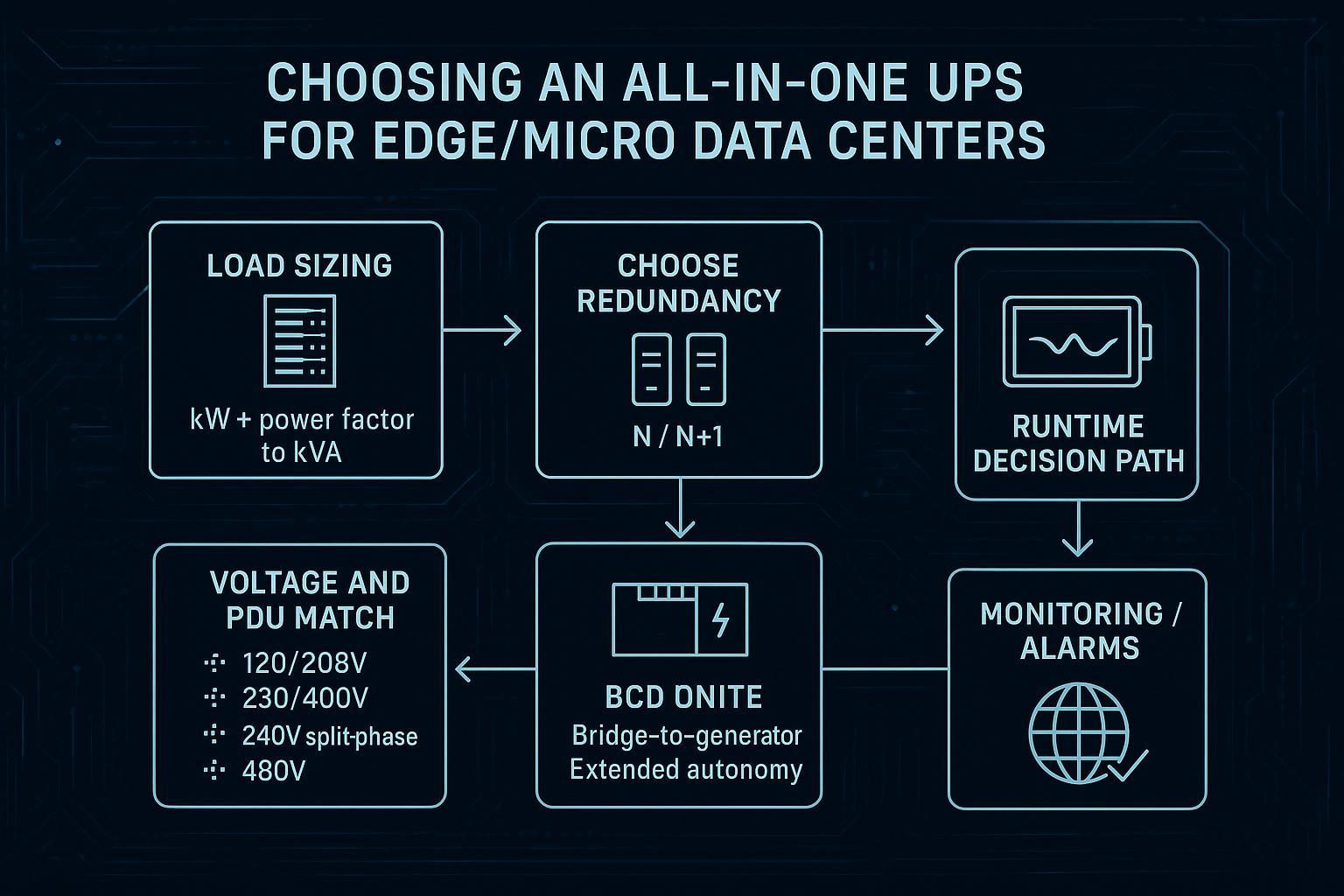
A clean way to keep this global-friendly is to separate the problem into three questions:
What load must the UPS carry (kW and kVA)?
What failure/maintenance events must the design survive (N, N+1, 2N)?
What is the UPS responsible for during an outage (seconds to bridge transfer, or minutes of autonomy)?
Power, voltage, and PDU alignment
Start with the load basis you will actually procure against. Coolnetpower’s data center load calculation workflow is a solid reference for documenting assumptions (measured vs nameplate, overhead buckets, and conversion steps).
From there:
Size from kW (real power), then confirm kVA (apparent power) using the load power factor.
Confirm whether the UPS is limited by kW, kVA, or both.
Validate voltage compatibility end-to-end: utility → bypass path → UPS output → rack PDUs → IT power supplies.
Regional voltage notes to keep straight:
North America (common): 120/208 V three-phase wye is common for IT distribution; 277/480 V is common upstream where larger distribution is needed.
Many EMEA/APAC sites (common): 230/400 V is typical, with different breaker/connector conventions.
Frequency: 60 Hz vs 50 Hz is a real design constraint for bypass paths and site standardization.
If you’re building a fleet standard, treat “voltage and PDU match” as a checklist item—not a detail to resolve late.
Redundancy and runtime strategy
Redundancy and runtime get confusing when teams stack “safety margins” on top of each other.
A clearer approach:
Capacity: the load you must carry (kW and kVA)
Redundancy: whether you can survive a module failure or maintenance event (N vs N+1 vs 2N)
Runtime: how long you must carry the load before something else happens (generator transfer, controlled shutdown, or longer autonomy)
For plain-language definitions that procurement and operations can share, Coolnetpower’s N+1 vs 2N redundancy explainer is a useful reference.
On runtime: if the site uses generators, your UPS runtime is often primarily about bridging startup and transfer. Data Center Dynamics notes in mission-critical UPS deployment considerations (2021) that generator start/transfer windows are frequently discussed in seconds (often cited as 10–20 seconds, design-dependent). The practical takeaway is to tie runtime requirements to your actual transfer sequence.
If a site has no generator (or generator availability is uncertain), runtime decisions change. In that case, size autonomy for your operational intent:
enough time for controlled shutdown and data integrity
enough time to ride through short utility events
enough time to keep service up until remote hands can respond
⚠️ Warning: Do not treat redundancy as “runtime.” A redundant path does not increase ride-through time unless it includes additional battery capacity sized for that purpose.
Battery chemistry and TCO
Battery choice affects more than a bill of materials. It changes:
footprint and weight
maintenance cadence and truck rolls
temperature sensitivity
replacement planning and recycling/disposal
Most edge discussions come down to VRLA vs lithium-ion:
VRLA is widely deployed and familiar, but can be maintenance-heavy across large fleets.
Lithium-ion often reduces footprint and can improve lifecycle characteristics, but it raises the bar for BMS integration, safety documentation, and compliance expectations.
At the edge, TCO is frequently dominated by operations—especially service visits. A battery technology that reduces maintenance events can outperform a cheaper upfront option over a multi-site rollout.
Deployment & Integration
Selecting a UPS is only half the job. Edge failures are often integration failures: transfer sequences, alarms that don’t map to your NOC, or thermal realities that weren’t validated in commissioning.
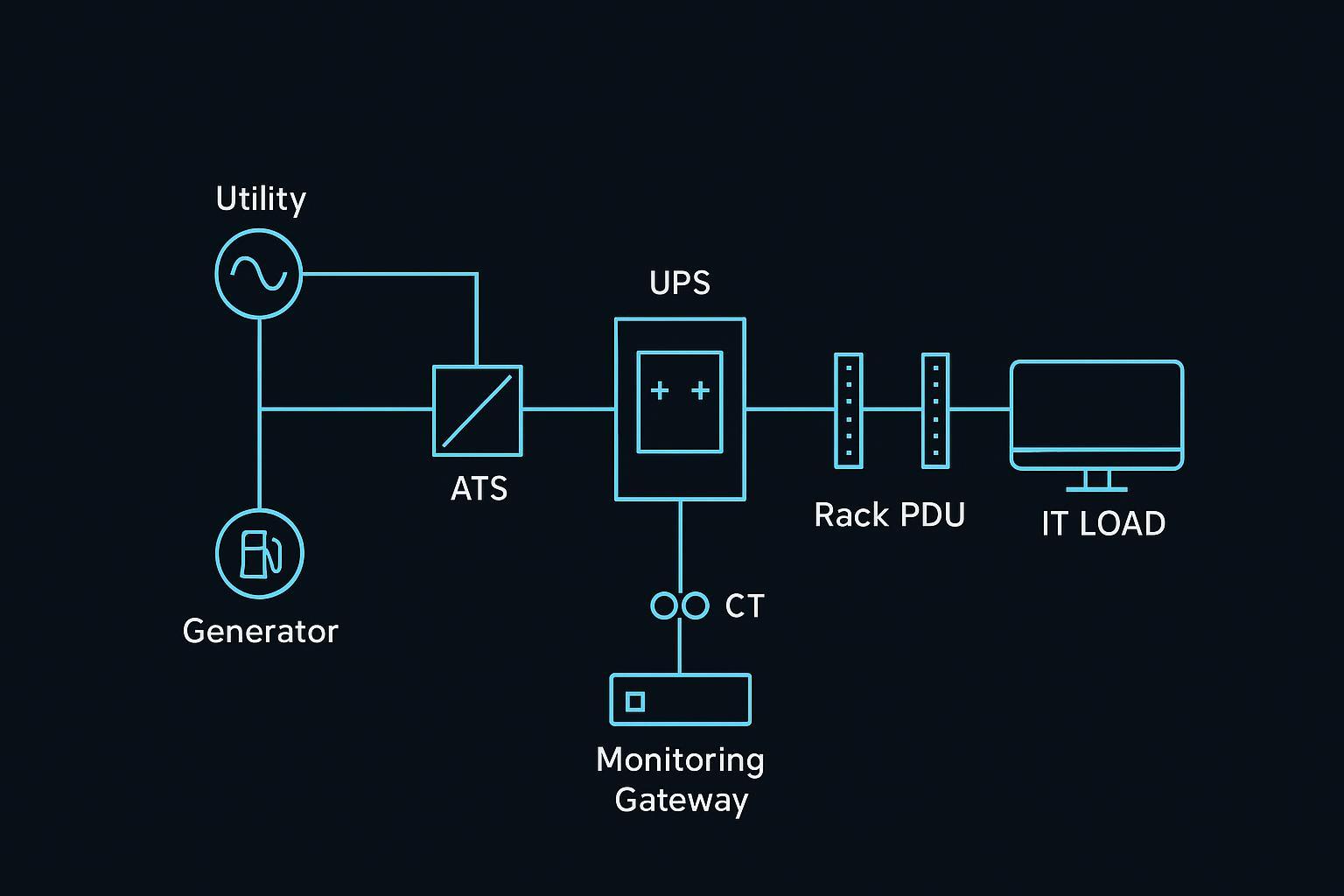
ATS and generator coordination
If your edge site includes a generator, the UPS must coordinate with:
ATS transfer logic and transfer time
generator warm-up and stabilization behavior
voltage/frequency tolerance windows
bypass behavior during abnormal input conditions
Schneider Electric’s discussion of UPS deployment considerations (2020) highlights an important point for small sites too: UPS choices are architecture choices, not isolated purchases.
In practical commissioning terms, you want to verify:
the UPS rides through the real transfer sequence you will operate
alarms and events are logged with timestamps and visible remotely
the site behaves predictably under bypass and return-to-normal conditions
Thermal and clearances
Micro sites can be thermally unforgiving. The UPS adds heat, and batteries have temperature constraints.
A field-friendly deployment checklist should include:
manufacturer clearance requirements (front/rear/side)
ventilation approach and filter maintenance
expected ambient range for the enclosure/shelter
confirmation that the site can handle UPS losses during normal operation
DCIM, alarms, and battery monitoring
All-in-one UPS value increases when monitoring is treated as a first-class system.
For telecom edge operators, a practical monitoring checklist includes:
battery health indicators (and test history)
input anomalies and bypass events
runtime estimate under current load
temperature near batteries and power electronics
a resilient network path for alarm forwarding
Define alarm mapping early:
which alarms trigger immediate dispatch vs scheduled maintenance
what constitutes SLA impact
what data is required for remote triage (event log, snapshots, timestamps)
If you’re deploying standardized micro data center blocks, it helps to have an integration partner that treats power, monitoring, and (where applicable) cooling as one commissioning package. That’s an area where Coolnetpower’s integrated micro data center delivery and liquid-cooling expertise can reduce rollout risk—by clarifying boundaries, monitoring points, and test procedures up front.
Trends: 2024–2026 Outlook
Three shifts matter for how edge operators think about all-in-one UPS systems.
Lithium-ion shift and benefits
Lithium-ion adoption is expanding where footprint, lifecycle, and service frequency drive value—especially across large fleets.
The tradeoff is increased emphasis on:
battery management integration
thermal design discipline
safety documentation and compliance alignment
Modular/rack UPS growth
The edge is increasingly “rack-shaped.” As a result, micro data center UPS choices are drifting toward modular, rack-aligned systems that scale in increments.
In practical terms, modular UPS for edge sites is growing because it helps operators standardize spares, expand capacity in small steps, and keep maintenance predictable across a fleet.
If you want deeper evaluation criteria—efficiency behavior under redundancy, architecture clarity, and what to request in submittals—Coolnetpower’s modular UPS buyer’s guide is a good starting point.
Hybrid power with generators/BESS
Hybrid power strategies (generator plus battery energy storage) are becoming more common as operators pursue resilience and energy strategy simultaneously.
At edge scale, hybrid power usually means:
more integration points and more controls logic
a bigger payoff for standardized commissioning
an even stronger reason to define what should happen, second by second, during a utility failure
Conclusion
All-in-one UPS systems fit edge and micro data centers because they match the operational truth of the edge: constrained sites, distributed fleets, and a need for repeatable commissioning and monitoring.
Key takeaways:
An all-in-one UPS reduces integration seams by packaging power electronics, batteries, bypass provisions, and monitoring as a cohesive system.
The edge advantage is often operational: fewer unique parts, fewer wiring variations, and more consistent alarms.
Selection works best when you separate capacity (kW/kVA), redundancy (N/N+1/2N), and runtime (bridge vs autonomy) instead of stacking margins.
Deployment success depends on integration: ATS/generator sequencing, thermal realities, and telemetry your NOC can act on.
Immediate next steps:
Confirm your load basis and assumptions, then validate UPS sizing kW vs kVA before locking equipment.
Decide whether your architecture targets N+1 redundancy for edge power (fleet-friendly) or full 2N (higher cost, higher independence).
Verify voltage/PDU compatibility across regions (120/208V vs 230/400V, 50/60 Hz) before procurement.
Define monitoring requirements (alarms, logs, battery health) as part of the purchase spec.
If you want a low-friction way to standardize rollout quality, request a commissioning checklist and an alarm/point list that matches your architecture.