
Data halls
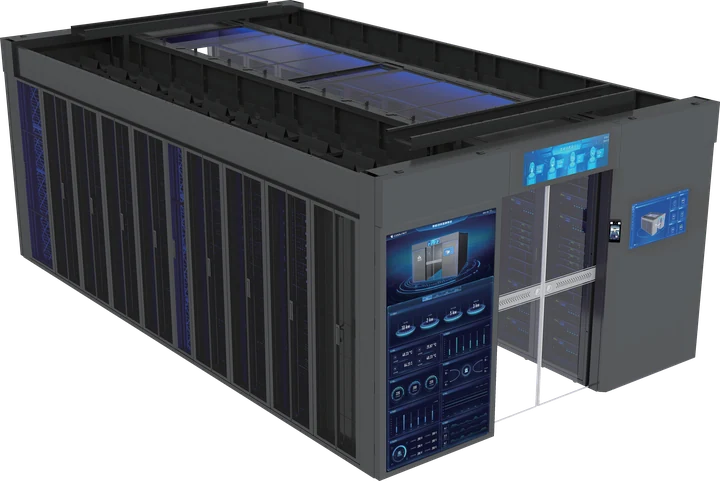
Liquid-cooled modular data center
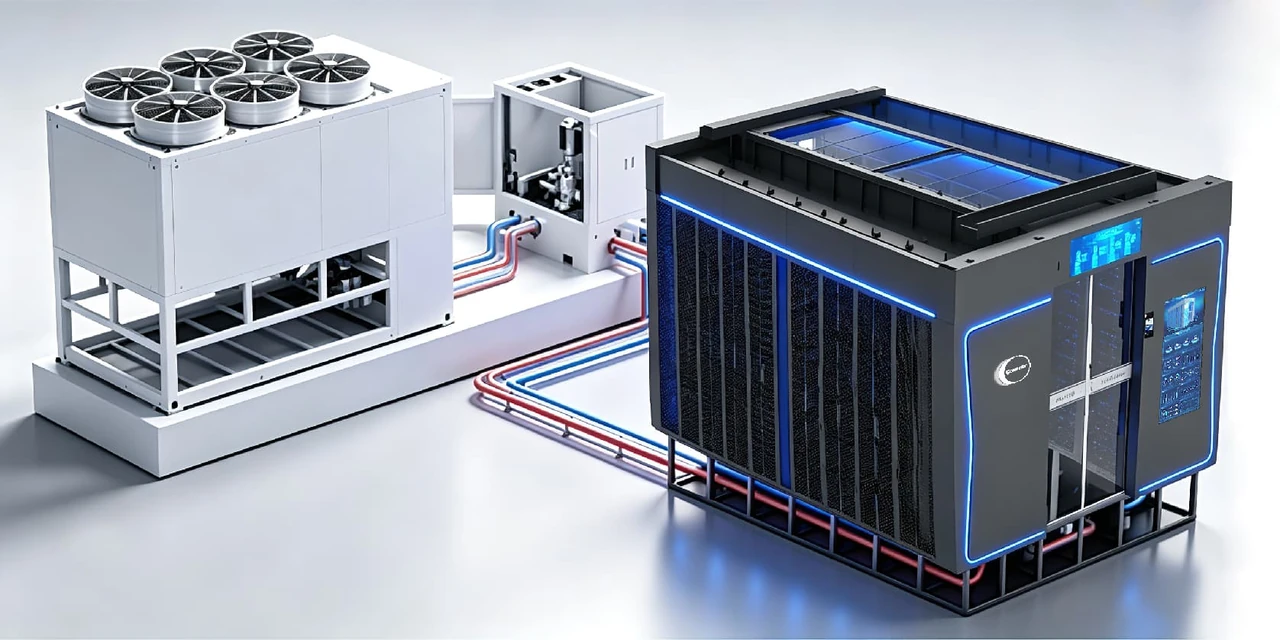
Liquid-cooled racks connect through CDUs to outdoor dry coolers, with separate cooling for residual air heat.
- Cooling approach
- CDUs, dry coolers and residual air cooling
- Deployment
- Liquid-cooled modular computing halls
- Solution planning range
- 100 kW+ per cabinet
Overview
Follow the heat from server to outdoors
Liquid-cooled racks connect through CDUs to the facility circuit and outdoor dry coolers. In-row air conditioning removes the remaining air-side heat.
Server-side connections
Coordinate the rack liquid loop
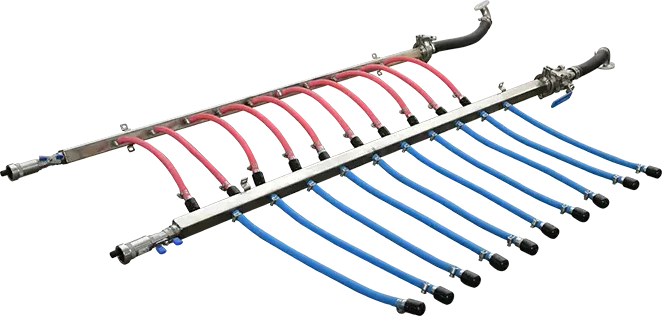
Match the server coolant requirements with manifolds, connections and prefabricated pipework.
Primary and secondary circuits
Use CDUs between the two loops
Confirm coolant specifications, flow rates and operating temperatures with the selected IT equipment.
Facility heat rejection
Retain both cooling paths
Outdoor dry coolers serve the liquid circuit, while in-row units handle the remaining air-side load.
Reference configuration
A sixteen-cabinet B300 configuration
B300 reference configuration with sixteen computing cabinets and two network cabinets, one active and one standby.
In this example
- Per computing cabinet
- 105 kW
- Computing cabinets
- 16
- Network cabinets · 1 active + 1 standby
- 2
| Source field | Source value |
|---|---|
| IT Rack Qty | 128 |
The source lists IT Rack Qty as 128 separately from 16 computing cabinets. It does not define the counting basis for this field; 128 is retained as printed and is not interpreted as a server count.
Refrigerant-pump in-row PAC units remove the residual air-side heat load.
Scroll the table to see all columns
| Equipment | Model | Quantity | Duty / standby |
|---|---|---|---|
| Coolant distribution unit | HP-CDU800T | 3 | 2 + 1 |
| Residual air cooling | CLA60F | 7 | 6 + 1 |
| Outdoor dry cooler | HP-DC800 | 3 | 2 + 1 |
Duty + standby: 2 + 1 means two duty units and one standby unit.
Reference water temperatures
Confirm final setpoints with the selected servers and site conditions.
- Primary facility circuit
- 35–45 °C
- Secondary rack circuit
- 40–50 °C
This example is not a fixed bill of materials. Final equipment selection, capacity and redundancy depend on the IT requirements and site operating conditions.
Technology
Inside the system
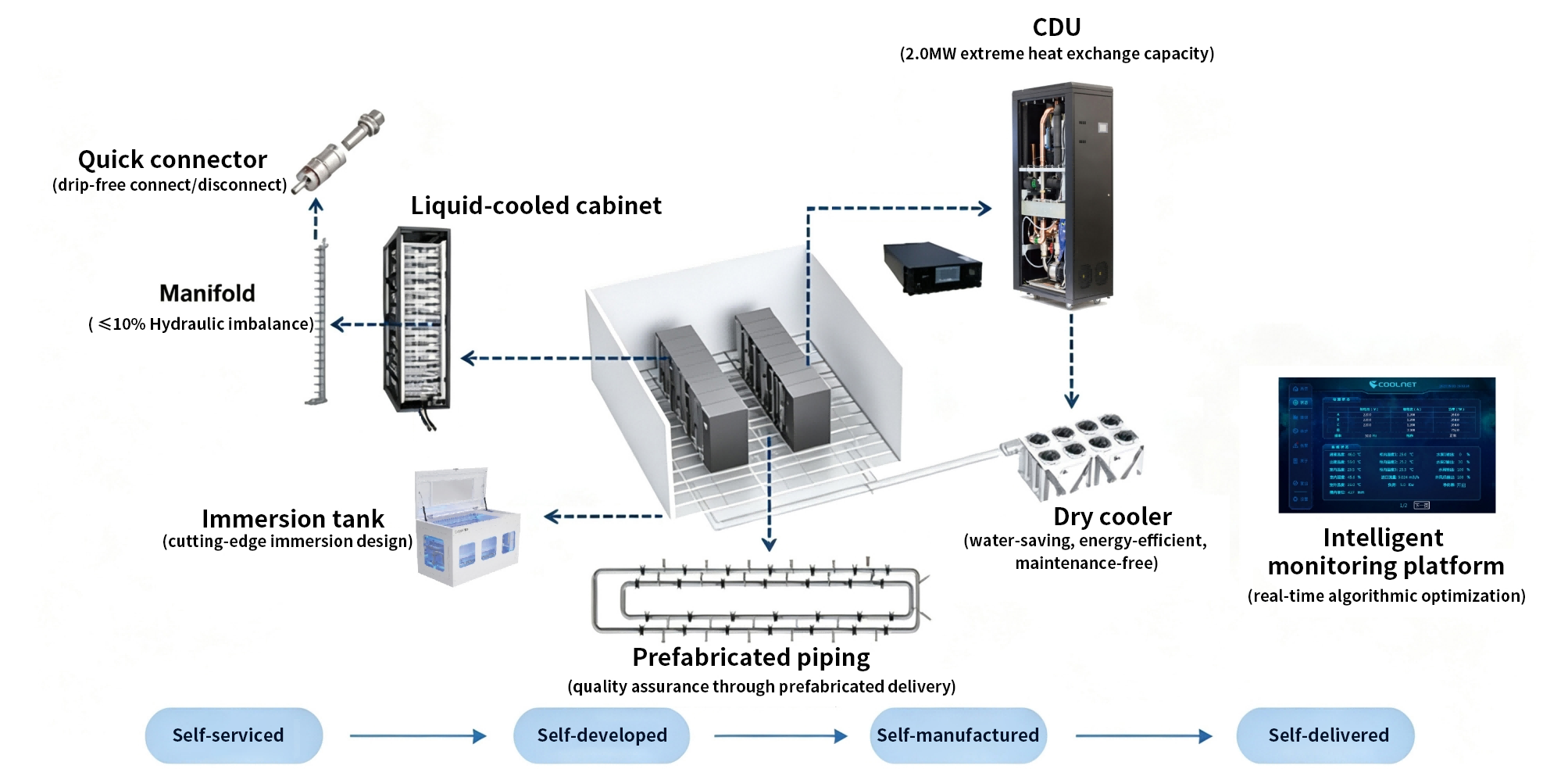
The complete liquid-cooling equipment chain
The portfolio connects rack-level liquid cooling to coolant distribution, outdoor heat rejection and system monitoring. It includes both cabinet and immersion approaches; the reference configurations on this page use liquid-cooled cabinets.
- In-house service, development, manufacturing and delivery support the complete equipment chain.
| Component | Function and reference capability |
|---|---|
| Quick connectors | Drip-free connection and disconnection |
| Manifolds | Distribute coolant to the rack; reference hydraulic imbalance ≤10% |
| Liquid-cooled cabinets | House the rack-level liquid-cooling connections |
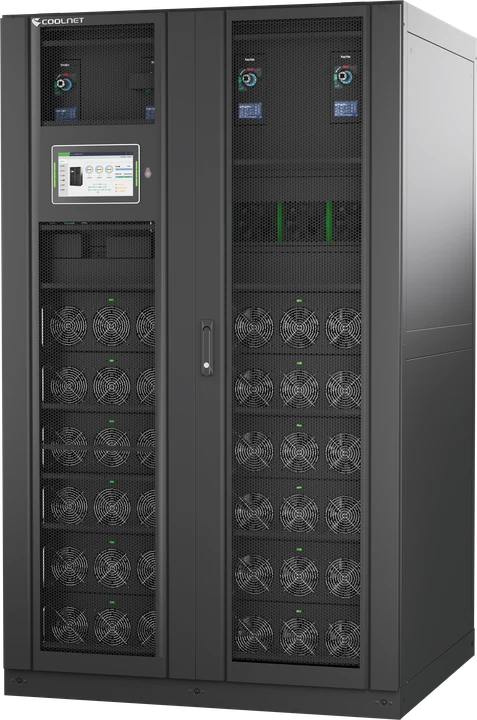
| Coolant distribution units | Transfer heat between rack and facility circuits; portfolio reference capability of 2.0 MW heat exchange |
| Immersion tanks | An alternative immersion-cooling format within the portfolio |
| Dry coolers | Outdoor heat rejection designed for water saving and energy efficiency |
| Prefabricated piping | Factory-prepared pipework for delivery and quality control |
| Intelligent monitoring | Real-time monitoring and algorithm-based optimization |
Primary cooling and secondary rack circuits
The architecture separates the primary cooling-source arrangement from the secondary cold-plate arrangement. Both modular-room and container deployments use these distinct parts of the cooling system.
- Primary cooling-source arrangement — dry cooler, liquid-cooling CDU and dual-source fan wall.
- Secondary cold-plate arrangement — liquid-cooled cabinets and prefabricated pipework.
- The project configuration determines the selected equipment, interfaces, water temperatures and residual air-cooling provision.
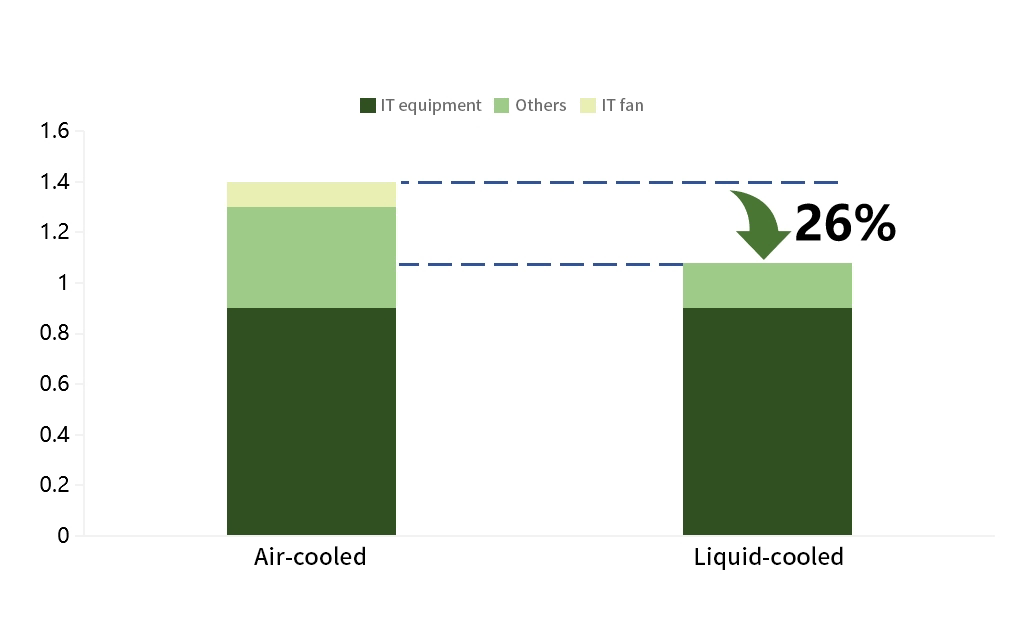
Air and liquid cooling: energy comparison
The reference comparison separates energy use into IT equipment, other consumption and IT fans for air-cooled and liquid-cooled arrangements. The illustration includes a 26% reduction annotation.
Related equipment
Explore the product families

Plan your project
Start with your requirements
Share your deployment needs to discuss the right configuration.
Talk to our teamUseful details to include
- Server type, cabinet count and liquid/air heat-load split
- Coolant specification, connection requirements and operating temperatures
- Dry-cooler site conditions, primary pipework and available service space
- Power supply, network cabinet redundancy and phased deployment