Introduction
Sub‑1.2 PUE used to sound like a hyperscaler-only headline. Now, it’s showing up in board discussions, power-allocation negotiations, and compliance conversations—because energy cost volatility, grid constraints, and disclosure regimes are pushing operators to prove efficiency with auditable data, not marketing claims. The Uptime Institute’s long-running surveys have shown the global average PUE hovering in the mid‑1.5s, meaning most sites still have substantial overhead to squeeze out—especially in cooling and airflow.
Free cooling (economization) is one of the few levers that can move the needle materially without changing the IT stack. Pair it with precision air conditioning (CRAC/CRAH) and tight airflow management, and you can reduce compressor hours dramatically while keeping temperature and humidity within equipment envelopes.
Key takeaways:
PUE < 1.2 is realistic in parts of the US—but it’s climate- and controls-dependent, and it needs annualized measurement discipline.
The fastest path is usually: airflow/containment → higher setpoints within ASHRAE guidance → economizer-first controls → metering and verification.
“Free cooling” is rarely free: you’ll trade against humidity control, filtration, water use (for towers/evap), and operational complexity.
This guide follows a practical sequence: first, what “<1.2” means in the real world; then how to integrate free cooling with precision AC; then climate playbooks for US regions; then a retrofit roadmap; and finally the KPIs and trade-offs to quantify risk and payback.
Is <1.2 PUE realistic today?
Current benchmarks (2023–2026)
Two benchmark realities can be true at the same time:
Many “typical” facilities still report annualized PUE around ~1.5–1.6, a plateau highlighted by Uptime Institute commentary on industry-wide progress.
Best-in-class operators routinely report much lower values. Google reports a trailing twelve‑month PUE around 1.09 across large-scale data centers once stable operations are reached, demonstrating what’s possible with end‑to‑end design and controls (Google Data Centers efficiency).
For most enterprise and colo operators, the question isn’t “can anyone hit <1.2?” It’s “can this specific site hit <1.2 annually, with our redundancy, our humidity constraints, and our climate?” The answer is usually:
Often yes for new builds in cool/temperate climates with economizer-first design, strong containment, and good instrumentation.
Sometimes yes for retrofits—especially if you can raise setpoints safely and you have (or can add) water-side or refrigerant-side economizer capability.
Hard in persistently hot/humid climates unless you can shift a large fraction of heat to warm-water loops (or accept that you may land closer to 1.25–1.35 annualized).
Standards enabling higher setpoints
One of the most underused efficiency levers is simply stopping overcooling. ASHRAE TC 9.9’s thermal guidance has long provided a recommended inlet temperature range of 18–27°C (64–81°F), with wider allowable envelopes by equipment class when engineered appropriately.
A practical implication: if you operate closer to the upper end of recommended ranges (and manage humidity/dew point correctly), you increase economizer hours. The “free cooling season” effectively gets longer because your allowable outdoor-air or condenser-water conditions no longer need to be as cold before you can bypass compressors.
If you need a quick reference for those envelopes, ASHRAE publishes a TC 9.9 reference card (5th edition guidance) that summarizes the classes and limits (ASHRAE thermal guidelines reference card).
Annualized reporting and categories
If you’re targeting “<1.2,” measurement discipline matters as much as mechanical design.
Annualized PUE (12 months of coincident energy data) is what investors, regulators, and internal governance will trust.
A “snapshot PUE” taken on a cold night can look great, but it won’t survive an audit.
Where you meter IT load changes the number. ISO/IEC 30134-2 defines different measurement categories/levels; a PUE measured at UPS output is not the same as a rack-level measurement.
Treat PUE like a financial metric: define the boundary, define the sampling method, and report consistently.
Integrating precision AC with free cooling
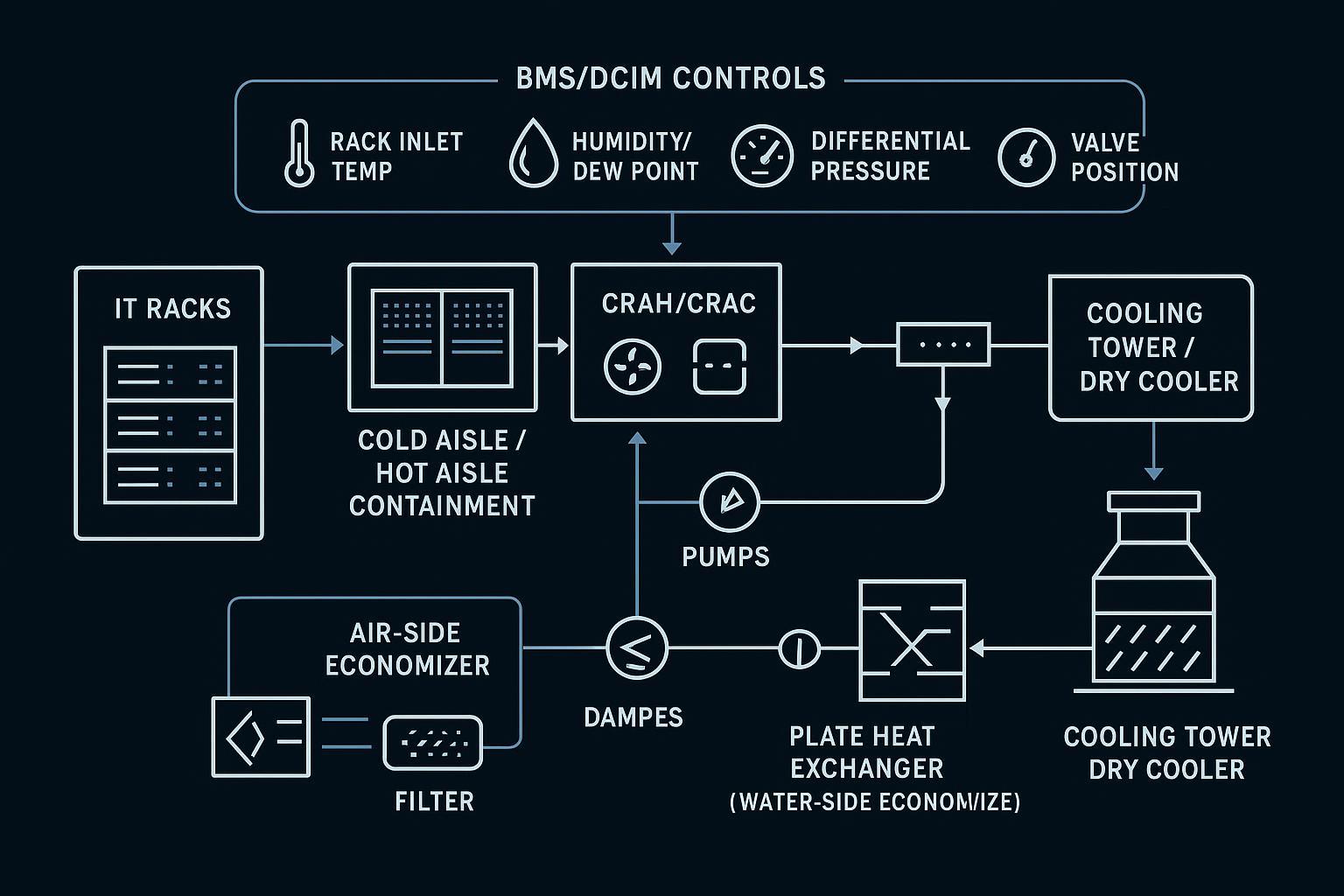
Air-side and water-side options
Free cooling comes in three common families, and the right choice depends on climate and your tolerance for air-handling complexity:
Air-side economizers bring filtered outdoor air in when temperature and humidity are within limits; hot air is exhausted rather than fully recirculated. This is powerful in cool/dry climates, but it shifts your risk profile toward filtration, corrosion control, humidity excursions, and smoke/fire events.
Water-side economizers use a heat exchanger (often with a cooling tower or dry cooler) to make “chilled” water without running chiller compressors when ambient wet-bulb conditions allow. ENERGY STAR summarizes the concept and climate suitability and highlights that paybacks can be favorable where wet-bulb is low enough for long periods (ENERGY STAR: Consider water-side economizers).
Dry coolers / fluid coolers (often treated as part of a water-side strategy) reject heat sensibly and can reduce water dependence, but may need larger heat rejection surfaces and fan power.
The integration rule that actually drives PUE improvement is simple: maximize hours in economizer modes, minimize hours in compressor modes, while maintaining inlet temperature stability and humidity/dew-point control.
Refrigerant-pump free cooling modes
If your site is DX-heavy or you want a low-water pathway, refrigerant-based economization can be attractive.
In a pumped‑refrigerant economizer, a small pump circulates refrigerant through the system during favorable outdoor conditions while bypassing the compressor, cutting the largest energy component of traditional DX cooling. A practical explainer of the operating sequence (pump as “heart” of the economizer mode; compressors engage when ambient conditions are unfavorable) is described in a refrigerant economizer walkthrough (MEP Academy: data center refrigerant economizer).
For humid climates (or water-constrained jurisdictions), this can be a useful complement to precision cooling—provided you manage refrigerant risk, redundancy, and maintenance maturity.
Controls that unlock savings
Most projects don’t miss <1.2 because they lack equipment. They miss because they can’t run the equipment aggressively enough.
Controls that unlock meaningful savings typically include:
Economizer-first staging: if outside conditions allow, your sequence should naturally bias toward air/water/refrigerant economizer modes before compressors.
Dew-point aware humidity control: avoid “units fighting each other” (simultaneous humidification and dehumidification).
Fan/pump optimization: VFD control with clear guardrails (differential pressure targets for containment, minimum flow for coil protection, and rate limits).
Sensor strategy: rack inlet temperature (not just “room temp”), humidity/dew point by zone, differential pressure across containment boundaries, and feedback signals (valve/damper position) for closed-loop verification.
Supervisory optimization: once you can measure, you can optimize. Many teams start with rules-based sequences and then progress to predictive setpoint tuning that considers weather forecasts, IT load, and redundancy constraints.
Brand integration cue
A practical (non-promotional) way to think about vendor choice is: can the precision cooling equipment and controls stack support your economizer strategy without creating new operational risk?
For example, an operator might standardize on precision air conditioning for stable humidity control and predictable airflow paths, while using a unified controls layer (BMS/DCIM integration) to enforce economizer-first sequences, alarm logic, and trending for commissioning evidence. Coolnetpower publishes several engineering-oriented resources that reflect this mindset—such as its guidance on precision cooling categories and decision criteria for CRAC/CRAH selection (see the Coolnetpower precision air conditioning category and its CRAC/CRAH vs in-row cooling discussion).
The key is not the brand; it’s the operational outcome: consistent sensor coverage, clear sequences of operation, and verifiable mode transitions that reduce compressor hours.
Climate playbooks (US)
Cool/dry & arid strategies
Think: Mountain West, upper Midwest winters, high-desert climates.
What works well:
Air-side economization with robust filtration and clear smoke/air-quality interlocks.
Water-side economizers or dry coolers with high supply-water temperatures (when IT and containment allow), extending “compressor-off” hours.
Higher inlet setpoints within ASHRAE recommended ranges to widen the economizer window.
What to watch:
Very dry air can trigger excessive humidification energy if your humidity band is overly tight.
Wind-driven dust events drive filter loading and pressure drops; factor fan energy into your PUE model.
Temperate-humid approaches
Think: Mid-Atlantic, coastal Pacific Northwest, parts of the Northeast.
What works well:
Water-side economizers can deliver a large share of annual free cooling hours when designed around local wet-bulb conditions.
Hybrid strategies: economizer when possible; high-efficiency mechanical cooling only when needed.
Controls maturity is the differentiator: mode-switch hysteresis, stable setpoints, and good fault detection.
What to watch:
Humidity swings create “hidden” energy in reheat/dehumidification loops.
Economizer changeovers can destabilize aisles if airflow discipline is weak.
Humid Southeast considerations
Think: Gulf Coast, Florida, lower Southeast.
What works well:
Refrigerant-pump economization (or other low-water approaches) can reduce chiller/compressor runtime without leaning heavily on evaporative towers.
Aggressive airflow management (containment, sealing, blanking panels) to cut fan power and reduce needed ΔT.
Segmenting the load: if parts of the site can operate at higher setpoints (within policy), do so to increase economizer hours.
What to watch:
Dehumidification energy can dominate if the sequence isn’t dew-point aware.
Water-side economizers tied to towers may see limited benefit during long humid seasons; model economizer hours based on wet-bulb, not dry-bulb.
Retrofit roadmap to <1.2
Containment and airflow first
Treat airflow as the foundation. Before you touch setpoints or equipment, remove the “air mixing tax”:
Implement (or repair) hot-aisle / cold-aisle containment.
Seal bypass paths: cable cutouts, missing blanking panels, leaky grommets.
Balance supply so the cold aisle is fed predictably.
The U.S. Department of Energy’s best-practices guidance consistently emphasizes that economizer savings depend on airflow discipline and controls—not just adding hardware (DOE Best Practices Guide for Energy-Efficient Data Center Design).
Raise setpoints within ASHRAE
Once containment is stable and you can actually trust inlet measurements:
Move setpoints upward in small steps.
Use representative rack inlet sensors to confirm you’re not creating localized hotspots.
Pair higher temperatures with humidity guardrails (dew point is often more actionable than RH).
A common failure mode is raising room temperature while ignoring that server fan power can rise sharply when inlet temperatures push too high. The goal is not “as hot as possible,” but “as warm as safely useful”—and the safety boundary should be grounded in ASHRAE guidance and your OEM envelopes.
Sensor density, VFDs, BMS/DCIM
If you can’t measure it, you can’t hold the line operationally.
Prioritize instrumentation and controls that support three outcomes:
Verification: prove economizer hours, compressor hours, and fan/pump energy in commissioning reports.
Stability: avoid oscillation during mode changes.
Accountability: provide data that procurement, compliance, and operations all accept.
In practical terms, this often means:
Rack inlet temperature coverage for “hotspot detection,” not just average room temp.
Differential pressure sensors across containment boundaries.
VFDs on CRAH/CRAC fans and major pumps.
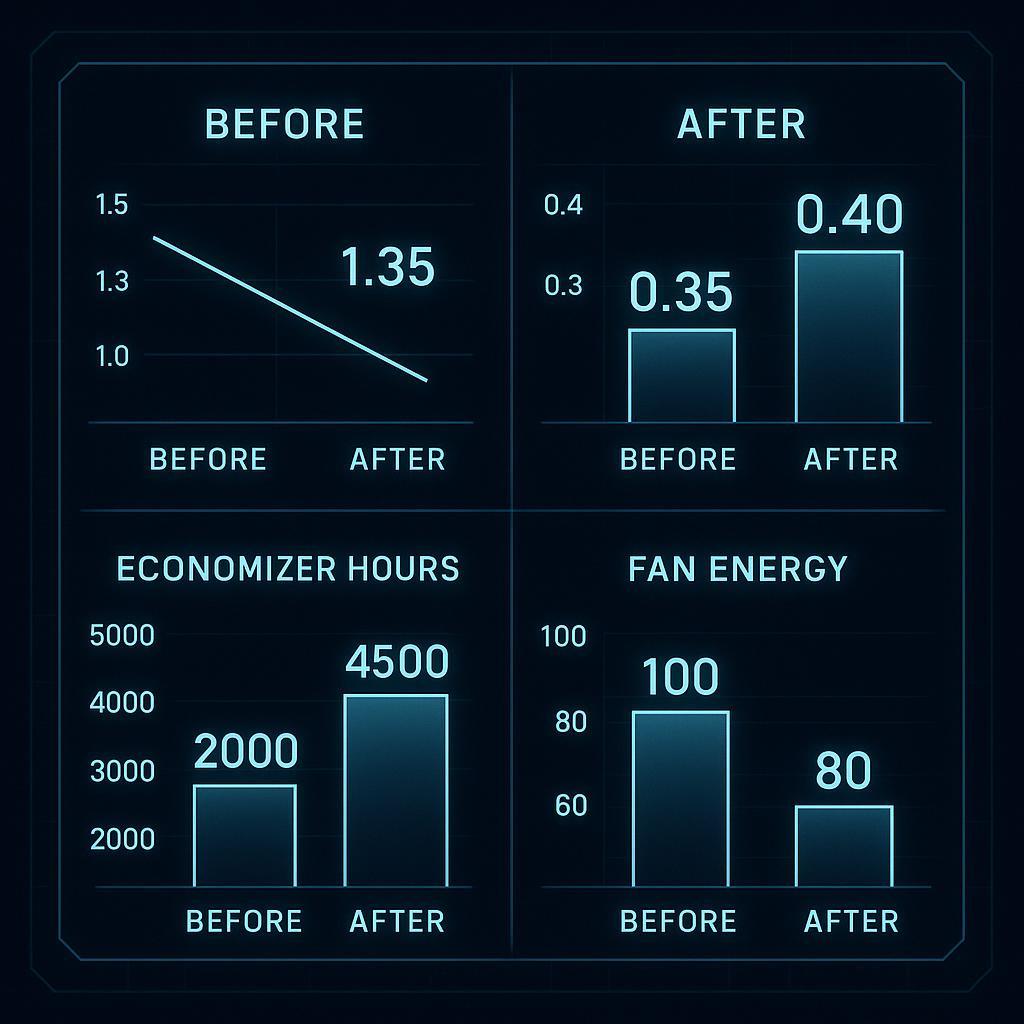
A BMS/DCIM trend set that can compute annualized PUE and visualize before/after.
If you want a vendor-neutral example of what a “real telemetry checklist” looks like, Coolnetpower outlines point-list thinking and data requirements for closed-loop optimization in its internal educational content (see Data requirements for AI thermal optimization).
KPIs, trade-offs, and payback
Commissioning metrics that matter
PUE improvement projects fail when they’re judged on the wrong evidence. Commissioning should focus on metrics that show you actually reduced overhead:
Economizer hours: total hours per month/season in air-side / water-side / refrigerant economizer modes.
Compressor runtime: hours and kWh attributable to mechanical cooling.
Fan energy: CRAH/CRAC fan kWh before/after (containment and VFD optimization should reduce this).
Thermal compliance: percent of time rack inlet stays within your chosen envelope (with alarms tied to actionable limits).
Energy vs water (WUE) balance
Chasing PUE can raise water use in some climates, especially with tower-based water-side economizers and evaporative assist.
If your stakeholders care about water—or your jurisdiction does—you’ll want to track WUE alongside PUE and explicitly document the trade-off. ENERGY STAR’s economizer guidance calls out that water-side economizers can use substantial water; in water-stressed regions, that can flip the business case.
The practical approach is to treat PUE and WUE as a paired optimization problem:
In arid regions, water may be the limiting factor even if economizer hours are plentiful.
In humid regions, economizer hours may be limited and water use may not buy you enough compressor avoidance.
Costs and typical payback ranges
Payback varies wildly by baseline efficiency, electricity price, climate, and how much downtime risk you can tolerate during retrofit.
A defensible way to discuss payback (without overpromising) is:
Low-capex operational tuning (setpoints, control sequences, basic airflow repairs) can have short paybacks when the baseline is poor.
Medium-capex upgrades (VFDs, sensors, controls integration, containment retrofits) often pay back when they materially increase economizer hours and reduce fan power.
High-capex retrofits (new economizers, plant rework, major distribution changes) need a site-specific model anchored to measured load profiles and local weather.
Key Takeaway: If you can’t estimate economizer hours credibly (based on climate data and your target inlet temperature), you can’t estimate payback credibly.
Conclusion
If you’re aiming for annualized PUE < 1.2, start by picking the levers that change compressor hours and fan energy without adding avoidable risk.
Key steps you can start this quarter: airflow/containment repairs, a sensor and trend-point audit, and a controls review focused on economizer-first staging.
How to validate improvements and iterate: define your PUE boundary and measurement level, baseline for at least a few weeks, then change one major variable at a time (setpoints, fan curves, economizer thresholds) with clear acceptance criteria.
Where to go deeper for design and modeling: use local weather (dry-bulb and wet-bulb), load profiles, and redundancy constraints to model economizer hours and mechanical cooling crossover points before committing capital.
If you want a practical starting point for internal alignment, Coolnetpower’s internal resources on precision cooling and controls can help teams agree on terminology and measurement approach (see the Coolnetpower data center calculator and its integrated solutions overview).