Introduction
AI and HPC racks compress more compute—and more heat—into less space. That density is manageable in temperate conditions, but extreme climates turn cooling from an optimization problem into a reliability problem. Hot/humid air shrinks your economizer window. Hot/dry air tempts evaporative strategies that can collide with water permits and water quality. Cold/dry winters raise humidification and static-risk questions. Coastal aerosol and industrial pollutants accelerate corrosion. Wildfire smoke challenges filtration and coil hygiene.
In this context, “good enough” thermal control is rarely good enough for AI. Two ASHRAE references help frame decisions in a way engineering, risk, and procurement teams can all audit:
The ASHRAE Thermal Guidelines for Data Processing Environments (5th edition) define operating envelopes and add new guidance for high-density air-cooled equipment, including Class H1, alongside traditional enterprise classes like A1. The supplemental reference card is a practical starting point for what the envelopes mean and where corrosion/pollutant caveats change humidity decisions (ASHRAE Thermal Guidelines 5th ed. reference card, 2021). This is the core source behind most summaries of the ASHRAE Thermal Guidelines 5th edition operating classes.
ASHRAE Standard 90.4 is a code-intended energy standard for data centers that focuses on mechanical and electrical infrastructure efficiency. It pushes teams to think in annualized, climate-aware terms (via mechanical and electrical load components) rather than relying on one snapshot metric (ASHRAE Standard 90.4-2022 fact sheet).
What you’ll take away:
A practical climate risk matrix you can reuse in site selection and retrofit planning.
A clear set of architecture choices (air, hybrid, liquid) mapped to climate constraints and AI rack density.
Efficiency and controls playbooks that improve resilience without relying on heroics.
If you’re looking for AI data center cooling guidance in extremes, the goal isn’t to pick a single “best” technology. It’s to match heat-removal architecture and controls to climate risk and operating envelope.
Key Takeaway: Extreme-climate cooling succeeds when you treat climate as a risk input (heat, moisture, contaminants, water, altitude) and treat standards as your shared language for decisions and sign-offs.
Climate risk and impacts
Extreme climates don’t just “add load.” They change failure modes: condensation risk, corrosion rate, particulate loading, and the stability of your supply air temperature during transients.
To make this actionable, here’s a simple risk matrix you can adapt during site selection or retrofit planning:
Climate stressor | What breaks first (typical) | Design/ops mitigations to plan early |
|---|---|---|
High dry-bulb heat | heat rejection capacity and compressor lift | hybrid economizer + right-sized mechanical, higher leaving-water temps where possible |
High dew point humidity | condensation management and coil hygiene | dew-point-based controls, drainage/access, segmentation |
Cold/dry winter | static risk and humidification stability | dew point limits, humidification strategy, control tuning |
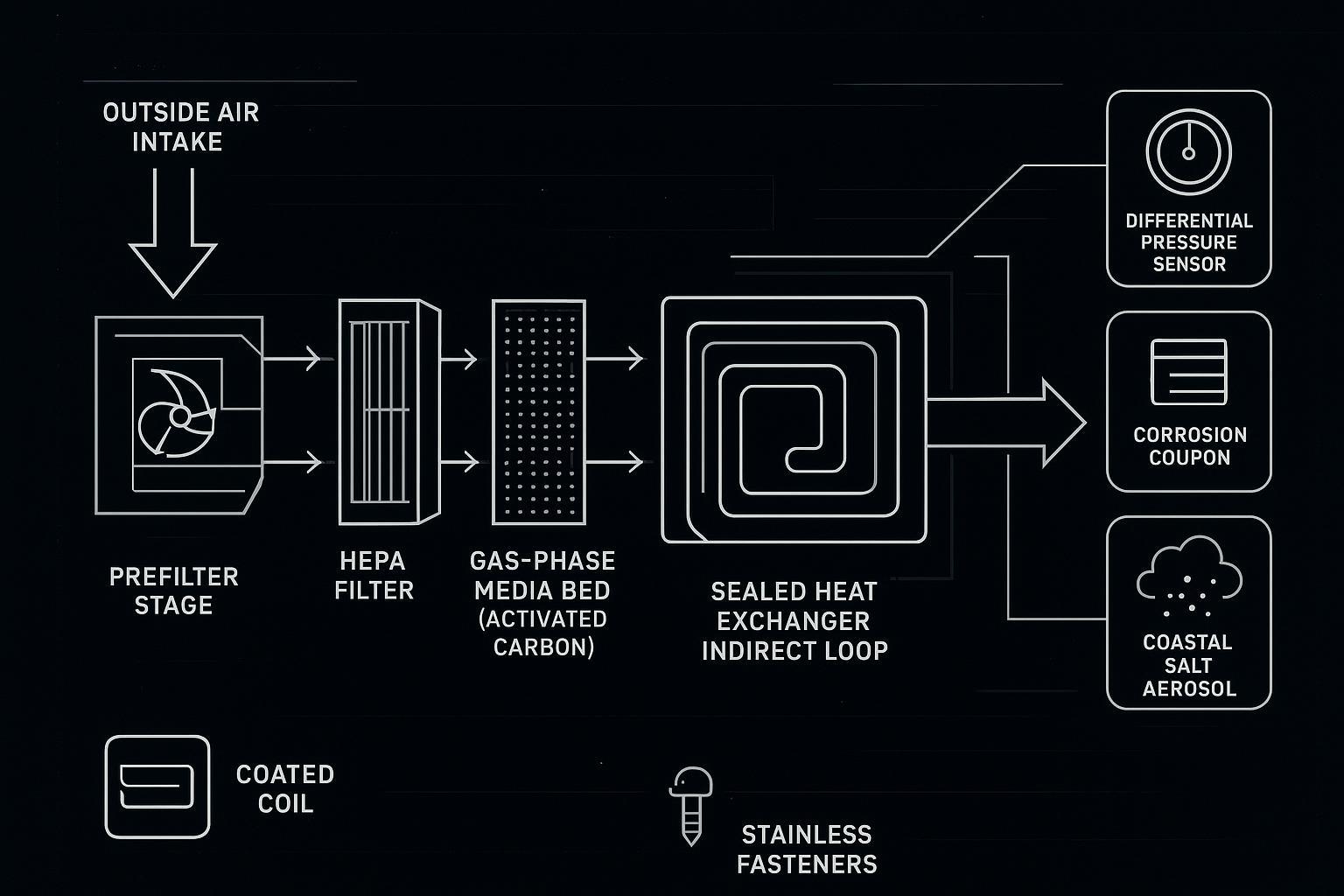
Coastal aerosol/pollutants | corrosion and coil degradation | sealing, materials/coatings, gas-phase filtration where needed |
Smoke/particulates | filter loading, airflow loss, coil fouling | step-up filtration plan, ΔP monitoring, event-mode sequences |
High altitude | airflow/capacity derating | containment/leakage control, fan/power allowances |
Heat, humidity, cold, altitude
Heat is obvious: higher ambient temperature raises heat rejection temperatures, increases compressor lift (if you’re running chillers or DX), and pushes airside strategies toward their limits. For AI/HPC racks, that often shows up as:
tighter control needed to avoid thermal throttling
more frequent “partial-mechanical” operation even when the weather looks suitable for economization
Humidity is usually the hidden constraint. In hot-humid climates, the constraint is often dew point, not dry-bulb. Once coil surface temperatures go below ambient dew point, you’re condensing water; that’s not inherently bad, but it changes maintenance, drainage, and coil hygiene requirements. It can also drive teams into narrower setpoints than they planned.
Cold climates create a different set of problems:
very low absolute humidity can increase electrostatic risk and push you toward humidification
outdoor air economizers can overcool if controls aren’t segmented and tuned
freeze protection for heat rejection and hydronic loops becomes a first-class design requirement
Altitude matters because thinner air reduces heat transfer and fan effectiveness. Practically, that can mean:
more airflow (and fan power) to move the same sensible heat
derated air-cooled heat rejection performance
tighter attention to containment, leakage, and local hotspots
Coastal corrosion, smoke
Coastal sites combine salt aerosol with humidity swings. Even if the data hall itself is controlled, salt deposition on coils and exposed metals can accelerate corrosion, particularly where condensation occurs.
Wildfire smoke is increasingly a design driver in North America, Australia, and parts of Europe. Smoke challenges cooling in three ways:
Particulate loading increases filter pressure drop and can reduce airflow.
Coil fouling reduces heat transfer and can trigger capacity loss during already-stressed periods.
Gas-phase contaminants can contribute to corrosion and material degradation in sensitive electronics environments.
Standards callouts (ASHRAE 5th edition, 90.4)
Two standards-related points are especially relevant to extreme climates:
H1 vs A1: ASHRAE’s 5th edition adds Class H1 for air-cooled high-density compute with a more restrictive temperature envelope than A1. In practice, that means “free cooling” opportunities can shrink materially for high-density air-cooled AI compared with general enterprise halls, depending on local weather and your inlet targets.
Pollutants change humidity decisions: The 5th edition explicitly ties recommended humidity operation to gaseous contamination / corrosion potential, pushing teams toward measurement and risk management rather than one universal RH number. Uptime Institute provides a readable summary of why this matters for efficiency-minded operators (Uptime Institute Journal, 2021).
90.4 is climate-aware by design: Standard 90.4 is meant to be applied with climate zone context. It’s a useful “governance layer” when procurement wants to compare design options beyond a marketing PUE claim. (For the primary summary, see the ASHRAE Standard 90.4-2022 fact sheet referenced in the Introduction.)
Architecture choices
Extreme climates don’t force one universal architecture. They force clearer boundaries:
What fraction of heat is removed by air vs liquid?
Where is the IT/facility thermal boundary (at the room, row, rack, or chip)?
What resources are constrained (water, power, filtration, maintenance access)?
If you need a quick orientation to the main liquid-vs-air options (direct-to-chip, rear-door, immersion) before choosing a direction, this comparison primer is useful: direct-to-chip vs immersion vs rear-door heat exchanger compared.
Air vs liquid for AI/HPC
A useful way to think about air vs liquid is not “old vs new,” but where the complexity lives.
Air-first approaches (containment + close-coupled air, improved distribution, better controls) keep liquid out of the rack and can work well at moderate densities. Their limitations show up as airflow volume, fan power, and tighter inlet targets as GPU density rises.
Liquid-assisted approaches move a meaningful fraction of heat into a hydronic loop. Options include rear-door heat exchangers (removing heat at rack exhaust) and direct-to-chip (cold plates at the CPU/GPU). They reduce the burden on room air and can expand your “effective climate envelope,” especially when outdoor air is dirty or humidity is difficult.
For teams needing a component primer on direct-to-chip architecture, this explainer focuses on the core building blocks and how the heat path is structured: direct-to-chip liquid cooling with cold plates explained.
Economization strategies
Economization is not one feature. It’s a family of strategies with climate-specific limits:
Airside economization: Great for cool, clean air; challenged by smoke, dust, salt, and humidity extremes.
Waterside economization: Uses cooling towers or fluid coolers to reject heat without full mechanical chilling when wet-bulb permits.
Indirect evaporative cooling (IEC): Can be strong in hot-dry climates; in hot-humid regions, performance can degrade because wet-bulb is high.
In practice, extreme-climate designs often end up hybrid: some economization hours plus mechanical cooling capacity sized for worst-case sequences (heat waves, smoke events, or high dew-point periods).
Water use and WUE tradeoffs
Water is increasingly a constraint, not a utility detail. The moment you rely on evaporative heat rejection or IEC, you should treat:
water availability and permitting
make-up water quality and blowdown management
drought restrictions and seasonal curtailment
as part of the same decision as chiller selection.
Pro Tip: If your site has uncertain water policy risk, design a “dry fallback mode” (dry coolers / air-cooled heat rejection) that preserves SLA even if WUE worsens during restricted periods.
Climate-specific playbooks
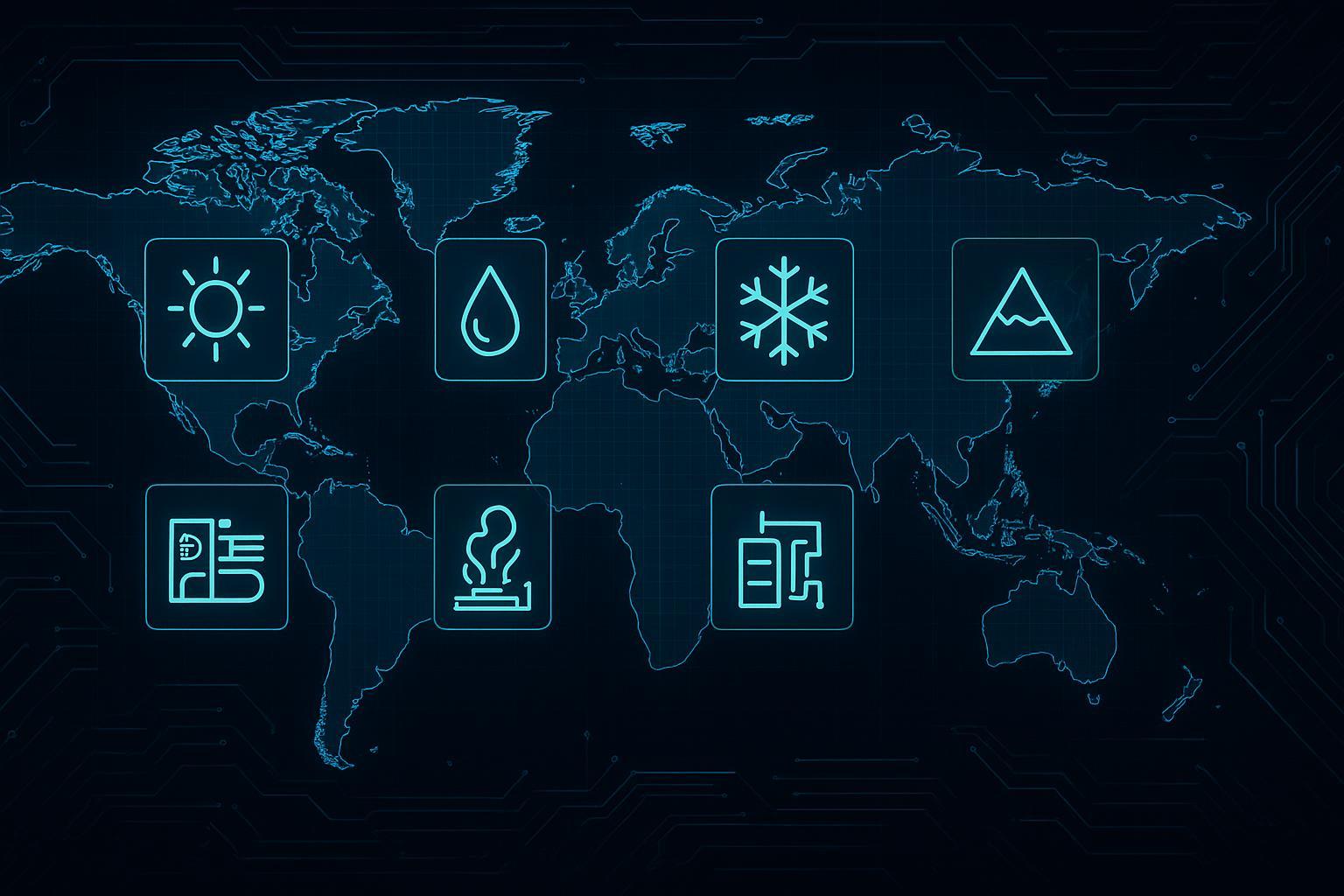
The goal of these playbooks is consistency: a repeatable set of design and operational moves that reduce risk without assuming perfect weather or perfect maintenance conditions.
Hot-dry and hot-humid
Hot-dry (high dry-bulb, lower humidity):
Treat dust and particulate as an efficiency variable: filtration strategy and coil cleaning plans belong in your design basis.
Consider IEC where water availability and water quality are stable—and define your dry fallback.
For higher AI densities, shift heat removal toward liquid or rack-level capture so room air doesn’t become the bottleneck.
Hot-humid (high dew point):
Plan around dew point control and latent load management. If you target very cold supply air to protect high-density air-cooled AI, you’ll condense more often; build for drainage, access, and coil hygiene.
Economizer hours can be limited even when temperatures look “moderate” because humidity is the constraint.
Segmentation matters: keep tighter envelopes for H1-like rows and allow broader envelopes for tolerant zones where possible.
Cold and high-altitude
Cold climates:
Don’t treat outdoor air economization as set-and-forget. Overcooling and control hunting can create thermal stress and unnecessary humidification.
Invest in loop freeze protection and control sequences for switchover events.
High-altitude:
Expect airside capacity derating and higher fan energy for the same heat removal.
Tighten containment and leakage control: every bypass path is more expensive when you’re already fighting reduced air density.
Coastal and wildfire-smoke
Coastal:
Assume corrosion risk is a lifecycle cost, not an incident.
Reduce salt aerosol ingress; minimize condensation on vulnerable surfaces; prioritize corrosion-resistant materials and coatings in high-risk zones.
Wildfire-smoke:
Treat smoke as an operating mode with a documented runbook: when to reduce outdoor air, when to step up filtration, and how to monitor airflow impact.
Use layered filtration and ensure tight sealing to prevent bypass.
A useful baseline for non-vendor filtration terminology is the EPA’s explanation of MERV ratings (US EPA, “What is a MERV rating?”, 2019).
For a more operations-oriented discussion of smoke events (step-up filtration, coil cleaning considerations, and contamination runbooks), see Critical Facilities Solutions’ “Managing Wildfire Smoke and Urban Contamination in Data Centers” (2025).
Efficiency and controls
Extreme climates punish “one setpoint for everything.” Efficiency and resilience improve when controls reflect real heterogeneity: different rack densities, different risk tolerance, different exposure to contamination.
Setpoints and segmentation
A practical segmentation model for mixed halls:
High-density air-cooled AI rows: tighter inlet targets, more sensors, stricter alarms.
Hybrid/liquid-assisted rows: allow broader room air targets because a larger fraction of heat is removed in the liquid path.
General compute/storage: use wider allowable envelopes where compatible with your IT warranty/support policy.
This is also where standards matter in a pragmatic way: if you’re operating some equipment in H1-like conditions and some in A1-like conditions, document it explicitly and control it explicitly.
Predictive controls and KPIs
In extreme climates, your best control asset is not a “smart chiller.” It’s observability.
KPIs that tend to be decision-relevant across climates:
Rack inlet temperature distribution (not just an average)
Hotspot frequency and duration (thermal excursions are what trigger throttling)
Humidity / dew point at critical locations
Filter differential pressure (ΔP) and replacement cadence (especially during smoke season)
Corrosion monitoring results (where applicable), aligned with the ASHRAE pollutant framing
Facility metrics aligned with governance needs (e.g., the mechanical/electrical components emphasized in 90.4 rather than a single headline number)
If you need an energy-standard lens for how to communicate mechanical and electrical efficiency in a code-intended way, ASHRAE’s 90.4 fact sheet is a concise reference (see the link in the Introduction).
For a plain-language explanation of why MLC/ELC can be more decision-useful than a single snapshot metric during design tradeoffs, Consulting-Specifying Engineer has a practical overview: “What ASHRAE 90.4 does for data center energy efficiency” (2020).
Implementation roadmap
A workable, low-regret roadmap for extreme-climate AI cooling looks like this:
Baseline and classify: inventory rack densities, cooling dependency (air vs liquid), and the target ASHRAE class envelope you’re committing to.
Build a climate risk matrix: map site-specific risks (heat waves, high dew point periods, smoke days, salt aerosol exposure, water curtailment) to failure modes and mitigations.
Segment first, then optimize: implement containment, sensing, and control segmentation before chasing small PUE gains.
Design for “event modes”: smoke mode, drought mode, extreme heat mode—each with a control sequence and maintenance plan.
Choose architecture transitions deliberately: for many operators, the “least disruptive” path is hybridization—adding rack/row liquid assistance where density forces it while keeping the rest of the hall stable.
Neutral note on Coolnetpower (non-promotional): Coolnetpower positions itself as an integrated provider (design through implementation) and publishes practical primers on liquid-cooling architectures such as direct-to-chip and rear-door heat exchangers. In standards-led programs, this can be used as reference material when documenting architecture choices and commissioning workflows across sites in different climates.
Conclusion
Extreme climates make AI cooling decisions less forgiving—but also more structured. The winning pattern is to:
Treat climate as a multi-factor risk input (temperature, moisture, contaminants, water constraints, altitude).
Match architecture to both rack density and resource constraints, rather than defaulting to one universal cooling philosophy.
Use standards as your shared governance layer: align operating envelopes to ASHRAE guidance, and align efficiency conversations to a climate-aware framework like 90.4.
Key actions to take next:
Build a simple climate risk matrix for each site (including smoke and coastal corrosion risk, not just temperature).
Segment controls by density class and criticality; instrument the system so you can see excursions, not just averages.
Validate performance with the metrics that matter: inlet temperature distribution, dew point control, filtration ΔP, and the efficiency components procurement can compare across designs.
If you want a procurement-friendly starting point, request a commissioning checklist that maps your chosen setpoints, sensor locations, and event-mode sequences back to ASHRAE envelope intent and your 90.4 reporting needs.